Wheat: The Evolution, Production, and Nutritional Value of a Global Staple
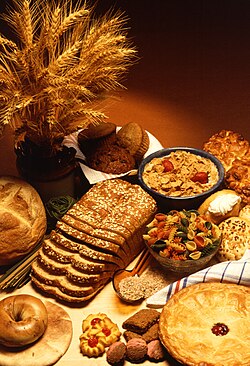
Wheat is one of the most significant cereal crops in human history, serving as a primary caloric source for populations worldwide. Belonging to the family Poaceae and the genus Triticum, this versatile grass has been domesticated and bred over millennia to support the growth of civilizations. From the ancient fields of the Fertile Crescent to modern industrial farms, wheat continues to be a cornerstone of global food security.
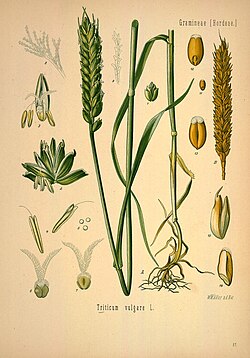
Key Facts
![Wheat prices in England, 1264–1996[114]](/images/bb/95/bb956c0c432100c1c92f4bd965ca9c7d0e60972a99e541b12d2ffc16bd62c51d.webp)
- Scientific Name: Triticum aestivum (Common Bread Wheat).
- Major Producers: China, India, Russia, and the United States.
- Genetic Diversity: Exists in diploid (2N), tetraploid (4N), and hexaploid (6N) forms.
- Nutritional Powerhouse: Rich in carbohydrates, manganese, and B vitamins.
- Global Impact: A primary ingredient in a vast array of foods globally.
Evolution and Taxonomy
The evolutionary journey of wheat is marked by complex genetic shifts known as polyploidy—the condition of possessing more than two complete sets of chromosomes. This process, often involving hybridization between different species, has allowed wheat to adapt to diverse environments and improve its yield.
Ploidy Levels and Species
Wheat species are categorized by their chromosome sets, which significantly influence their characteristics and uses:
- Diploid (2N): Includes Einkorn (T. monococcum), the simplest form.
- Tetraploid (4N): Includes Durum (T. durum), Emmer, and Khorasan (Kamut). These are often used for pasta and specialty breads.
- Hexaploid (6N): Includes Common Bread Wheat (T. aestivum) and Spelt (T. spelta), known for their superior baking qualities.
![A 2007 view of wheat origins by repeated hybridisation and polyploidy.[60] Not all species are shown.](/images/b4/60/b460d6425b7d51312ea9b0719802772fdbc8bbb0b71836997a2db6154bdae6e7.webp)
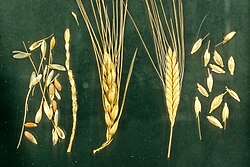
History and Domestication
Wheat domestication began in the Neolithic period, fundamentally changing human society by enabling sedentary farming. Early farmers used primitive tools, such as sickles with stone microblades, to harvest wild grains between 8500 and 4000 BC.
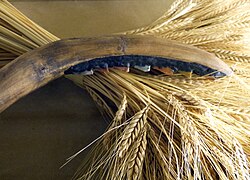
As farming techniques evolved, wheat spread from its origins into Egypt, Europe, and eventually Asia. The transition from wild grasses to high-yielding crops involved centuries of selection and repeated hybridization, allowing the grain to thrive in various climates.
Nutritional Profile and Food Use
Wheat is prized for its energy density and essential micronutrients. A key component of wheat is gluten, a protein complex that provides elasticity to dough, making it ideal for leavened bread.
| Nutrient | Amount | % Daily Value (%DV) |
|---|---|---|
| Energy | 327 kcal | - |
| Carbohydrates | 71.18 g | - |
| Protein | 12.61 g | - |
| Dietary Fibre | 12.2 g | - |
| Manganese | - | 173% |
| Iron | - | 18% |
| Thiamine (B1) | - | 32% |
| Niacin (B3) | - | 34% |
Global Production and Agronomy
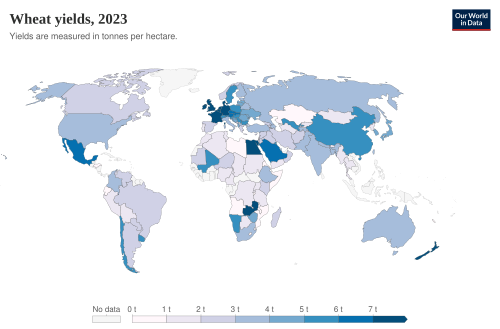
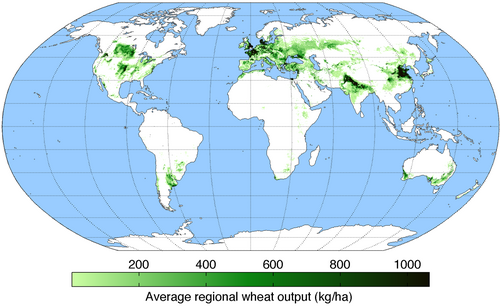
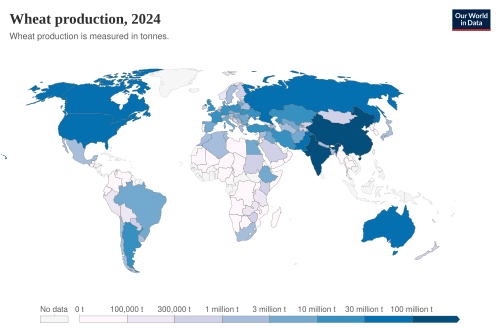
Modern wheat production is a massive global operation. The highest production volumes are found in China (140.1 million tonnes), India (113.3 million tonnes), and Russia (82.5 million tonnes).
Growing Conditions
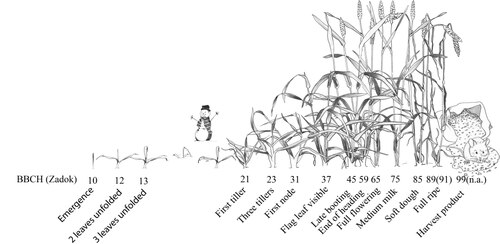
Spring wheat is particularly sensitive to temperature. It thrives between 21°C and 24°C. While it can tolerate temperatures from 4°C to 35°C, germination below 4°C or maturation above 35°C typically results in reduced crop yields.
Pests and Diseases
Wheat crops face several biological threats that can devastate yields:
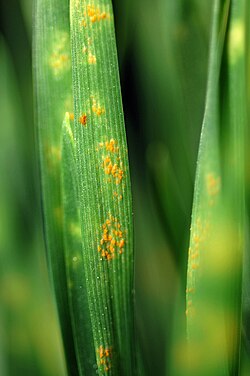
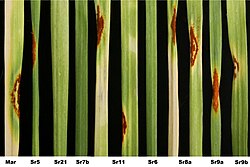
- Stem Rust: Caused by the fungus Puccinia graminis f. sp. tritici (such as the Ug99 strain).
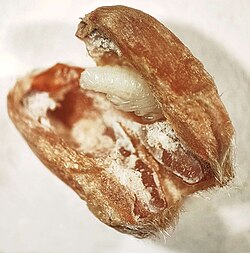
- Animal Pests: Including the wheat weevil (Sitophilus granarius), which can infest kernels.
Modern Breeding and Genomics
To combat disease and increase food security, scientists focus on several breeding objectives, including hybrid vigour, water efficiency, and resistance to insects and fungi. The decoding of the wheat genome has allowed for precise genetic engineering, such as the knockout of the TaMs1 gene to produce novel male sterility for breeding purposes.
![Wheat yields in Europe[163] – Breeding has increased yields over time](/images/69/44/69448687e940ebb2970c3f022840025d4ef6e8976f45c8d2394142ddd2d8473f.webp)
Wheat in Culture
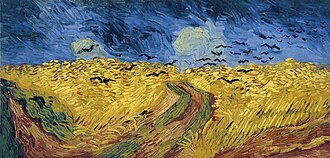
Beyond its utility as food, wheat has inspired artists for centuries, symbolizing abundance and the cycle of nature. A notable example is Vincent van Gogh's 1890 painting, Wheatfield with Crows.
Frequently Asked Questions
What is the difference between diploid, tetraploid, and hexaploid wheat?
These terms refer to the number of chromosome sets in the plant. Diploid (2N) wheat like Einkorn has two sets, tetraploid (4N) like Durum has four, and hexaploid (6N) like common bread wheat has six. Higher ploidy levels generally correlate with greater adaptability and different baking properties.
Which countries produce the most wheat?
Based on FAOSTAT data, the leading producers are China, India, Russia, the United States, and Canada.
What is stem rust and why is it dangerous?
Stem rust is a fungal disease caused by Puccinia graminis f. sp. tritici. It is dangerous because it can rapidly spread and destroy large portions of a wheat crop, threatening global food supplies.
What are the ideal temperatures for growing spring wheat?
Spring wheat grows best between 21°C and 24°C. Yields are negatively impacted if germination occurs below 4°C or if maturation occurs above 35°C.
Why is wheat considered a high-value nutritional source?
Wheat provides a significant amount of energy through carbohydrates and is an excellent source of manganese (173% DV), niacin, thiamine, and dietary fiber.