Puerto Rican Tanager
The Puerto Rican tanager (Nesospingus speculiferus) is a small passerine bird found exclusively within the archipelago of Puerto Rico. Known locally as the llorosa (meaning 'cryer'), this unique species is the sole member of the genus Nesospingus. While historically categorized within the tanager family, modern scientific studies suggest it may belong to its own distinct family, Nesospingidae, or the family Phaenicophilidae, sharing its closest evolutionary ties with spindalises.
Key Facts
- Conservation Status: Vulnerable (IUCN 3.1).
- Endemism: Found only in Puerto Rico.
- Habitat: Mid- to high-elevation montane forests (300–1,350 m).
- Diet: Omnivorous, consuming invertebrates, fruits, and occasionally small vertebrates.
- Social Behavior: Roosts communally in bamboo or palms.
Physical Description and Identification
The Puerto Rican tanager is a compact bird, typically measuring between 18 and 20 cm (7 to 8 inches) in length and weighing approximately 36 g (1.3 oz). Both sexes exhibit olive-brown upperparts and pale grey to white underparts. Adults are characterized by pure white throats, faint dusky striping on the breast, and a dark crown and face that obscures the eye.
A distinguishing feature of the adult is a conspicuous white spot on the wing. Sexual dimorphism is primarily visible in the bill: males possess a brown-black maxilla (upper mandible) and a white mandible, whereas females have entirely black bills. Immature birds resemble adults but lack the white wing spot and possess brownish underparts.
Vocalizations and Communication
The most common sound associated with this species is a harsh call described as a "chewp" or "chuck," which is frequently heard when the birds feed in flocks. This can sometimes extend into a longer "chi-chi-chit" sequence. During the breeding season, the tanager produces a light, sweet, and rapidly delivered song: "tswet-tswet-tswet-tswet." Other social interactions are signaled by a soft sigh, resembling a heavy exhale, or a light "tsip-tsip-tsip" call.
Behavior and Social Structure
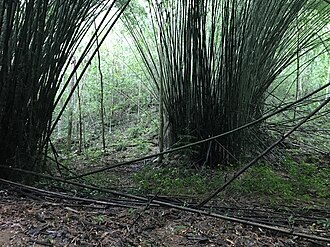
These birds are highly social and are known to roost communally in large palms or bamboo clumps. In the winter, they often serve as the nucleus species for mixed feeding flocks, attracting various neotropical migrants. While they are strong flyers, they generally prefer short flights through the brush or canopy rather than long-distance travel.
During the breeding season, their social nature shifts as they become highly territorial, aggressively defending their nesting sites.
Diet and Foraging
The Puerto Rican tanager maintains a diverse diet consisting primarily of invertebrates and fruits. They frequently consume spiders, insects, centipedes, and snails. A notable part of their diet includes Eleutherodactylus tree frogs, such as the common coquí. While fruit consumption varies by season, they often feed on species from the Cecropia and Clusia genera. On rare occasions, they have been reported to eat lizards and the nestlings of other birds.
Breeding and Life Cycle
The primary breeding season occurs from January to late July, although some individuals breed outside this window. Males establish strong territories during this period. Nests are cup-shaped, measuring roughly 9.2 cm (3.6 in) across, and are built from roots, vines, ferns, and palm fibers, lined with palm leaves and feathers. These nests are typically positioned at the ends of branches between 2 and 10 meters (10 to 30 feet) above the ground.
The female typically lays a clutch of two or three elliptical white eggs, which are marked with reddish-brown splotches.
Distribution, Habitat, and Threats
The species is restricted to montane forests at elevations between 300 and 1,350 meters (1,000 to 4,400 feet). Their preferred habitats include subtropical lower montane forests as well as mature and second-growth subtropical rain and wet forests. Significant populations are concentrated in the Maricao State Forest and El Yunque National Forest, on the eastern and western sides of the central cordillera.
Historically, the population spanned the entire central cordillera, but deforestation has fragmented their habitat. They are now largely confined to higher peaks and preserved areas. Additionally, their communal roosting habits make them vulnerable to predators, specifically the Puerto Rican owl and the Puerto Rican sharp-shinned hawk.
| Attribute | Details |
|---|---|
| Scientific Name | Nesospingus speculiferus |
| Average Length | 18–20 cm |
| Average Weight | 36 g |
| Primary Habitat | Montane subtropical forests |
| Conservation Status | Vulnerable |
| Key Predators | Puerto Rican owl, Puerto Rican sharp-shinned hawk |
Frequently Asked Questions
Why is the Puerto Rican tanager considered vulnerable?
The species is listed as vulnerable primarily due to habitat fragmentation caused by deforestation, which has restricted its range to preserved areas and high-elevation peaks in the central cordillera.
What is the local name for the Puerto Rican tanager?
Locals call the bird the llorosa, which translates to 'cryer'.
What do Puerto Rican tanagers eat?
Their diet consists mainly of insects, spiders, centipedes, snails, and fruits (particularly Cecropia and Clusia). They also eat Eleutherodactylus tree frogs and occasionally lizards or other birds' nestlings.
Where can the Puerto Rican tanager be found?
They are endemic to Puerto Rico, specifically in mid- to high-elevation montane forests, with notable populations in El Yunque National Forest and Maricao State Forest.
How can you tell a male Puerto Rican tanager from a female?
The primary difference is the bill: males have a brown-black maxilla and a white mandible, while females have bills that are entirely black.