Common Starling: Biology, Behavior, and Global Impact
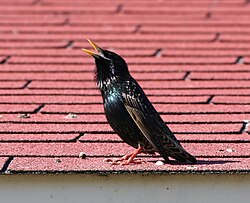
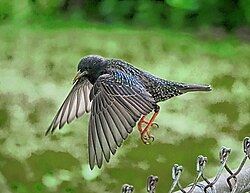
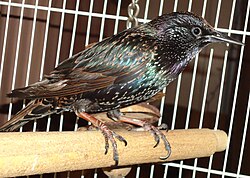
The Common Starling (Sturnus vulgaris) is a highly adaptable member of the family Sturnidae. Known for its iridescent plumage and complex social structures, this species has expanded from its native Palearctic range to become one of the most widespread birds in the world. While admired for its singing and flocking behavior, it is also recognized as a significant invasive species in several continents.
From the forests of Europe to the suburban landscapes of North America, the starling's ability to thrive in diverse environments is a testament to its biological flexibility. Whether acting as a natural pest controller or a nuisance to agriculture, the common starling remains a subject of intense scientific study.
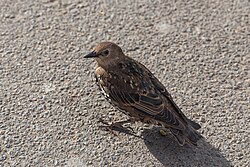
Key Facts
- Scientific Name: Sturnus vulgaris
- Conservation Status: Least Concern (IUCN 3.1)
- Global Population: Estimated at 310 million, with approximately 45% (140 million) in the United States.
- Lifespan: Average of 2–3 years, though the record longevity is 22 years and 11 months.
- Distribution: Native to Europe, Asia, and North Africa; introduced to North America, South America, Australia, New Zealand, South Africa, and the West Indies.
Taxonomy and Subspecies
The common starling is classified under the order Passeriformes. Due to its vast geographic range, several subspecies have been identified, reflecting regional adaptations in plumage and size.
| Subspecies | Primary Range | Authority |
|---|---|---|
| S. v. vulgaris | Europe (e.g., Germany, Netherlands) | Linnaeus, 1758 |
| S. v. faroensis | Faroe Islands | Feilden, 1872 |
| S. v. zetlandicus | Shetland Islands | Hartert, 1918 |
| S. v. granti | Azores | Hartert, 1903 |
| S. v. porphyronotus | Western Central Asia (e.g., Kazakhstan) | Sharpe, 1888 |
| S. v. humii | Kashmir to Nepal | Brooks, 1876 |
Behavior and Ecology
Feeding Habits
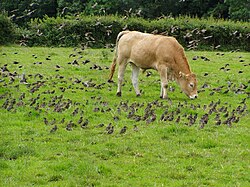
Starlings are opportunistic feeders. They possess specialized protractor muscles in their jaws, allowing them to force open soil or organic matter—such as cowpats—to locate insect larvae.
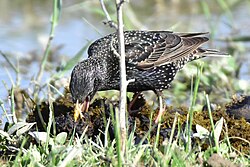
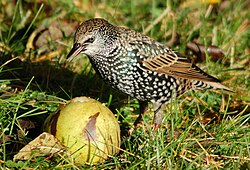
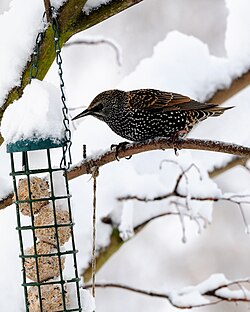
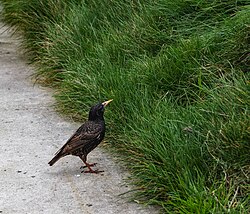
Their diet is varied, ranging from insects and larvae to fruits, such as windfall apples, and seeds provided at bird feeders. In winter, adults are often identified by their black beaks.
Social Structure and Communication
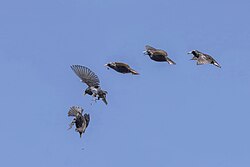
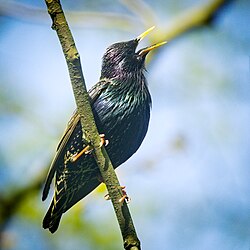
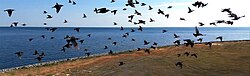
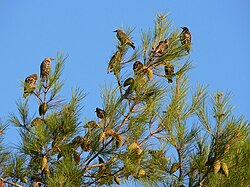
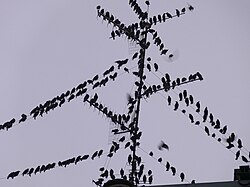
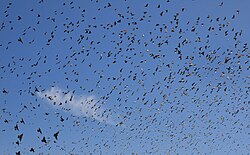
Starlings are highly social birds, often seen in large flocks during foraging or migration. Their vocalizations are complex; they are known for their singing and ability to mimic other sounds.
Breeding and Life Cycle
Starlings typically nest in gaps in walls or other cavities. Breeding is characterized by high competition and complex social dynamics. Intraspecific brood parasitism is common, where unpaired females (known as "floaters") lay their eggs in the nests of other pairs.
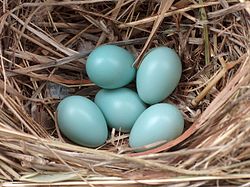

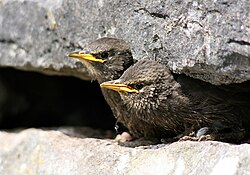
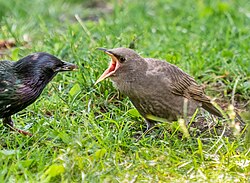
While the rate of successful fledging ranges from 48% to 79%, only about 20% of nestlings survive to reach breeding age. Adult survival is higher, at approximately 60%.
Human Interaction and Environmental Impact
Health and Agricultural Concerns
Starlings can pose health risks to humans and livestock. Their droppings can harbor Histoplasma capsulatum, a fungus that causes histoplasmosis. This is particularly prevalent at large roosting sites. The impact on livestock can be severe; for example, a 2014 report from a Nebraska facility noted a loss of 10,000 pigs due to the disease, valued at $1 million.
Control and Management
In regions where they are invasive, starlings are strictly managed. In Western Australia, an eradication program using trapping, netting, and DNA analysis has significantly reduced the population, leaving only about 300 birds by 2009.
In the United States, starlings are exempt from the Migratory Bird Treaty Act, meaning no permit is required to remove their nests or cull the birds. To manage populations, the government has utilized avicides such as DRC-1339 (marketed as Starlicide), which is designed to be toxic to starlings but low-toxicity to mammals.
Frequently Asked Questions

Are common starlings protected in the United States?
No, common starlings are exempt from the Migratory Bird Treaty Act in the U.S., allowing for the removal of nests and the culling of adults and juveniles without a permit.
What is histoplasmosis and how is it linked to starlings?
Histoplasmosis is a respiratory disease caused by the fungus Histoplasma capsulatum, which can thrive in the accumulated droppings of starlings at roosting sites.
How do starlings find food in the ground?
They use specialized protractor muscles in their jaws to force apart soil or debris, allowing them to search for insect larvae effectively.
What is intraspecific brood parasitism in starlings?
This occurs when unpaired females, called "floaters," lay their eggs in the nests of other starling pairs, forcing the host parents to raise the offspring.
How successful are starling nests in terms of survival?
While 48% to 79% of nests successfully fledge, only about 20% of those nestlings survive to reach breeding age.