European Herring Gull
The European herring gull (Larus argentatus) is a large, opportunistic seabird found throughout the northern and western coasts of Europe. Reaching up to 66 cm (26 in) in length, these birds are well-known for their adaptability, thriving both in wild coastal environments and bustling urban centers. While many are permanent residents in regions like Britain, Ireland, and Iceland, those in colder climates often migrate south for the winter.
These birds are generalists by nature, possessing a varied diet that ranges from fish and crustaceans to plants and human refuse. Their intelligence and boldness have made them a common sight in cities, where they have developed complex interactions with human populations.
Key Facts
- Scientific Name: Larus argentatus (Latin for "silver-decorated gull").
- Conservation Status: Least Concern globally, though listed as Red List in the UK.
- Lifespan: Long-lived, with a maximum recorded age of 49 years.
- Diet: Omnivorous; consumes fish, crustaceans, carrion, and human food.
- Size: Males average 60–67 cm; females average 55–62 cm.
Taxonomy and Subspecies
The European herring gull belongs to the genus Larus. While closely related to several other species—including the American herring gull, Caspian gull, and Yellow-legged gull—the European herring gull is distinct in its morphology and range.
Recognized Subspecies
There are two primary subspecies of the European herring gull:
- L. a. argentatus (Scandinavian herring gull): Found in Scandinavia and northwestern Russia. This is a larger, bulkier bird with a flatter forehead and extensive white "mirrors" (spots) on the wingtips.
- L. a. argenteus (Western European herring gull): Found in Western Europe, including the UK, Ireland, France, and Germany. It is smaller than the Scandinavian variety, with paler upper parts and more black in the wingtips.
Physical Description
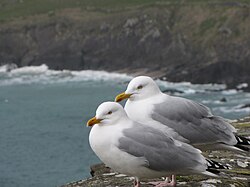
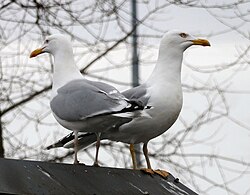
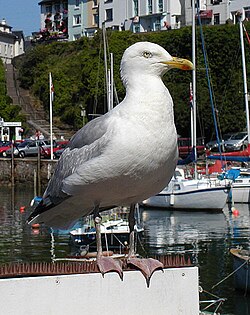
Adults in breeding plumage are characterized by a light grey back and upper wings, contrasted with a white head and underparts. Their wingtips are black with white spots known as mirrors. A key identifying feature is the yellow bill, which sports a distinctive red spot, and a ring of bare yellow skin around the pale eye.
While legs are typically pink across all ages, some populations—particularly in the Baltic region—exhibit yellow legs. This variety, formerly called L. a. omissus, is not a separate subspecies because these birds breed freely with pink-legged individuals.
Comparison with Similar Species
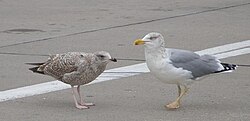
The European herring gull is significantly larger than the ring-billed gull and possesses a thicker yellow bill with a more pronounced gonys (the ridge on the lower mandible). While second- and third-winter juveniles can be difficult to distinguish from other gulls, their overall larger size and bill dimensions are the primary identifiers.
Diet and Foraging Behavior
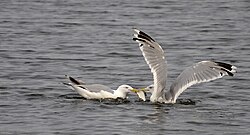
As omnivores, herring gulls are highly opportunistic. Contrary to their name, they do not prefer herrings; stomach analyses show that crustaceans and echinoderms often make up a larger portion of their diet than fish. However, fish remains the primary food source provided to nestlings.
Their foraging methods are diverse:
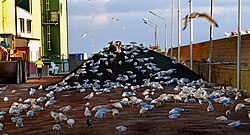
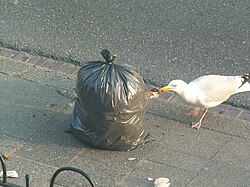
- Scavenging: They frequent landfill sites and sewage outflows, with refuse sometimes comprising 50% of their diet.
- Hunting: They engage in plunge diving (up to 1–2 meters deep) and may steal prey from other birds like plovers.
- Tool Use: They have been observed dropping shelled prey from heights to break them open and using bread as bait to catch goldfish.
Reproduction and Life Cycle
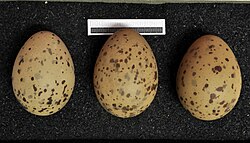
Herring gulls typically lay two to four olive-brown, speckled eggs on ground nests or cliff ledges. Both parents incubate the eggs for 28 to 30 days. Once hatched, chicks are covered in fluffy down and can walk within hours.
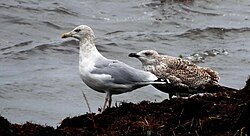
The relationship between parents and offspring is marked by specific behaviors. Juveniles peck at the red spot on the adult's bill to signal hunger, prompting the parent to regurgitate food. While they can fly within 35–40 days, they may continue to beg for food for over six months.
Urban Adaptation and Human Interaction
In recent decades, the European herring gull has successfully transitioned into urban environments. In the UK, while coastal populations have declined—leading to a Red List conservation status—urban populations have increased. This is partly due to a lower adult mortality rate (less than 5% annually) in cities compared to the coast.
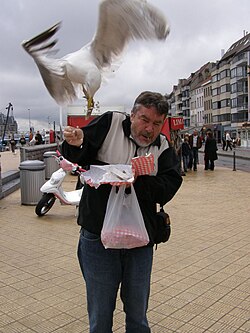
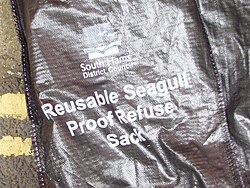
This success has led to conflict with humans. Urban gulls are known to steal food directly from people's hands, though research suggests they may be less likely to do so if the person maintains eye contact. During breeding season, they can become aggressive, "dive-bombing" perceived threats to their nests.
| Feature | Male | Female |
|---|---|---|
| Average Length | 60–67 cm | 55–62 cm |
| Average Weight | 1,050–1,525 g | 710–1,100 g |
| Wingspan | 125–155 cm | 125–155 cm |
| Leg Color | Typically Pink (some Yellow) | Typically Pink (some Yellow) |
Frequently Asked Questions
Why are they called herring gulls if they don't prefer herring?
The name is traditional, but scientific examinations of their stomach contents reveal that crustaceans and echinoderms are often more prevalent than fish in their adult diet.
What is the red spot on their beak for?
The red spot serves as a visual cue for chicks; juveniles peck at this spot to signal hunger and trigger the parent to regurgitate food.
Are European herring gulls endangered?
Globally, they are listed as "Least Concern" by the IUCN. However, in the United Kingdom, they are on the Red List of conservation concern due to significant population declines in coastal areas.
How long can a European herring gull live?
They are long-lived birds, with the maximum recorded age reaching 49 years.
What is the difference between the two main subspecies?
The Scandinavian subspecies (L. a. argentatus) is generally larger and bulkier with more white in the wingtips, while the Western European subspecies (L. a. argenteus) is smaller with paler upper parts.