Parrots: Evolution, Taxonomy, and the Biology of Psittaciformes
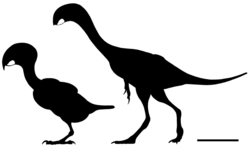
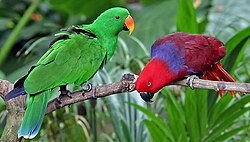
Parrots are some of the most recognizable and charismatic birds on Earth, known for their vibrant plumage, powerful beaks, and remarkable intelligence. Belonging to the order Psittaciformes, these birds have a complex evolutionary history and a diverse range of physical forms, from the tiny pygmy parrot to the heavy, flightless kākāpō.
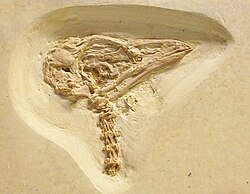
From their origins in the Eocene epoch to their current global distribution, parrots have adapted to a wide variety of environments, including tropical rainforests, temperate zones, and even alpine regions.
Key Facts
- Temporal Range: Eocene to Holocene (approximately 50 to 0 million years ago).
- Size Diversity: Ranges from the buff-faced pygmy parrot (under 10g) to the kākāpō (up to 4.0kg).
- Major Groups: Divided into three superfamilies: Strigopoidea, Cacatuoidea, and Psittacoidea.
- Specialized Traits: Known for zygodactyl feet (two toes forward, two backward) and high cognitive abilities.
- Conservation Status: Many species face threats from habitat loss and the illegal pet trade.
Taxonomy and Classification
The scientific classification of parrots places them within the clade Psittacopasseres. They are organized into three primary superfamilies, each containing distinct families and genera.
Strigopoidea (New Zealand Parrots)
This group includes the family Strigopidae. A notable member is the kākāpō, a flightless and critically endangered parrot native to New Zealand.
Cacatuoidea (Cockatoos)
The family Cacatuidae comprises the cockatoos. This group is further divided into the black cockatoos (Calyptorhynchinae) and the Cacatuinae, which include the black palm cockatoo and various white, pink, and grey species.
Psittacoidea (True Parrots)
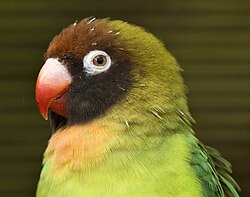
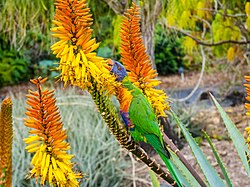
This is the most diverse superfamily, encompassing the families Psittacidae and Psittaculidae. It includes a vast array of birds, such as macaws, lories, lorikeets, and budgerigars.
Morphology and Physical Characteristics
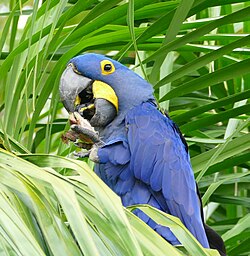
Parrots exhibit a massive spectrum of physical sizes. The buff-faced pygmy parrot is one of the smallest, measuring only 8 cm in length and weighing less than 10 g. In contrast, the hyacinth macaw can reach 1 meter in length, and the kākāpō can weigh as much as 4.0 kg.
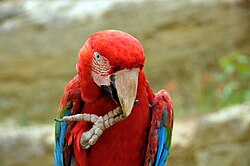
A defining physical characteristic of parrots is their zygodactyl feet, which allow them to grip food and climb with great dexterity.
Distribution and Habitat
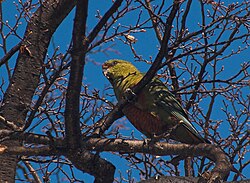
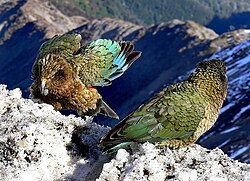
While the majority of parrot species are found in tropical regions, they are not limited to the heat. Some species, such as the austral parakeet, live in temperate zones, and the kea is the only parrot adapted to alpine environments.
Behavior and Intelligence
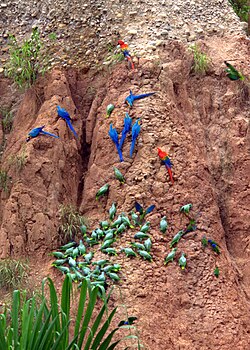
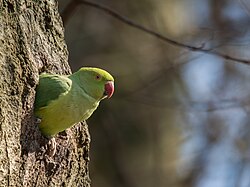
Parrots are renowned for their cognitive abilities, including complex puzzle-solving skills and the ability to imitate human speech and other sounds. Many species are cavity nesters, meaning they seek out hollows in trees for breeding.

Relationship with Humans
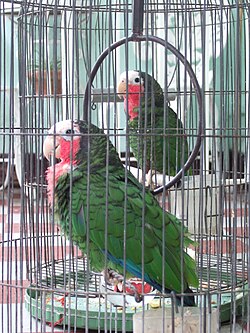
Parrots have a long history with humans, appearing in ancient art, such as Moche pottery from 200 CE. While popular as pets, this demand has led to significant conservation challenges.
In Mexico, for example, reports indicate that between 65,000 and 78,500 parrots are captured annually for trade, with a mortality rate exceeding 75% before the birds reach a buyer. Similarly, the hyacinth macaw suffered severe population declines in Brazil during the 1980s due to the pet trade.
![Hyacinth macaws were taken from the wild for the pet trade in the 1980s.[121] As a result, Brazil now has only a very small number of breeding pairs left in the wild.[122]](/images/79/b8/79b85a63f9a0459623b5dfd65ea151d5baabd2a9be55dda5d4f91c074447d32e.jpg)

Conservation and Threats
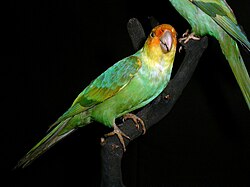
Many parrot species are currently threatened by habitat loss and overhunting. Some have already been lost; the Norfolk kākā and the Carolina parakeet are both extinct.
Conversely, some species have become feral (domesticated animals that have returned to the wild), such as the red-masked parakeets found in San Francisco.

![The Norfolk kākā went extinct in the mid-1800s due to overhunting and habitat loss.[161]](/images/f8/70/f870467a5973695d7671061d4c564b75521e943f34f22eeb9bfe461516a73be1.jpg)
Summary of Parrot Superfamilies
| Superfamily | Common Name | Key Characteristics | Example Species |
|---|---|---|---|
| Strigopoidea | New Zealand Parrots | Generally large; includes flightless species | Kākāpō |
| Cacatuoidea | Cockatoos | Tend to be large birds; often have crests | Black Palm Cockatoo |
| Psittacoidea | True Parrots | Highly variable in size and color | Hyacinth Macaw, Budgerigar |
Frequently Asked Questions
What is the smallest and largest parrot?
The smallest is the buff-faced pygmy parrot, weighing under 10 g and measuring 8 cm in length. The largest by weight is the kākāpō, which can reach 4.0 kg, while the hyacinth macaw is among the longest at 1 meter.
What does zygodactyl mean?
Zygodactyl refers to the arrangement of the toes on a parrot's foot, where two toes point forward and two point backward, providing superior gripping and climbing ability.
Are all parrots found in the tropics?
No. While most are tropical, some species live in temperate zones, and the kea is specifically adapted to alpine environments.
Why are some parrots considered endangered?
Many parrots face extinction due to a combination of habitat loss, overhunting, and the illegal wildlife trade, which often results in high mortality rates for captured birds.
Which parrots are flightless?
The kākāpō of New Zealand is a notable example of a flightless parrot.