Hangar Architecture: The Evolution of Aircraft and Airship Shelters
A hangar is a specialized building or structure designed to house aircraft or spacecraft. Whether constructed from metal, wood, or concrete, these structures serve critical roles in aviation, providing essential protection from weather and direct sunlight. Beyond simple storage, hangars are vital hubs for the maintenance, repair, manufacture, and assembly of flight technology.
The term itself has deep linguistic roots, originating from the Middle French hanghart ("enclosure near a house"). This traces back to Germanic and Old Norse origins, such as the Frankish haimgard, which translates to a "home-enclosure" or "fence around a group of houses."
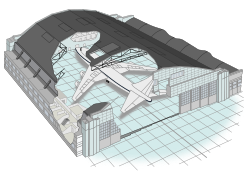
Key Facts
- Primary Uses: Protection from weather, maintenance, repair, assembly, and storage.
- Common Materials: Steel, wood, concrete, and fabric.
- Size Classification: Ranges from Small (under 30m span) to XXL (over 120m span).
- Historical Evolution: Transitioned from early wooden sheds and "aeroplane sheds" to massive steel and timber airship hangars.
- Specialized Types: Includes airship sheds, shipboard hangars, and residential hangar homes.
A History of Aviation Shelters
The history of the hangar is closely tied to the pioneers of flight. In 1902, the Wright brothers utilized a wooden hangar at Kill Devil Hills, North Carolina, to store and repair their gliders. After completing the Wright Flyer in Ohio, they returned to find their original structure damaged, necessitating repairs and the construction of a new workshop.
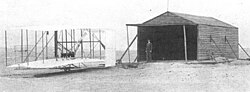
In the early 20th century, aviation pioneers required improvised solutions. Carl Richard Nyberg used a hangar for his 1908 Flugan (fly) in Sweden. Similarly, in 1909, Louis Blériot—who was racing to be the first to cross the English Channel—famously rolled his monoplane into a farmer's cattle pen in France, eventually setting up headquarters in an unused shed.
In Britain, the earliest structures were known as aeroplane sheds. Some of the oldest surviving examples are located at Larkhill, Wiltshire, built in 1910 for the Bristol School of Flying. British aviation pioneer Alliott Verdon Roe also built one of the first sheds in 1907 at Brooklands, Surrey.
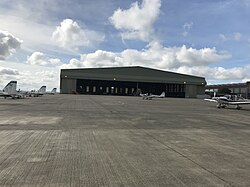
As aviation became more established, standardized military designs emerged. During World War I, the Royal Flying Corps adopted various models, including the Bessonneau hangar and the side-opening aeroplane shed of 1913. Other notable designs from this era included the Admiralty F-Type and the Handley Page aeroplane shed.
Construction Methods and Materials
The materials used to build hangars have evolved alongside the size and weight of the aircraft they protect.
Steel Construction
Steel is used for the most massive structures, particularly those designed for rigid airships. Some of the largest hangars in the world are steel-framed, such as the Goodyear Airdock in Akron, Ohio, which measures 1,175 by 325 by 211 feet. Another massive example is Hangar One in Mountain View, California, completed in 1931.

Hangar No. 1 at Lakehurst, New Jersey, is a significant historical site. Completed in 1921, it was used to build and store the American USS Shenandoah and served various airships, including the Graf Zeppelin and the Hindenburg, the latter of which famously crashed at this site in 1937.
Wood and Fabric Construction
During World War II, the U.S. Navy built 17 hangars across ten "lighter-than-air" (LTA) bases as part of a coastal defense plan. These wooden hangars are among the largest freestanding timber structures in the world. While many have been lost, several remain in California, Oregon, and New Jersey.
For more temporary needs, fabric construction offers a flexible alternative. Portable fabric shelters can be built up to 215 feet wide and 100 feet high. These structures can be relocated or expanded to accommodate multiple aircraft as requirements change.
Hangar Dimensions and Classification
Because hangars must accommodate massive wingspans and heights, they are classified by their span (the distance from one side to the other). As aircraft grow larger, the complexity of the engineering required to support the roof increases significantly.
| Size Class | Span (Meters) |
|---|---|
| S | Less than 30 m |
| M | 30–60 m |
| L | 60–90 m |
| XL | 90–120 m |
| XXL | More than 120 m |
XXL hangars are specifically engineered for the world's largest aircraft, such as the Airbus A380, Boeing 747, and the Antonov 225.
Specialized Hangar Types
Airship Hangars
Airship hangars (or sheds) are typically much taller than standard aircraft hangars. Because early airships often used highly flammable hydrogen gas, these structures had to be designed to protect against stray sparks to prevent catastrophic explosions. Due to this risk, many hydrogen-based hangars were designed to house only one or two craft at a time.

Hangars Aboard Ships
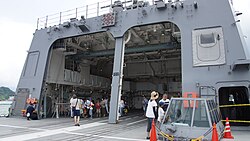
Modern warships, including cruisers, destroyers, and frigates, often feature hangars for aircraft storage and maintenance. On aircraft carriers and amphibious assault ships, these hangars are usually located beneath the flight deck, utilizing elevators to move aircraft into position. In some space-constrained vessels, the hangar and flight deck may share the same area.
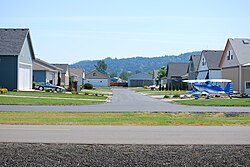
Hangar Homes
A unique residential concept is the hangar home. These are residences with an integrated or attached hangar, allowing homeowners to park their private aircraft directly at their house. These are most commonly found in specialized residential airparks.
Frequently Asked Questions
What is the main purpose of a hangar?
Hangars are primarily used to protect aircraft and spacecraft from weather and sunlight, and to provide a controlled environment for maintenance, repair, assembly, and storage.
How are hangars sized?
Hangars are classified by their span, ranging from Small (under 30 meters) to XXL (over 120 meters) to accommodate everything from small planes to massive aircraft like the Boeing 747.
Why were airship hangars built differently than plane hangars?
Airship hangars required much greater height and specific safety measures to manage the risks associated with hydrogen gas, including protection from sparks that could cause explosions.
Can a hangar be portable?
Yes, portable fabric structures can be used for aircraft storage and maintenance. They are flexible in length and can be relocated or expanded as needed.
What is a hangar home?
A hangar home is a residential property that includes an attached or integrated hangar, allowing the owner to store their private aircraft on-site.