The Evolution of Air Force One: A History of the Flying White House
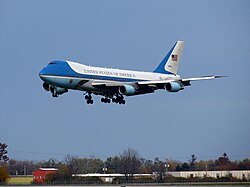
To most people, Air Force One is the iconic, blue-and-white Boeing 747 that carries the President of the United States across the globe. However, in technical terms, "Air Force One" is not the name of a specific airplane. It is the official air traffic control call sign used whenever a United States Air Force aircraft is carrying the President.
While the term is often used to describe the primary presidential aircraft—the VC-25—it can technically apply to any military aircraft the President happens to be traveling on. From the early days of converted commercial planes to the massive, highly customized jets of the modern era, the history of presidential aviation is a story of evolving security, technology, and prestige.
Key Facts
- Call Sign: "Air Force One" is a designation used by air traffic control, not a permanent name for a single aircraft.
- First Purpose-Built Plane: The Douglas C-54 Skymaster, nicknamed the "Sacred Cow," served in 1945.
- The Call Sign Origin: The term was standardized in 1954 to prevent confusion with commercial flights.
- Iconic Design: The famous livery (paint scheme) was designed by Raymond Loewy.
- Current Fleet: The aging VC-25A models are being replaced by the Boeing VC-25B series.
The Early Years: From Commercial Flights to the "Sacred Cow"
During World War II, military advisors grew concerned about the risks of using commercial airlines for presidential travel. This led to the development of dedicated military aircraft for the Commander-in-Chief. In 1944, the Douglas C-54 Skymaster was converted for this purpose. Known as the Sacred Cow, it carried President Franklin D. Roosevelt to the Yalta Conference in 1945 and continued to serve President Harry S. Truman.
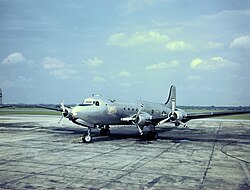
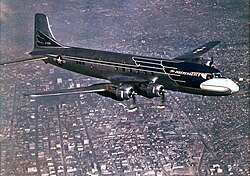
Following the Sacred Cow, the VC-118 Independence became a primary aircraft for President Harry S. Truman.
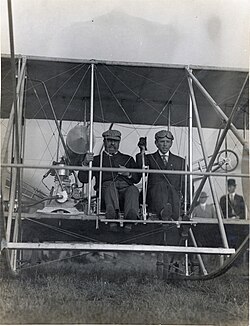
The era of flight also saw early pioneers. For instance, Theodore Roosevelt and pilot Arch Hoxsey were part of the early history of aviation that paved the way for presidential flight.
The Birth of the "Air Force One" Call Sign
The specific call sign "Air Force One" was born out of a need for safety and clarity. In 1953, a Lockheed Constellation carrying President Dwight D. Eisenhower (registration N8610) entered the same airspace as a commercial Eastern Air Lines flight using the same flight number. To prevent such dangerous confusion in the future, pilot William G. Draper suggested a standardized designation. The "Air Force One" call sign became official in 1962.
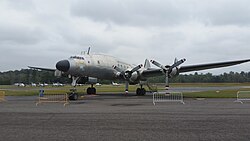
One of the aircraft used during this era was the Columbine II. Another version of the Constellation, the Columbine III, also served the presidency.
The Loewy Design and the Jet Age
In 1962, the arrival of SAM 26000 (a VC-137C) marked a new era. This aircraft introduced the distinctive blue-and-white livery designed by the renowned industrial designer Raymond Loewy, which became the visual standard for presidential aircraft.
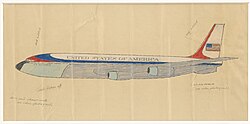
The transition to the jet age saw the introduction of several Boeing 707 aircraft in the 1960s and 1970s. As the fleet modernized, older planes like SAM 970 were repainted in a secondary livery used for Air Force Two—the designation for aircraft carrying the Vice President or other senior officials.
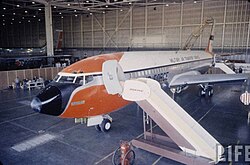
SAM 970 is currently on display at The Museum of Flight in Seattle, while SAM 971 is located at the Pima Air and Space Museum.
The Boeing 747 Era: VC-25A
During the presidency of Ronald Reagan, the United States moved toward larger, wide-body aircraft. The Air Force issued a request for proposals for aircraft with a minimum range of 6,000 miles. This resulted in the order of two Boeing VC-25A aircraft, which are highly customized versions of the Boeing 747-200B. The interiors, designed by First Lady Nancy Reagan, were inspired by the American Southwest.
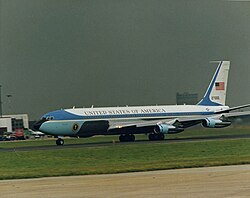
These aircraft, including SAM 27000 and SAM 28000, served multiple presidents. SAM 27000 was famously used by President Richard Nixon as he traveled to California to announce his resignation.
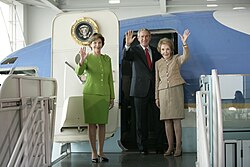
The VC-25A fleet has been a constant presence in modern history, appearing in significant moments such as the September 11 attacks.
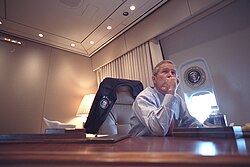
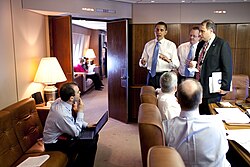
The aircraft have also been used for routine presidential travel, including flights by President Barack Obama and President George W. Bush.
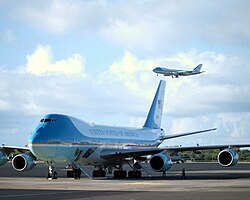
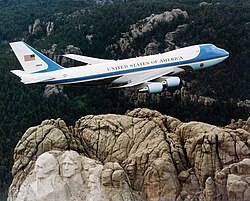
The Future: The VC-25B "Bridge" and Beyond
As the VC-25A fleet reaches the end of its service life, the Air Force has moved to acquire new aircraft. The aging systems and engines have become increasingly expensive to maintain. The replacement program involves the Boeing VC-25B, based on the Boeing 747-8 platform.
A significant part of this transition involves the VC-25B Bridge, a modified Boeing 747-8 received as a gift from the Qatari government. This aircraft completed flight testing in May 2026 and entered service on July 1, 2026, following an official unveiling at Joint Base Andrews.
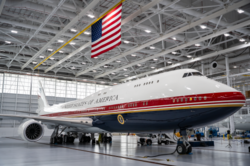
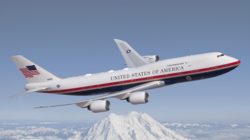
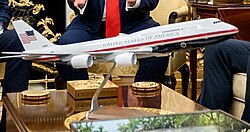
The full fleet of two Boeing VC-25Bs is expected to enter service no earlier than 2027 or 2028. While there were previous design proposals, such as a color scheme announced in 2023, the current fleet follows the updated design announced in early 2026.
![Illustration of the VC-25B color scheme announced in March 2023, later canceled.[66]](/images/e7/87/e787a22ff77124f11f4acf677031bdee9699e0dffd33a6d78b2804feaffe0c2c.jpg)
Summary of Presidential Aircraft Evolution
| Era/Type | Primary Aircraft Models | Key Characteristics |
|---|---|---|
| Early WWII Era | Douglas C-54 "Sacred Cow" | First purpose-built presidential plane. |
| Constellation Era | Lockheed Constellation (Columbine) | First to use the "Air Force One" call sign. |
| Jet Age | Boeing 707 (VC-137) | Introduced the Loewy livery design. |
| Modern Era | Boeing 747 (VC-25A) | Wide-body, highly customized interiors. |
| Future Era | Boeing 747-8 (VC-25B) | Newer technology; includes "Bridge" aircraft. |
Other Presidential Transport
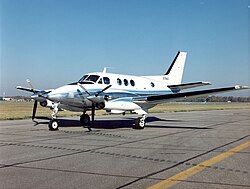
Not every flight taken by a president uses a massive 747. For smaller airports or different mission requirements, the Air Force uses other aircraft:
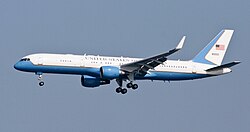
- Boeing C-32 (Boeing 757): Used for smaller airports; often serves as Air Force Two for the Vice President.
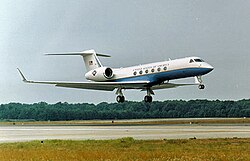
- USAF Gulfstream V: Used in VIP livery for high-level transport.
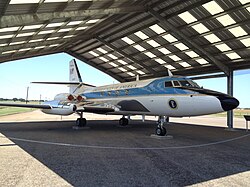
- Lockheed VC-140B: Used by President Johnson.
- Executive One: A call sign used when a president travels on a commercial airline (notably used by Richard Nixon on a United DC-10).
Frequently Asked Questions
Is Air Force One a specific airplane?
No. Air Force One is the call sign used by air traffic control whenever the President of the United States is aboard a military aircraft. It is a designation used for safety and identification.
Why was the "Air Force One" call sign created?
It was created in 1954 to prevent confusion between presidential flights and commercial airline flights that might be using similar flight numbers or identifiers.
What is the difference between Air Force One and Air Force Two?
Air Force One is the call sign for the aircraft carrying the President. Air Force Two is the designation used for the aircraft carrying the Vice President or other senior officials.
What is the "Bridge" aircraft?
The VC-25B Bridge is a modified Boeing 747-8 (gifted by Qatar) that serves as an interim aircraft to provide presidential transport while the full fleet of new VC-25B aircraft is being prepared for service.
Can the President fly on a commercial airline?
Yes. While rare, it has happened. For example, President Richard Nixon flew on a United Airlines DC-10 in 1973 to conserve fuel. In such cases, the call sign used is Executive One.