Shuttle Carrier Aircraft: NASA's Modified Boeing 747 Giants
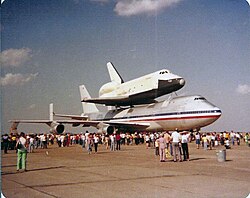
During the decades of the Space Shuttle program, a unique logistical challenge emerged: how to move massive space orbiters across the United States. To solve this, NASA utilized the Shuttle Carrier Aircraft (SCA), two extensively modified Boeing 747 airliners designed to ferry orbiters from landing sites back to the Kennedy Space Center.
These specialized aircraft served as the backbone of shuttle logistics, ensuring that after a mission concluded at secondary landing sites like Edwards Air Force Base in California, the precious orbiters could be returned to Florida for processing and subsequent launches.
Key Facts
- Aircraft Models: Boeing 747-100 (N905NA) and Boeing 747-100SR (N911NA).
- Primary Function: Transporting Space Shuttle orbiters across the continental United States.
- Modification Method: Orbiters were mounted on top of the fuselage using specialized struts and Mate-Demate Devices.
- Operational Limits: Carrying an orbiter reduced the aircraft's range to approximately 1,000 nautical miles and capped the altitude at 15,000 feet.
- Current Status: Both aircraft are retired and preserved in museums.
Design and Development
Early in the development of the Space Shuttle, NASA evaluated several options for orbiter transport. While the Lockheed C-5 Galaxy was considered, NASA ultimately chose the Boeing 747. The decision was driven by the 747's low-wing design, which was more suitable for the task than the C-5's high-wing configuration, and the ability for NASA to own the aircraft outright.
The First SCA: N905NA
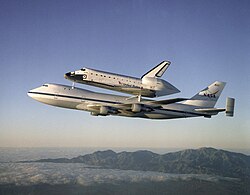
The first aircraft, registered as N905NA, was a Boeing 747-123 originally operated by American Airlines. After being acquired by NASA in 1974, it underwent extensive modifications at the Dryden Flight Research Center. Engineers strengthened the fuselage, added mounting struts to match the shuttle's external fuel tank fittings, and installed vertical stabilizers on the tail to improve stability while carrying the heavy orbiter.
One unique safety feature included an internal escape slide behind the flight deck. In the event of a mid-flight emergency, explosives would create an opening in the fuselage, allowing the crew to exit via the slide and parachute to safety. However, this system was later removed due to concerns regarding engine ingestion risks.
The Second SCA: N911NA
Following the Challenger accident in 1986, NASA procured a surplus Boeing 747SR-46 from Japan Airlines. Registered as N911NA, this aircraft entered NASA service in 1990. While functionally identical to N905NA, N911NA featured five upper-deck windows on each side, whereas N905NA had only two.
Approach and Landing Tests
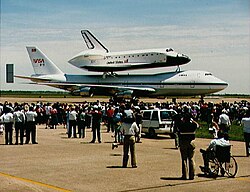
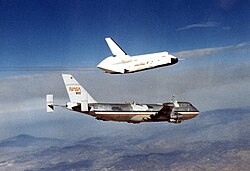
Before the Space Shuttle became fully operational, the prototype orbiter Enterprise underwent a series of critical trials known as the Approach and Landing Tests in 1977. These tests verified how the shuttle would behave when released from the SCA during flight.
The program included three taxi tests, eight captive flight tests (where the shuttle remained attached), and five free flight tests. During these free flights, the Enterprise would detach from the SCA and glide to a landing under its own control.
Operational Logistics and Ferry Flights
Transporting an orbiter was a massive undertaking. A crew of 170 people required an entire week to prepare both the shuttle and the SCA for a single flight. Because the added weight and drag of the orbiter significantly impacted performance, the aircraft had to make multiple refueling stops during transcontinental journeys.
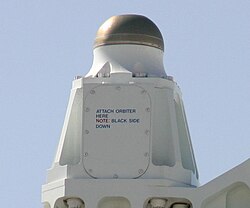
To attach the orbiter, technicians used Mate-Demate Devices—large, gantry-like structures that hoisted the orbiter into position. Interestingly, the mounting points on the aircraft featured humorous instructional notes, such as "attach orbiter here" or "place orbiter here," accompanied by the warning "black side down" to ensure correct orientation.
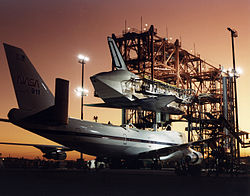
Beyond standard ferry flights, the SCAs were used for high-profile missions. In 1983, N905NA was secretly fitted with an infrared countermeasures system to protect it from heat-seeking missiles during a tour of Europe with the Enterprise. More recently, in 2010, an SCA was used to transport the Phantom Ray unmanned combat aerial vehicle (UCAV) demonstrator.
Retirement and Preservation
As the Space Shuttle program drew to a close, the SCAs performed their final duties by delivering retired orbiters to museums. The Discovery was flown to the Smithsonian's Udvar-Hazy Center, and Endeavour was delivered to the California Science Center via a series of low-level flyovers.
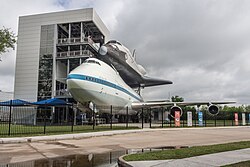
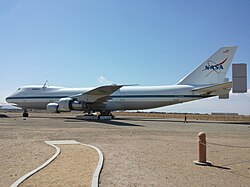
N911NA was retired in February 2012 and is currently preserved at the Joe Davies Heritage Airpark in Palmdale, California. N905NA was also preserved and is on display at Space Center Houston, where it is uniquely mated with a mockup of the Space Shuttle Independence.
Technical Specifications
| Feature | Specification |
|---|---|
| Crew | 4 (2 pilots, 2 flight engineers) |
| Payload Capacity | 108,999.6 kg (240,303 lb) |
| Cruise Speed | Mach 0.6 (approx. 290 mph) |
| Service Ceiling | 15,000 ft (4,600 m) |
| Range | 1,150 nmi (1,320 mi) |
| Powerplant | 4 × Pratt & Whitney JT9D-7J turbofans |

Frequently Asked Questions
Why did NASA choose the Boeing 747 instead of the C-5 Galaxy?
NASA preferred the 747 due to its low-wing design, which was more practical for the mission, and the fact that NASA could own the 747s outright rather than sharing ownership with the U.S. Air Force as they would have with the C-5.
How was the Space Shuttle attached to the aircraft?
The orbiter was mounted on top of the 747 using specialized mounting struts that connected to the same fittings used to attach the shuttle to its external fuel tank during launch.
What were the Approach and Landing Tests?
These were a series of flight trials conducted in 1977 using the prototype shuttle Enterprise to verify its flight characteristics, both while attached to the SCA and during free-flight glides.
Where can I see a Shuttle Carrier Aircraft today?
You can visit N911NA at the Joe Davies Heritage Airpark in Palmdale, California, or see N905NA at Space Center Houston, where it is displayed with the Space Shuttle Independence mockup.
How much did the orbiter affect the aircraft's flight performance?
The orbiter significantly reduced the aircraft's range from 5,500 nautical miles (unladen) to just 1,150 nautical miles, and limited the service ceiling to 15,000 feet.