Martin Marietta X-24: The Lifting Body That Paved the Way for the Space Shuttle
The Martin Marietta X-24 was a pioneering American experimental aircraft that redefined how engineers thought about returning from space. Developed through a joint venture between NASA and the United States Air Force under the PILOT program (1963–1975), the X-24 was designed to test the lifting body concept—a design where the fuselage itself generates lift, eliminating the need for traditional wings.
By experimenting with unpowered reentry and precision landings, the X-24 provided the critical data and operational validation required to develop the Space Shuttle. The program evolved through two primary iterations: the bulbous X-24A and the streamlined X-24B.
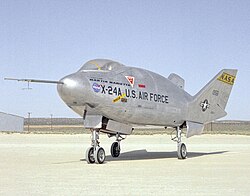
Key Facts
- Purpose: To demonstrate that wingless vehicles could maneuver and land safely like airplanes.
- Launch Method: Drop-launched from a modified B-52 Stratofortress.
- Evolution: A single airframe (Serial 66-13551) served as the X-24A before being rebuilt as the X-24B.
- Top Speed: Reached 1,164 mph (1,873 km/h) in the X-24B configuration.
- Legacy: Validated the unpowered landing concepts used by the Space Shuttle.
Design and Development
The X-24 was part of a broader series of lifting bodies flown at the NASA Flight Research Center (now Armstrong Flight Research Center) and Edwards Air Force Base. In a lifting body, aerodynamic lift—the force that keeps an aircraft aloft—is generated by the shape of the vehicle's body rather than wings. To maintain stability and control the flight path, these vehicles utilized fins and specialized control surfaces.
The X-24 (Model SV-5P) followed earlier designs such as the NASA M2-F1, the Northrop HL-10, and the Northrop M2-F2. It was designed to be launched from a B-52 at altitudes around 45,000 feet. Once released, the pilot could either glide to a landing or ignite a rocket engine to reach higher altitudes and speeds.

The X-24A Configuration
The X-24A featured a short, teardrop-shaped body with three control fins: one vertical center fin and two canted outward. It made its first unpowered glide flight on April 17, 1969, piloted by Maj. Jerauld R. Gentry. Over 28 flights, the X-24A reached speeds of 1,036 mph (Mach 1.6) and climbed to 71,400 feet.

The X-24B Evolution
To improve the lift-to-drag ratio (the efficiency of the aircraft's lift relative to the air resistance it encounters), the Air Force requested a redesign. The X-24A was returned to Martin Marietta and converted into the X-24B. This version abandoned the bulbous shape for a "flying flatiron" design, characterized by a rounded top, flat bottom, a pointed nose, and a double delta planform.
The X-24B first flew on August 1, 1973. It proved that accurate, unpowered landings were operationally feasible, culminating in precise landings on the concrete runway at Edwards Air Force Base. The X-24B flew a total of 36 times, reaching a maximum altitude of 74,130 feet.


The SV-5J and X-24C Proposals
Beyond the primary X-24 program, other variants were explored. The SV-5J was a jet-powered version of the X-24A, built by Martin on its own initiative. Instead of a rocket, it used a Pratt & Whitney J60-PW-1 jet engine. Despite the effort, the SV-5J remained unflown. One of these aircraft was later modified to look like the X-24A for museum display.
Additionally, several "X-24C" proposals were considered between 1972 and 1978. The most notable was the Lockheed Skunk Works L-301, which aimed to use scramjets (supersonic combustion ramjets) to achieve speeds of Mach 8.
Technical Specifications and Performance
The following table summarizes the specifications for the X-24B, the final iteration of the program.
| Characteristic | Detail |
|---|---|
| Length | 37 ft 6 in (11.43 m) |
| Wingspan | 19 ft 2 in (5.84 m) |
| Empty Weight | 7,800 lb (3,538 kg) |
| Max Takeoff Weight | 13,800 lb (6,260 kg) |
| Primary Engine | Reaction Motors XLR11-RM-13 Rocket |
| Max Speed | Mach 1.52 (approx. 1,164 mph) |
| Service Ceiling | 74,130 ft (22,590 m) |
Frequently Asked Questions
What is a lifting body?
A lifting body is an aircraft design where the fuselage itself is shaped to generate aerodynamic lift, allowing the vehicle to fly without the need for traditional wings.
How was the X-24 launched?
The X-24 was not capable of taking off from a runway. It was carried to high altitudes (approximately 45,000 feet) by a modified B-52 Stratofortress and then drop-launched.
What was the difference between the X-24A and X-24B?
The X-24A had a bulbous, teardrop shape, while the X-24B was rebuilt into a "flying flatiron" shape with a flat bottom and pointed nose to improve its lift-to-drag ratio and stability.
Did the X-24 program contribute to the Space Shuttle?
Yes. The X-24 program validated the concept that a wingless or low-wing vehicle could be maneuvered and landed unpowered at a predetermined site, which was essential for the Space Shuttle's reentry profile.
What happened to the X-24 aircraft?
The original airframe, in its X-24B configuration, is now on public display at the National Museum of the United States Air Force in Ohio.