William C. C. Claiborne: The First Governor of Louisiana
William Charles Cole Claiborne was a pivotal figure in the early expansion of the United States, serving as a bridge between colonial rule and American statehood in the Deep South. A versatile politician and military officer, Claiborne is most remembered as the first governor of Louisiana, overseeing the complex transition of the region from French and Spanish influence to U.S. sovereignty.
His career was marked by rapid ascent and significant challenges, from navigating the volatile politics of the early Republic to managing the diverse and often resistant populations of the Louisiana Purchase. Whether serving in the U.S. House of Representatives or governing frontier territories, Claiborne remained a steadfast member of the Democratic-Republican Party.
Key Facts
- First Governor: Served as the first governor of the state of Louisiana (1812–1816).
- Territorial Leadership: Governed the Territory of Orleans and the Mississippi Territory.
- Congressional Record: Possibly the youngest member of the U.S. Congress in history.
- Louisiana Purchase: Supervised the formal transfer of Louisiana from France to the U.S. in 1803.
- Military Service: Served in the Louisiana Militia during the Battle of New Orleans.
Early Life and Rapid Political Rise
Born in Sussex County, Virginia, between 1773 and 1775, Claiborne was educated at the Richmond Academy and the College of William & Mary. His entry into public service began in New York City, where he worked as a clerk for John Beckley, the clerk of the U.S. House of Representatives. After studying law, Claiborne moved to Tennessee in 1794 to establish his own practice.
Claiborne's political trajectory was remarkably steep. In 1796, Governor John Sevier appointed him to the Tennessee Superior Court. By 1797, he resigned to run for the U.S. House of Representatives, succeeding Andrew Jackson. His age at the time remains a point of historical debate; while the Constitution required members to be 25, records suggest he may have been as young as 22 or 23 when he took his seat on November 23, 1797.
Influence in the Election of 1800
During the tie in the Electoral College for the presidential election of 1800, Claiborne played a strategic role in the House of Representatives. He supported Thomas Jefferson over Aaron Burr and helped secure votes from the Tennessee delegation to ensure Jefferson's victory.
Governing the Frontier: Mississippi Territory
From 1801 to 1803, Claiborne served as the governor and superintendent of Indian affairs in the Mississippi Territory. During this tenure, he was known for a conciliatory approach toward the Choctaw and Chickasaw nations, working to improve their material well-being while still pursuing land acquisitions.
Claiborne also focused on establishing law and order, notably offering a $2,000 reward to capture the outlaw Samuel Mason. Additionally, he managed a public health crisis in 1802, implementing the first recorded mass vaccination in the territory to save the city of Natchez from a smallpox epidemic.
The Transition of Louisiana
On December 20, 1803, Claiborne moved to New Orleans to oversee the transfer of the Louisiana Purchase from French to U.S. control. He governed the region, then known as the Territory of Orleans, until 1812.
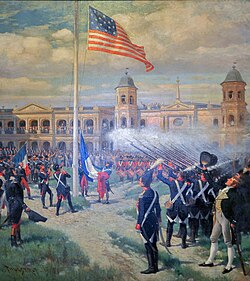
This period was fraught with tension. The local Créole population (descendants of French and Spanish settlers) often viewed the American administration as a military occupation. Claiborne, who initially spoke no French, faced opposition from powerful merchants like Daniel Clark. This rivalry eventually culminated in a duel on June 8, 1807, in which Claiborne was shot in both legs.
Social and Political Challenges
Claiborne's administration was marked by complex social dynamics. He faced backlash from the white elite for retaining free people of color in the militia. He also presided over the territory during the 1811 German Coast Uprising, one of the largest slave rebellions in U.S. history, though the suppression of the revolt was largely carried out by local parish courts and planters rather than the federal government.
Statehood and Later Years
When Louisiana achieved statehood in 1812, Claiborne won the first gubernatorial election, serving until 1816. His leadership during the War of 1812 included raising militia companies and negotiating with the pirate Jean Lafitte to help defend New Orleans from British forces in 1815.
Following his governorship, Claiborne was elected to the U.S. Senate. His tenure was brief; he died in office on November 23, 1817, exactly 20 years to the day after he first entered Congress. He passed away in New Orleans due to a liver ailment at approximately 42 years of age.
Summary of Public Service
| Role | Jurisdiction | Term/Years |
|---|---|---|
| Justice | Tennessee Superior Court | 1796–1797 |
| U.S. Representative | Tennessee (At-large) | 1797–1801 |
| Governor | Mississippi Territory | 1801–1803 |
| Governor | Territory of Orleans | 1803–1812 |
| Governor | State of Louisiana | 1812–1816 |
| U.S. Senator | Louisiana | 1817 |
Legacy and Descendants
Claiborne's name remains prominent in the geography of the South. Claiborne Parish in Louisiana, as well as Claiborne Counties in Mississippi and Tennessee, are named in his honor. In New Orleans, Claiborne Avenue stands as the city's longest street. He is also commemorated through the Claiborne Building in Baton Rouge and Camp Claiborne, used by the Louisiana Army National Guard.
His family legacy continued through several generations of public servants and notable figures, including his great-great-great-granddaughter, the fashion icon Liz Claiborne.
Frequently Asked Questions
Was William C. C. Claiborne the youngest member of Congress?
He is possibly the youngest member in U.S. history, though sources differ. While he took his seat in 1797, records vary on whether he was 22, 23, or 24 years old, which would have been below the constitutional requirement of 25.
What was the Territory of Orleans?
The Territory of Orleans was the name given to the region acquired in the Louisiana Purchase from 1804 until 1812, when it officially became the state of Louisiana.
How did Claiborne handle the 1811 German Coast Uprising?
While Claiborne was the territorial governor during the rebellion, the U.S. government had little participation in its suppression. The uprising was primarily suppressed by local planters and parish courts, resulting in the massacre of many enslaved people.
Why was Claiborne's burial controversial?
Claiborne was initially buried in St. Louis Cemetery Number 1 in New Orleans. This was controversial because he was a Protestant being buried in a Roman Catholic cemetery. He was later re-interred at Metairie Cemetery.
What role did he play in the Battle of New Orleans?
Claiborne raised militia companies for the defense of the city and negotiated with the French pirate Jean Lafitte to secure assistance against the British attack in 1815.