Wari Empire: The Middle Horizon Civilization of the Andes
Long before the rise of the Inca, the Wari (also known as Huari) established one of the most influential civilizations in the south-central Andes and coastal regions of modern-day Peru. Flourishing between 500 and 1000 AD during the Middle Horizon period, the Wari evolved from a regional power into a sprawling empire that bridged the gap between the highlands and the coast.
The heart of this civilization was the capital city of Wari, located approximately 11 km northeast of present-day Ayacucho. From this center, the Wari projected power across vast territories, leaving behind a legacy of sophisticated urban planning, innovative agriculture, and intricate art that would later inspire the Inca Empire.
Key Facts
- Timeline: 5th century to 10th century AD.
- Capital: Wari, located near modern Ayacucho, Peru.
- Key Innovation: Widespread implementation of terrace agriculture and the use of khipu for record-keeping.
- Primary Deity: The Staff God, a central figure in Andean spirituality.
- Major Sites: Pikillaqta, Cerro Baúl, and the Northern Wari ruins near Chiclayo.
- Collapse: Likely triggered by centuries of severe drought around 800 AD.
The Rise and Expansion of the Wari State
The Wari Empire began its expansion around 600 AD, notably taking control of small villages in the Carahuarazo Valley. This expansion was not merely political; it was transformative. The Wari introduced terrace agriculture—the practice of carving steps into mountainsides to create flat farmland—which allowed them to shift staple crops from tubers to a combination of tubers and maize.
While the exact drivers of Wari expansion remain a subject of scholarly debate, evidence suggests a combination of religious conversion, the spread of agricultural technology, and military conquest. The city of Conchopata provides stark evidence of the violence and militarism used to maintain imperial control.
The empire eventually extended its reach to the oracle center of Pachacamac and dominated territories previously held by the Moche and later the Chimu cultures. However, historians still debate whether the Wari politically dominated the Central Coast or if those coastal polities remained independent commercial states.
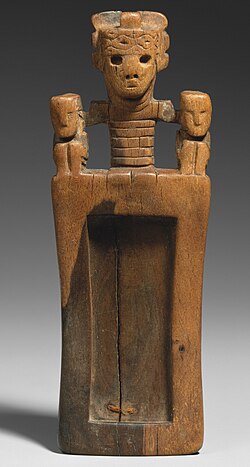
Government and Social Hierarchy
The Wari did not possess a written language. Instead, they utilized the khipu, a system of knotted strings used for accounting and record-keeping. While the Inca are most famous for the khipu, many scholars believe the Wari were the first to use it as a formal recording tool.
Social stratification was deeply embedded in Wari society. The discovery of El Castillo de Huarmey, an undisturbed royal tomb containing three royal women, reveals a culture of immense material wealth. Similarly, excavations at Conchopata uncovered over 200 individuals, revealing a hierarchy that included servants, a middle class, elites, and potentially governors.
Bioarchaeological evidence suggests that violence was systemic and gendered. Studies of adult crania at Conchopata showed that 26% of both men and women suffered posterior head wounds, but only women were subject to anterior wounds, indicating a structured social hierarchy of violence.
Architecture and Urban Planning
Wari architecture is characterized by its administrative efficiency. Unlike the more open, ritual-centric plans of the Tiwanaku culture, Wari centers consisted of large, rectangular enclosures made of rough fieldstones coated in white plaster. These compounds typically lacked windows and central gathering spaces, emphasizing administrative control over public ceremony.
A signature element of Wari design was the D-shaped structure, small buildings (roughly 10 meters) often used as temples. The Wari also developed an extensive road network and terracing systems that served as a blueprint for the later Inca highway system and agricultural projects.
Social life often revolved around ritual feasts. In the province of Cotocotuyoc, archaeologists found camelid remains that were intentionally left uneaten—a practice known as ritual wasteful consumption—to signal the host's wealth and social capital.
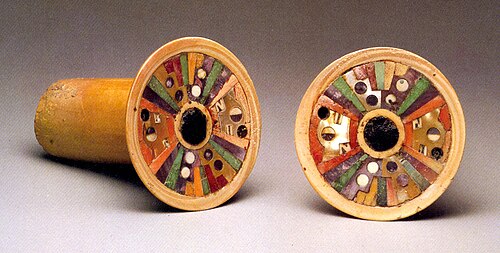
Religion and Artistic Expression
The spiritual life of the Wari centered on the Staff God, a deity common to many Andean cultures. Depictions of this god on pottery and textiles date back over 3,000 years, and some scholars view the Staff God as a predecessor to the Inca gods of the Sun, Moon, and Thunder.
Religious practice also included animal sacrifice. In Conchopata, the remains of a young camelid and thirty-two guinea pigs were found in a "lineage house," likely sacrificed to mark the end of the rainy season.
Artistically, the Wari are most renowned for their textiles. Using an incredible amount of thread—between six and nine miles per tunic—they created highly abstracted geometric designs. These complex motifs may have served as an esoteric code for the elite, with distortions designed to make the wearer's chest appear larger, symbolizing high rank.
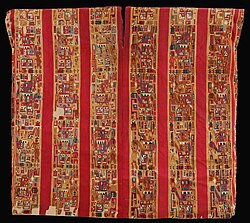
Beyond textiles, the Wari excelled in polychrome ceramics and metalwork using gold, silver, and copper. They produced qiru (ceremonial bowls), jewelry, and mummy masks. Conchopata served as a primary ceramic hub, evidenced by the presence of pit kilns and ceramic molds.
The Decline and Collapse
The decline of the Wari began around 800 AD, driven by centuries of prolonged drought. By 1000 AD, the capital city was dramatically depopulated. In a poignant archaeological detail, many doorways in government centers were deliberately blocked, suggesting the Wari hoped to return once the rains returned.
As the state structure collapsed, interpersonal violence increased. Evidence of raiding and warfare among rival groups surged, marking the transition into the Late Intermediate Period.
| Feature | Details |
|---|---|
| Period | Middle Horizon (500–1000 AD) |
| Geography | South-central Andes and Coast of Peru |
| Key Sites | Wari, Pikillaqta, Conchopata, Cerro Baúl |
| Agriculture | Terrace farming (Tubers and Maize) |
| Record Keeping | Khipu (knotted strings) |
| Art Forms | Abstract textiles, Polychrome ceramics, Gold/Silver metalwork |
Frequently Asked Questions
Who were the Wari people?
The Wari were a Middle Horizon civilization in modern-day Peru that flourished from approximately 500 to 1000 AD, eventually forming a powerful empire that influenced both the Andean highlands and the coast.
What is a khipu and did the Wari use it?
A khipu is a recording tool made of knotted strings. While most famously associated with the Inca, many scholars believe the Wari were among the first to use khipus for administrative and accounting purposes.
How did the Wari influence the Inca?
The Inca drew significant inspiration from Wari innovations, including their extensive road networks and the use of terrace agriculture to farm steep mountain terrain.
What caused the collapse of the Wari Empire?
Archaeological evidence suggests that centuries of severe drought led to the deterioration of the culture, resulting in the depopulation of the capital by 1000 AD and a subsequent increase in regional warfare.
What was the significance of the Staff God?
The Staff God was the chief deity of the Wari and other Andean cultures. It is often depicted in their art and is considered by some to be a precursor to the primary gods of the Inca civilization.