Tourmaline: The Vibrant Spectrum of the Cyclosilicate Mineral
Tourmaline is one of the most diverse and visually stunning minerals in the natural world. A complex cyclosilicate—a mineral characterized by silicate rings—it is renowned for its extraordinary range of colors and its unique chemical composition. From the deep blacks of common schorl to the neon glows of Paraiba specimens, tourmaline captures the imagination of geologists and jewelry designers alike.
The mineral's beauty is matched by its scientific complexity. Its chemical formula is highly variable, allowing for the substitution of various elements like lithium, iron, magnesium, and manganese, which in turn dictates the stone's final color and species.
Key Facts
- Hardness: 7.0 to 7.5 on the Mohs scale.
- Crystal System: Trigonal.
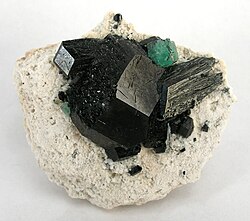
- Common Species: Schorl (black), Dravite (brown), and Elbaite (multi-colored).
- Unique Feature: Often exhibits bi-color or tri-color crystals.
- Luster: Vitreous (glass-like).
The Primary Species of Tourmaline
While the tourmaline supergroup contains many rare minerals, three primary species dominate the landscape.
Schorl
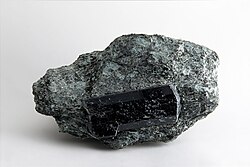
Schorl is the most abundant species, potentially accounting for 95% or more of all natural tourmaline. It is the sodium iron endmember of the group and is typically brownish-black to black. Historically, the name is linked to the village of Zschorlau in Saxony, Germany, where it was found in tin mines.
Dravite
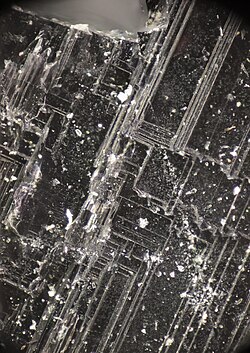
Dravite is a magnesium-rich variety, typically appearing in shades of dark yellow to brownish-black. It was named by Professor Gustav Tschermak in 1884 after the Drava river area in Carinthia (now spanning Austria and Slovenia), where the type locality is situated.
Elbaite
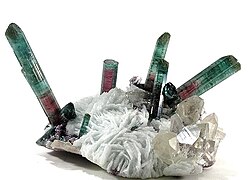
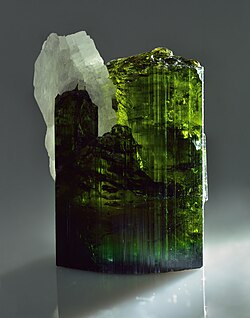
Elbaite is the lithium-rich species and the most prized for gemstones. Named after the island of Elba in Italy, elbaite can appear in almost any color. This species is further divided into several gemstone varieties:
- Rubellite: Red or pinkish-red.
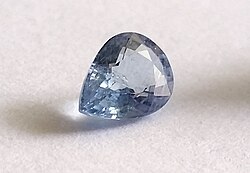
- Indicolite: Light blue to bluish-green.
- Verdelite: Green.
- Achroite: Colorless.
Physical and Optical Properties
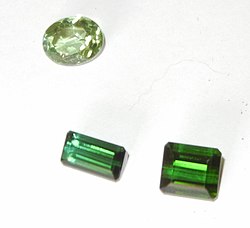
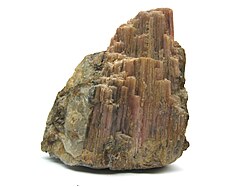
Tourmaline crystals typically form as elongated, parallel prisms that can be acicular (needle-like) or radiating. They possess a vitreous luster and are brittle in tenacity. One of the most fascinating optical properties of tourmaline is pleochroism, meaning the crystal can show different colors when viewed from different angles.
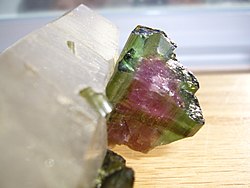
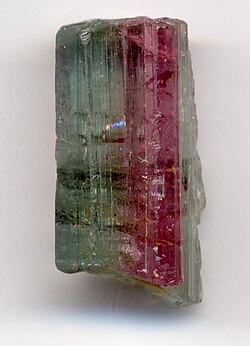
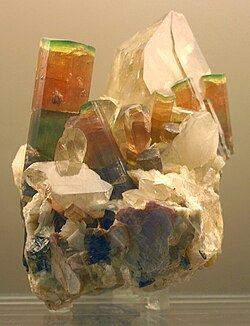
The mineral is also known for its striking color zoning. Watermelon tourmaline is a prized variety where the crystal is green on the outside and pink on the inside, mimicking the appearance of the fruit.
Technical Specifications Summary
| Property | Value/Description |
|---|---|
| Chemical Formula | (Ca,K,Na, ▢ )(Al,Fe,Li,Mg,Mn)3(Al,Cr,Fe,V)6(BO3)3(Si,Al,B)6O18(OH,F)4 |
| Crystal Class | Ditrigonal pyramidal (3m) |
| Specific Gravity | 3.06 + 0.20–0.06 |
| Refractive Index | n ω = 1.635–1.675; n ε = 1.610–1.650 |
| Fracture | Uneven, small conchoidal |
| Streak | White |
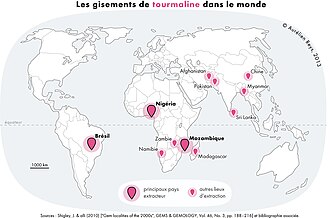
Global Localities and Notable Finds
United States
The US has a rich history of tourmaline mining. In Maine, the 1972 discovery of "The Big Pocket" on Plumbago Mountain yielded two metric tons of crystals, including red, green, and watermelon specimens. California is equally famous, particularly the Himalaya Mine in San Diego County, which produced pink tourmalines highly coveted by the Empress Dowager Cixi of China.
Brazil and Africa
Brazil is home to some of the world's most exceptional specimens. The world's largest cut tourmaline is a 191.87-carat bluish-green stone from Paraiba. Paraiba tourmalines are specifically renowned for their vivid, copper-induced neon colors.
Frequently Asked Questions
What is watermelon tourmaline?
Watermelon tourmaline is a variety of elbaite that exhibits a distinct color zoning, typically featuring a pink center surrounded by a green outer layer, resembling a slice of watermelon.
What is the difference between schorl and elbaite?
Schorl is an iron-rich species that is almost always black and usually opaque, whereas elbaite is lithium-rich and can occur in a wide array of transparent or translucent colors.
How hard is tourmaline on the Mohs scale?
Tourmaline has a Mohs scale hardness of 7.0 to 7.5, making it a durable mineral suitable for use in jewelry.
Where are the most famous tourmalines found?
Major deposits are found in Brazil (especially Paraiba), the United States (Maine and California), and various regions across Africa.
What does pleochroism mean in tourmaline?
Pleochroism is an optical property where the mineral appears to change color depending on the direction from which it is viewed.