Emerald: The Science, History, and Value of the Green Beryl
The emerald is one of the world's most coveted gemstones, prized for its vivid green hue and deep historical significance. Scientifically, an emerald is a variety of the mineral beryl, a cyclosilicate with the chemical formula Be3Al2(SiO3)6. While beryl can occur in many colors, it is classified as an emerald only when it possesses the characteristic green color derived from trace amounts of chromium or, occasionally, vanadium.
From the biblical breastplate of the High Priest of Israel to the fictional Emerald City in The Wonderful Wizard of Oz, this gemstone has long captured the human imagination. Its beauty is matched by a complex geological origin, often occurring alongside minerals such as quartz, muscovite, albite, and fluorite.
Key Facts
- Mineral Variety: A green variety of beryl.
- Coloring Agents: Trace amounts of chromium or vanadium.
- Hardness: 7.5 to 8 on the Mohs scale.
- Crystal System: Hexagonal.
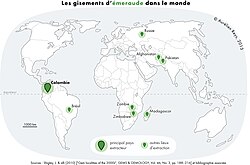
- Major Producers: Colombia and Zambia.
- Chemical Formula: Be3Al2(SiO3)6.
Mineralogical Properties
Emeralds are defined by their specific physical and optical characteristics. They crystallize in the hexagonal system, often forming prismatic crystals. While they possess a high hardness, most emeralds contain numerous inclusions—internal flaws or trapped minerals—which typically result in poor toughness, making them susceptible to fracturing.
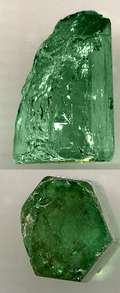
The luster of an emerald is described as vitreous (glass-like), and its diaphaneity ranges from transparent to opaque. Optically, emeralds are uniaxial negative with a refractive index typically between 1.564 and 1.602. Notably, the gemstone itself does not exhibit ultraviolet fluorescence, although some materials used to fill fractures for clarity improvement may fluoresce under UV light.
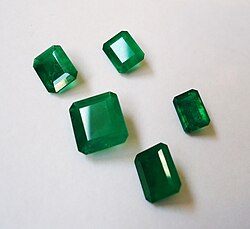
Physical Specifications Summary
| Property | Value/Description |
|---|---|
| Formula Mass | 537.50 |
| Mohs Hardness | 7.5–8 |
| Specific Gravity | Average 2.76 |
| Fracture | Conchoidal |
| Streak | White |
| Birefringence | 0.0040–0.0070 |
Global Production and Notable Specimens
Colombia has historically been a primary source of high-quality emeralds, but Zambia has emerged as a powerhouse in production. In 2004, Zambia's Kafubu River area (Kagem Mines) accounted for approximately 20% of the world's gem-quality emerald production. By 2020, Kagem Mining Limited alone produced 1,880 kg (9.4 million carats) of emerald and beryl.
![Brazilian emerald (grass-green variety of the mineral beryl) in a quartz-pegmatite matrix with typical hexagonal, prismatic crystals[12]](/images/1d/7f/1d7fbadc0260848fe77efb46cac00b4102f3b7164860faa10e48e82b77e0613b.jpg)
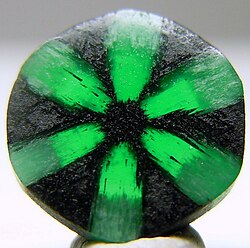
Throughout history, several extraordinary specimens have been documented. The Bahia Emerald from Brazil is one of the largest, with crystals in host rock weighing 752 lb (341 kg). Other notable stones include the Chipembele from Zambia (7,525 carats) and the Patricia Emerald from Colombia (632 carats uncut), known for its dihexagonal 12-sided structure.
Synthetic Emeralds and Identification
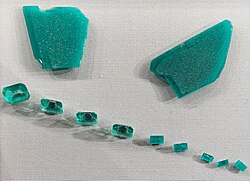
The creation of synthetic emeralds via hydrothermal synthesis—a process mimicking natural heat and pressure—became commercially viable in the 1960s through the work of Johann Lechleitner. Early products, such as "Emerita" and "Esmeralda," were grown as thin layers on natural colorless beryl.
Modern synthesis, such as that performed by Tairus, can produce "Colombian created emeralds" that closely mimic the chemical composition of natural alkaline deposits. To prevent the chromium colorant from precipitating, acidic conditions are required during growth. Experts often use ultraviolet light as a supplementary test to distinguish natural stones from synthetics, although both can sometimes be UV inert.
Frequently Asked Questions
What gives emeralds their green color?
Emeralds get their distinctive green color from trace amounts of chromium or vanadium within the beryl crystal structure.
Are all emeralds natural?
No. There are synthetic emeralds created through hydrothermal synthesis that mimic the chemical and physical properties of natural stones.
Why are emeralds often considered fragile?
Despite their high Mohs hardness (7.5–8), most emeralds have many internal inclusions, which reduces their overall toughness and makes them prone to cracking.
Which countries are the leading producers of emeralds?
Colombia and Zambia are among the most significant producers of gem-quality emeralds in the world.
How can you tell a synthetic emerald from a natural one?
Identification often involves analyzing chemical composition and using ultraviolet light, as some synthetic stones and fracture-filling materials exhibit different fluorescence patterns than natural emeralds.