Topaz: The Science, History, and Varieties of a Versatile Gemstone
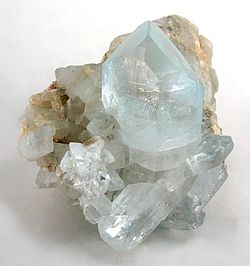
Topaz is a stunning silicate mineral prized for millennia as a gemstone in jewelry and adornments. Known for its exceptional hardness and wide array of colors, it is a nesosilicate—a type of silicate mineral where the silicon-oxygen tetrahedra are isolated from one another. While naturally occurring topaz is often colorless or golden-brown, modern treatments have expanded its palette to include vibrant blues, pinks, and purples.
From its ancient associations with legendary islands to its role as a state gemstone in several U.S. states, topaz blends geological fascination with cultural significance.
Key Facts
- Chemical Formula: Al2SiO4(F, OH)2
- Hardness: 8 on the Mohs scale (a defining mineral for this level).
- Crystal System: Orthorhombic.
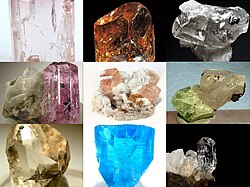
- Primary Colors: Naturally colorless, yellow, or brown; treated to be blue, pink, or purple.
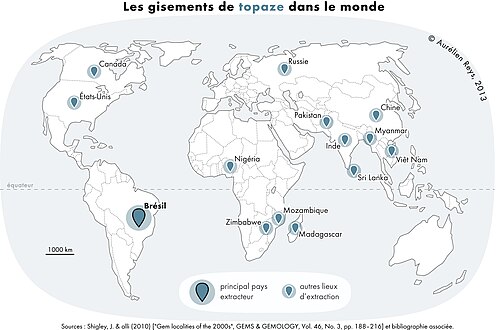
- Major Sources: Brazil and Russia are among the most popular sourcing locations.
- Key Use: Primarily used in jewelry, but also as an abrasive and in refractory materials.
Mineralogical Properties and Structure
Topaz is an aluminosilicate mineral. Its crystal structure is characterized by alternating sheets of (F, OH)2O and O, with aluminum occupying octahedral sites and silicon occupying tetrahedral sites. In nature, fluorine can be substituted by hydroxide in amounts up to 30 mol.%.
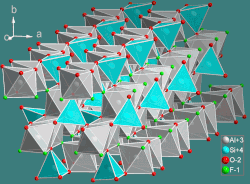
The mineral typically forms prismatic crystals, which can range from slender and long to bulky and short. One of its most diagnostic features is its perfect cleavage on the {001} plane, which breaks Al-O and Al-F bonds without disrupting the Si-O bonds. Additionally, some topaz crystals contain cavities filled with brewsterlinite, a hydrocarbon liquid with a refractive index of 1.13, indicating the mineral formed in a wet environment.
Physical Identification
Topaz is distinguished by its vitreous luster and a specific gravity between 3.49 and 3.57. Because it is significantly heavier than citrine (approximately 25% heavier by volume), weight is a primary method for distinguishing the two. Furthermore, topaz can be polished to a level of smoothness that feels "slippery," a quality quartz cannot replicate.
| Property | Value/Description |
|---|---|
| Chemical Formula | Al2SiO4(F, OH)2 |
| Crystal System | Orthorhombic |
| Mohs Hardness | 8 |
| Refractive Index | nα = 1.606–1.629, nβ = 1.609–1.631, nγ = 1.616–1.638 |
| Specific Gravity | 3.49–3.57 |
| Luster | Vitreous |
| Cleavage | Perfect [001] |
Varieties and Coloration
The natural color of topaz is often colorless or greyish, though trace impurities can produce golden-brown or yellow hues. When chromium replaces aluminum in the structure, the resulting stones can be pink or red.
Imperial and Precious Topaz
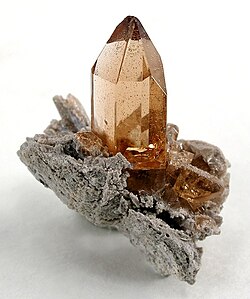
Imperial topaz is highly valued and appears in yellow, pink-orange, or rare pink hues. Brazilian imperial topaz is particularly noted for its deep golden-brown or violet tones, though some specimens may fade if exposed to sunlight for long periods. Orange topaz is often referred to as "precious topaz" and serves as the birthstone for November.
Treated and Synthetic Varieties
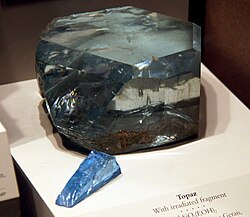
- Blue Topaz: Naturally rare; most deep blue topaz is produced via heat treatment and irradiation of colorless or pale yellow material.
- Mystic Topaz: Colorless topaz that has undergone a vapor deposition process to create a rainbow-colored surface coating.
- Synthetic Topaz: Created in labs through the thermal hydrolysis of SiO2 and AlF3 at temperatures between 750°C and 850°C.
Occurrence and Mining
Topaz is typically found in silicic igneous rocks, such as granite and rhyolite. It often crystallizes in granitic pegmatites or within vapor cavities in rhyolite lava flows. Major deposits are found in Brazil, Russia, Pakistan, Afghanistan, Sri Lanka, and the United States (notably Utah and Texas).
Mining methods vary by scale. Large-scale operations utilize open-pit and underground mining, where ore is washed and sorted. Small-scale alluvial mining involves dry sieving, where material is shoveled into sieves to separate gemstones from debris by hand.
History and Etymology
The name "topaz" is believed to derive from the Greek Topázios, referring to St. John's Island in the Red Sea. Historically, the term was used broadly in the Middle Ages to describe any yellow gemstone. It wasn't until 1737 that the name was specifically applied to the silicate mineral we recognize today. Some suggest an alternative origin from the Sanskrit word tapas, meaning "heat" or "fire."
Frequently Asked Questions
How can I tell the difference between topaz and citrine?
Topaz is significantly heavier than citrine (about 25% more by volume). Additionally, topaz can be polished to a much higher degree of smoothness, giving it a "slippery" feel. In a laboratory setting, topaz will sink in a solution of bromoform or methylene iodide, while quartz (citrine) will float.
How should I clean and care for topaz jewelry?
It is recommended to use warm water and mild soap. You should avoid using steam cleaners or ultrasonic cleaners, as these can cause small fractures to form within the crystal structure.
Is blue topaz naturally occurring?
While naturally occurring blue topaz exists, it is quite rare. Most blue topaz found in jewelry is the result of heat treatment and irradiation of colorless, gray, or pale yellow topaz.
What are the industrial uses of topaz?
Beyond jewelry, lower-quality topaz is used as an abrasive material due to its hardness. It is also used to produce refractory materials for high-temperature environments and as a flux in steel production.