Aquamarine: The Serene Blue Gemstone of the Sea
Aquamarine is a captivating variety of the beryl family, prized for its serene palette of pale blue to light green hues. Named for its resemblance to seawater, this gemstone is transparent to translucent and is widely celebrated for its brilliance and accessibility. While it shares a chemical lineage with the emerald, aquamarine is more common, making it a popular choice for both high-end jewelry and decorative arts.
The name itself is derived from the Latin words aqua (water) and marina (of the sea), a term first recorded in 1677. Because of its distinct color, the word "aquamarine" is often used as a modifier to describe similar shades in other minerals, such as aquamarine sapphire or aquamarine topaz.
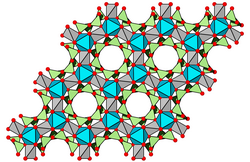
Key Facts
![Queen Elizabeth II wearing an aquamarine jewel set, a coronation gift from Brazil (except for the tiara).[17]](/images/92/11/9211ae1d35d255beebd15f57bdf85ed1e4fc1af48f82eb0b383ae48a518cfcf0.png)
- Chemical Formula: Be3Al2Si6O18
- Hardness: 7.5–8 on the Mohs scale, making it suitable for daily wear.
- Color: Pale blue to light green, caused by trace amounts of iron.
- Birthstone: The official birthstone for the month of March.
- Primary Source: Brazil, specifically the state of Minas Gerais.
- Crystal System: Hexagonal.
Physical and Chemical Properties
![Aquamarine stone in a platinum and diamond pendant. The item belonged to Lady Bird Johnson (U.S. first lady from 1963 to 1969) and was a gift to her from Brazilian president Artur da Costa e Silva.[23]](/images/f6/d0/f6d0df913a6ae65e989c5b9182d2b3a9b6944f775a97d9602523b99dc5142a0d.gif)
Aquamarine is a silicate mineral characterized by a hexagonal crystal system, typically forming prismatic crystals with a hexagonal cross-section. These crystals can range from microscopic to enormous and often feature vertical striations on their faces. Its luster varies from vitreous (glass-like) to resinous, providing a brilliant sheen when professionally cut and polished.
Chemically, aquamarine consists of beryllium, aluminum, silicon, and oxygen, with iron providing its signature blue-green color. It is chemically stable and resistant to acids. While often clear, some specimens contain inclusions of mica, hematite, rutile, pyrite, biotite, or saltwater.
| Property | Value |
|---|---|
| Mohs Hardness | 7.5–8 |
| Specific Gravity | 2.65–2.85 |
| Refractive Index | 1.57–1.59 |
| Fracture | Conchoidal |
| Streak | White |
| Diaphaneity | Transparent to translucent |
Geological Formation and Occurrence
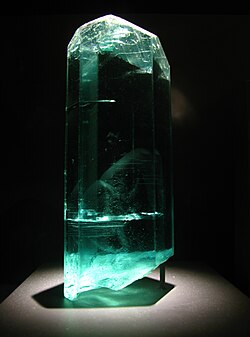
The formation of aquamarine requires beryllium, a relatively rare element in the Earth's crust. It primarily forms in granite pegmatites—coarse-grained igneous rocks that are the final stage of granitic magma crystallization. These environments are rich in volatile elements like silicon and aluminum, which facilitate the growth of beryl crystals over millions of years.
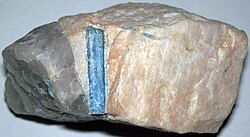
Additionally, aquamarine can form via hydrothermal fluids, which are hot, mineral-rich solutions that precipitate minerals into veins of metamorphic rocks. It is frequently found alongside minerals such as muscovite, quartz, fluorite, and morganite.
While found globally in countries like Afghanistan, Pakistan, Russia, Mozambique, and the United States, Brazil remains a premier source. The state of Minas Gerais is particularly renowned for producing some of the world's finest specimens.
Value and Grading
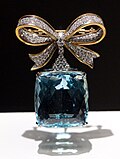
The market value of an aquamarine is determined by its weight, color, cut, and clarity. While generally more affordable than emeralds or red beryl, it typically commands a higher price than blue topaz. Naturally blue specimens are more valuable than those that have undergone heat treatment to remove yellow tones caused by ferric iron.
A rare variant known as Maxixe exhibits a deep blue color caused by NO3. However, this coloration is unstable and can fade when exposed to sunlight. Interestingly, this deep blue can be artificially induced in other beryl colors through high-energy radiation (X-rays, gamma rays, or neutrons). In terms of size, stones over 25 carats often have a lower price per carat than smaller stones of equivalent quality.
Cultural Significance and Uses
Throughout history, aquamarine has been a symbol of youth and happiness. Ancient sailors carried the stone as a lucky charm to protect against shipwrecks, believing it originated from the treasure chests of mermaids. The Ancient Romans attributed healing properties to the stone, noting its near-invisibility when submerged in water.
Artistically, the Ancient Greeks used aquamarine for intaglios (engraved gems), while the Chinese crafted seals and showpiece dolls, and the Japanese created netsuke (miniature sculptures).
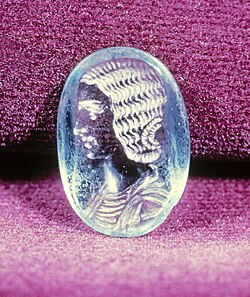
Today, it is primarily used in jewelry for rings, necklaces, and bracelets. Beyond adornment, aquamarine powder is used in some cosmetics for its skin-protecting and binding properties. In 1971, it was designated as the state gem of Colorado.
Notable Examples
Several world-famous aquamarines highlight the stone's grandeur:
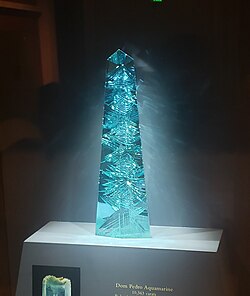
- Dom Pedro Aquamarine: The world's largest cut aquamarine, weighing 10,363 carats and housed in the National Museum of Natural History, Washington, D.C.
- The Roosevelt Aquamarine: A 1,298-carat specimen given to Eleanor Roosevelt in 1936.
- The Schlumberger Bow: A 148.5-carat piece once owned by Tiffany & Co., now in the Field Museum of Natural History.
- Royal Jewels: Queen Elizabeth II possessed an aquamarine set and tiara, and Meghan Markle wears a ring that previously belonged to Princess Diana.
Mining and Maintenance
Mining begins with geological mapping and remote sensing to locate beryllium-rich formations. Extraction occurs via open-pit mining—the most common method involving the removal of overburden with heavy machinery—or underground mining for deeper, harder-to-reach veins.
Once extracted, the ore is crushed and processed using gravity separation, froth flotation, or magnetic separation. The resulting crystals are then graded by gemologists based on the "four C's": color, clarity, cut, and carat weight.
To maintain its beauty, aquamarine should be stored separately to avoid scratches from harder gems. It can be cleaned safely with warm soapy water and a soft brush, and is generally compatible with ultrasonic cleaners.
Frequently Asked Questions
Is aquamarine a durable stone for everyday jewelry?
Yes. With a Mohs hardness of 7.5 to 8, aquamarine is considered a durable gemstone suitable for everyday wear, such as in rings and earrings.
What is the difference between aquamarine and emerald?
Both are varieties of the mineral beryl. The primary difference is their color and the trace elements that cause it: aquamarine is blue-green due to iron, while emerald is green due to chromium or vanadium.
Can the color of aquamarine fade?
Generally, no. However, the rare deep-blue variety known as Maxixe can fade when exposed to sunlight.
How can I tell if an aquamarine has been heat-treated?
Heat treatment is often used to reduce yellow tones caused by ferric iron. Naturally blue-hued specimens are typically more valuable than those that have been treated to achieve their color.
Where is the largest aquamarine in the world?
The Dom Pedro aquamarine, weighing 10,363 carats, is located in the National Museum of Natural History in Washington, D.C.