Agate: The Science, Structure, and History of Banded Chalcedony
Agate is a captivating variety of chalcedony, a form of silica that is either microcrystalline (microscopic crystals) or cryptocrystalline (crystals so small they cannot be seen with a standard microscope). Known for its striking bands and diverse colors, agate is a member of the quartz group and the broader category of tectosilicate minerals. From its ancient use in Stone Age tools to its role in modern jewelry, agate combines geological complexity with timeless aesthetic appeal.
The name "agate" is historically linked to the River Achates in Sicily, as noted by the Greek philosopher Theophrastus around 350 BCE and later by Pliny the Elder. While etymologists suggest the river may have been named after the stone, the term entered the English language in the 15th century via Latin and Anglo-Norman French.
Key Facts
- Chemical Formula: SiO2 (Silicon Dioxide).
- Hardness: 6.5 to 7 on the Mohs scale.
- Composition: Primarily quartz with 5% to 20% moganite.
- Luster: Waxy, becoming vitreous (glass-like) when polished.
- Fracture: Conchoidal (shell-like curves).
- Diaphaneity: Usually translucent, ranging from transparent to opaque.
Chemical Composition and Mineralogy
At its core, agate consists of silica. While most of this is quartz, it also contains moganite, a polymorph of quartz with monoclinic symmetry, whereas quartz has trigonal symmetry. Because moganite is less stable, it gradually converts to quartz over geological time; consequently, moganite is absent in agates dating before the Silurian period.
Unlike macrocrystalline quartz, which is anhydrous (contains no water), the chalcedony in agate typically contains 0.5% to 3% water. This is mostly found as silanol (Si–OH). The concentration of silanol decreases as moganite converts to quartz, providing a potential method for determining the age of younger agates.
Some agates also contain opal, an amorphous silica. Most of this exists as opal-CT, composed of nanometer-sized crystals of cristobalite and tridymite. Like moganite, these forms are metastable and eventually transform into quartz.
Macrocrystalline quartz is frequently found within agates, often forming a solid core or a hollow geode.
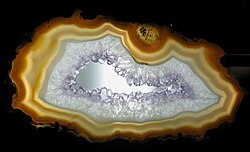
Physical Structure and Banding
Fibrous Nature
The chalcedony in agate is fibrous, consisting of intergrown crystals that form helical, chain-like structures. These fibers typically range from 0.1 to 1.0 µm in diameter. Most agates are composed of "length-fast" fibers (crystals stacked side-to-side). "Quartzine" (length-slow fibers stacked tip-to-tip) is rare, appearing only in outer layers or as thin intergrowths.
![When backlit, thin slices of agate can occasionally show their fibrous structure as lines running perpendicular to the bands (top)[1]](/images/fa/bf/fabfd9465e3d455848284ce24519e57555b4d560ad9bd19150eef3e8822d7bd1.jpg)
Banding Patterns
Agates are primarily categorized by their banding. This includes wall banding (also known as fortification or concentric banding) and level banding. In some specimens, level banding may occupy the center, surrounded by layers of wall banding.
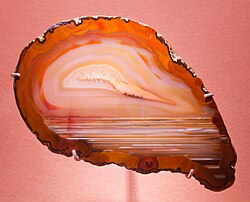
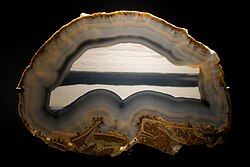
Historical Uses and Industrial Processing
Agate has been utilized by humans for millennia. As early as 10,000 BCE, the Natufian people of the Levant crafted knives and arrowheads from moss agate. Similar tools were found in Mongolia dating to 7,000 BCE. By 2,500 BCE, Sumerians were creating agate jewelry, a practice continued by the Ancient Egyptians, Mycenaeans, and Romans.
In the late 14th century, Idar-Oberstein in Germany became a center for industrial agate production. By the 20th century, this business globalized, importing vast quantities of Brazilian agate as ship's ballast. These stones were often treated with proprietary chemical processes to create vibrant colored beads.
Artificial Coloring
In the 19th century, the introduction of organic aniline dyes derived from coal tar allowed for colors like pink and purple. Unlike classical chemical treatments, organic dyes only penetrate the surface and can fade when exposed to heat or light. Dyed Brazilian agates remain common in the global market today.
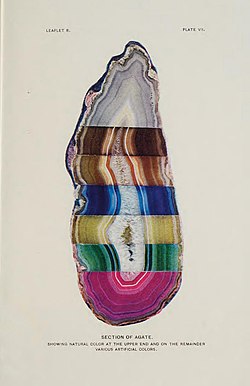
Mineral Properties Summary
| Property | Value/Description |
|---|---|
| Crystal System | Trigonal (quartz) or Monoclinic (moganite) |
| Specific Gravity | 2.60–2.64 |
| Density | 2.6 g/cm3 |
| Refractive Index | 1.530–1.543 |
| Streak | White |
| Cleavage | None |
Frequently Asked Questions
What is the difference between agate and quartz?
Agate is a variety of quartz. Specifically, it is a form of chalcedony, which is cryptocrystalline or microcrystalline silica, whereas standard quartz is often macrocrystalline (visible crystals).
How is agate colored?
Natural agate gets its color from impurities. However, many commercial agates are artificially colored using chemical processes or organic aniline dyes, which can produce colors like pink and purple.
What is a geode in the context of agate?
A geode is a hollow, vaguely spherical rock cavity lined with crystals. In agates, macrocrystalline quartz often forms these hollow centers or solid cores.
What is moganite and why does it matter?
Moganite is a monoclinic polymorph of silica found in chalcedony. Because it is unstable and converts to quartz over time, its presence or absence can help geologists estimate the age of an agate specimen.
What are enhydro agates?
Enhydro agates are specimens that contain bubbles of liquid water trapped inside the nodule or geode, often occurring long after the stone's initial formation.