Temple of Ellesyia: From the Banks of the Nile to the Museo Egizio
The Temple of Ellesyia is a remarkable example of ancient Egyptian rock-cut architecture. Originally carved directly into the stone cliffs near Qasr Ibrim, this sacred site has traveled thousands of miles from its original home in Nubia to its current residence at the Museo Egizio in Turin, Italy. Its journey reflects not only the religious evolution of ancient Egypt but also a global effort to preserve human heritage against the rising tides of modernization.
Key Facts
- Founder: Built by Pharaoh Thutmosis III during the 18th Dynasty.
- Original Location: Near Qasr Ibrim, accessible only by river.
- Current Location: Museo Egizio, Turin, Italy.
- Dedicated To: The deities Amun, Horus, and Satis.
- Preservation: Saved by UNESCO's International Campaign to Save the Monuments of Nubia.
Architectural Design and Sacred Art
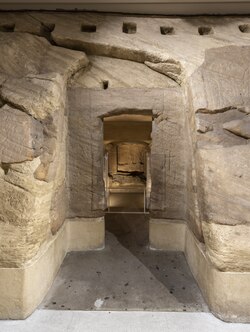
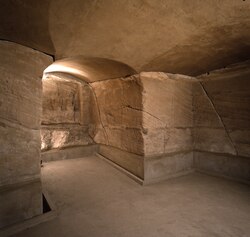
Constructed during the reign of Thutmosis III (1479–1425 BCE), the temple was designed as a rock-cut sanctuary, meaning it was hewn directly into the natural rock face. The layout follows an inverted T-shaped structure, featuring a central corridor that leads to two side chambers.
The interior walls are adorned with scenes depicting the king presenting offerings to both Egyptian and Nubian gods. At the rear of the temple, the figures face a back wall featuring half-relief carvings of Thutmosis III seated on a throne alongside the deities Horus and Satet.
Evolution of the Temple's Worship
The Temple of Ellesyia served as a mirror to the political and religious shifts of Egypt over centuries. During the reign of Akhenaten (1352–1336 BCE), a period marked by a shift toward monotheism, many of the temple's original decorations were chiseled away.
Later, Rameses II (1279–1213 BCE) restored the site, remodeling the rear niche to feature a triad consisting of Amon, Horus, and the king himself. In a final transformation, the temple became a Christian place of worship. This era is still visible today through the presence of five-pointed stars and crosses engraved upon the interior walls and the entrance portal.
The Rescue and Relocation to Turin
In the mid-20th century, the construction of the Aswan High Dam threatened to submerge numerous ancient sites under the rising waters of Lake Nasser. To prevent the permanent loss of these treasures, UNESCO launched the International Campaign to Save the Monuments of Nubia.
As part of this massive undertaking, the Temple of Ellesyia was carefully dismantled and moved in 1967. It was donated to Italy and is now a centerpiece of the Museo Egizio in Turin. This relocation was part of a broader international effort where other temples were similarly saved and moved to museums in Berlin, Leiden, New York, and Madrid.
| Temple Name | Current Location | City/Country |
|---|---|---|
| Temple of Ellesyia | Museo Egizio | Turin, Italy |
| Temple of Kalabsha | Ägyptisches Museum | Berlin, Germany |
| Temple of Taffeh | Rijksmuseum van Oudheden | Leiden, Netherlands |
| Temple of Dendur | Metropolitan Museum of Art | New York, USA |
| Temple of Debod | Madrid | Madrid, Spain |
Frequently Asked Questions
Who originally built the Temple of Ellesyia?
The temple was built by Pharaoh Thutmosis III of the 18th Dynasty between 1479 and 1425 BCE.
Which deities were honored at the temple?
The temple was dedicated to the deities Amun, Horus (specifically Horus of Miam), and Satis (also known as Satet).
Why was the temple moved to Italy?
The temple was located in an area that would have been submerged by Lake Nasser following the construction of the Aswan High Dam. It was moved to the Museo Egizio in 1967 as part of a UNESCO campaign to save Nubian monuments.
What evidence exists of the temple's use as a Christian church?
The Christian influence is evident from the engravings of crosses and five-pointed stars found on the interior walls and the entrance portal.
What is the architectural layout of the temple?
The temple features an inverted T-shaped interior, consisting of a main corridor and two side chambers.