Sumac: The Versatile Spice, Dye, and Botanical Marvel
Sumac refers to a diverse group of approximately 35 species of flowering plants within the genus Rhus. Members of the cashew and mango tree family (Anacardiaceae), these plants are found in subtropical and temperate regions across nearly every continent, with the exceptions of Antarctica and South America. While many species exist, Rhus coriaria is the most prominent for its culinary applications.
Beyond the kitchen, sumac holds deep cultural and industrial value. It is a symbolic element of the Haft-sin table during Nowruz, the Persian New Year, and has historically served as a vital source for dyes and holistic remedies.
Key Facts
- Culinary Star: Rhus coriaria is the primary species used to create the tart, lemony spice common in Middle Eastern food.
- Botanical Profile: Sumacs are dioecious (having separate male and female plants) shrubs or small trees reaching 1 to 10 meters.
- Chemical Property: The characteristic tartness of sumac fruit is caused by high concentrations of malic acid.
- Industrial Use: High tannin levels in the bark and leaves make sumac a traditional agent for vegetable tanning leather.
- Global Reach: Found globally, with significant species diversity in North America, Asia, and Europe.
Botanical Description and Growth
Sumacs are characterized by their growth habit as shrubs or small trees. Their leaves vary by species, ranging from simple or trifoliate to pinnately compound. The plants produce small flowers in dense spikes or panicles, which can range from 5 to 30 cm in length and appear in shades of greenish, creamy white, or red.
The most distinctive feature of the plant is its fruit: reddish, thin-fleshed drupes (stone fruits) that form dense clusters at the tips of branches, often referred to as "sumac bobs." These plants are hardy and propagate through seeds—often dispersed by animals—and through rhizomes, which allow them to form large clonal colonies.
Taxonomy and Classification
The genus Rhus has a complex taxonomic history. While it once encompassed over 250 species, modern classification has segregated several groups into separate genera such as Cotinus and Searsia. The name "sumac" is derived from the Arabic summāq, which originates from the Syriac word for "red."
| Category | Details |
|---|---|
| Scientific Genus | Rhus (Family: Anacardiaceae) |
| Primary Culinary Species | Rhus coriaria |
| Key Flavor Component | Malic Acid |
| Industrial Application | Leather tanning (Tannins) |
| Common Habitats | Subtropical and temperate regions |
Culinary Applications
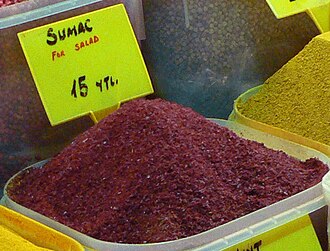
Sumac is most famous as a tangy, crimson spice. The dried fruits of Rhus coriaria are ground into a powder that adds a lemony acidity to a wide array of dishes. In Middle Eastern cuisine, it is a staple garnish for meze (appetizers) like hummus and tashi, a key ingredient in falafel, and a primary component of the Palestinian dish musakhan and the spice blend za'atar.
Its influence extends across Afghan, Armenian, Iranian, and Turkish cuisines, where it is frequently added to grilled meats, rice, and lahmajoun. Historically, sumac was also popular in medieval European cookbooks among the affluent, appearing in stews known as sumāqiyya.
In North America, species such as the smooth sumac (R. glabra) and staghorn sumac (R. typhina) are used to create a refreshing beverage called "sumac-ade" or "Indian lemonade." This is made by steeping the drupes in cool water and straining the liquid to remove irritating hairs.
Industrial and Medicinal Uses
Tanning and Dyeing
The bark and leaves of most sumac species are rich in tannins, specifically pyrogallol-type tannins. This makes them invaluable for vegetable tanning, a process used to create flexible, light-colored leather, such as morocco leather. The Latin name R. coriaria actually translates to "tanner's sumac."
Sumac also possesses powerful dyeing properties. In ancient times, it was used to create red ink. In Japan, a specific sumac-dye (kōrozen) was historically reserved exclusively for the outerwear of the Emperor.
Health and Traditional Medicine
Historically used in West and Central Asian medicine, sumac has been studied for its modern health benefits. A clinical study indicated that dietary sumac can serve as an adjunctive treatment for patients with hypertension by helping to decrease blood pressure.
Other Practical Uses
- Beekeeping: Dried sumac bobs are sometimes used as fuel for bee smokers.
- Crafts: The soft pith of sumac stems was traditionally removed by Native Americans to create pipe stems.
- Science: Dried sumac wood exhibits fluorescence under long-wave ultraviolet radiation.
Toxicity and Identification
It is critical to distinguish true sumacs from poison sumac (Toxicodendron vernix). While true sumacs have red drupes, poison sumac is identified by its white drupes. Poison sumac, along with poison ivy and poison oak, contains urushiol, an allergen that causes severe skin hypersensitivity reactions.
Frequently Asked Questions
What is the difference between sumac and poison sumac?
True sumacs (genus Rhus) typically have red berries and are used for food and dye. Poison sumac (genus Toxicodendron) has white berries and contains urushiol, which causes severe allergic skin reactions.
What does sumac taste like?
Sumac has a tart, lemony, and acidic flavor profile, which is attributed to its high concentration of malic acid.
How is sumac used in Middle Eastern cooking?
It is used as a ground spice to add acidity to salads, grilled meats, and meze. It is also a key ingredient in the za'atar spice blend and dishes like musakhan.
Can sumac be used for more than just food?
Yes, sumac is used industrially for vegetable tanning of leather, as a natural dye for fabrics and ink, and in some traditional medicinal practices to manage blood pressure.
Which species of sumac is best for the kitchen?
Rhus coriaria (Sicilian or Tanner's sumac) is the species most commonly used for culinary spice production.