Roman Forum of Beirut: The Heart of Ancient Berytus
Deep beneath the modern streets of downtown Beirut lies the remnants of Berytus, a once-prosperous Roman city. At the center of this ancient urban landscape was the Roman Forum, the primary meeting place and administrative hub that symbolized the city's power and wealth. While much of the city has evolved over millennia, archaeological discoveries continue to reveal the grandeur of this Mediterranean outpost.
Key Facts
- Location: Situated in downtown Beirut, Lebanon, near the modern Place de l'Etoile.
- Major Structures: Included a civic basilica, a temple precinct, and a large bath complex.
- Regional Significance: Home to one of the five largest Roman hippodromes on the eastern Mediterranean shores.
- Key Discovery: The northern façade of a public building was uncovered in 1994 during parliamentary office construction.
- Resilience: Parts of the bath complex remained operational until the 10th century.
The Layout of Ancient Berytus
The Roman city of Berytus expanded primarily toward the south and west. The Forum served as the civic core, flanked by essential public infrastructure. To the north, a civic basilica—a large public building used for legal and administrative purposes—stretched 99 meters in length. This structure featured a Corinthian portico crafted from polychrome (multi-colored) materials, remnants of which are now displayed in front of the Beirut Museum.
The southern boundary of the Forum was marked by a temple precinct, while the northern side was bordered by an extensive bath complex. Beyond the Forum, the city boasted a theater and a massive Roman hippodrome, located on the northwest side of the Colline du Sérail.
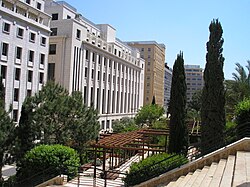
Archaeological Discoveries and Urban Evolution
Much of what is known about the Forum comes from modern excavations. In 1994, construction work for parliamentary offices revealed the northern façade of a Roman public building, characterized by elegant marble arched niches. These decorated façades and colonnades were designed to project the prosperity of the Roman Empire.
The city's transportation network was centered around the Cardo Maximus, the primary north-south street. This ancient pavement remained in use within the Souk al-Najjarin area for centuries, until 1934, when it was removed to facilitate the creation of the star-shaped Etoile Square.
In the early 1970s, the clock tower in Etoile Square was temporarily dismantled to allow archaeologists to investigate the ground beneath. This process exposed several Roman columns, which remain preserved underground today. The clock tower was eventually re-erected in 1998 as part of Beirut's post-war reconstruction efforts.
Timeline of the Roman Forum and Berytus
| Period/Year | Event |
|---|---|
| 1st Century A.D. | Construction of the 99m civic basilica with Corinthian portico. |
| 551 A.D. | Major earthquake strikes Beirut; public buildings in the Forum are partially restored. |
| 10th Century | The Roman bath complex remains in service until this period. |
| 1934 | Pavement of the Cardo Maximus is removed for the development of Etoile Square. |
| Early 1970s | Clock tower dismantled for archaeological investigation, exposing Roman columns. |
| 1994 | Excavations reveal the northern façade of a Roman public building. |
| 1998 | The clock tower is re-erected during post-war reconstruction. |
Frequently Asked Questions
What was the purpose of the Roman Forum in Berytus?
The Forum served as the central meeting place of the city, housing administrative buildings, a temple precinct, and a civic basilica, reflecting the city's power and prosperity.
How large was the hippodrome in Beirut?
The Roman hippodrome in Berytus was one of the five largest hippodromes found along the eastern shores of the Mediterranean.
What happened to the Cardo Maximus?
The Cardo Maximus was the city's main street. Its pavement remained in use until 1934, when it was removed to make way for the star-shaped design of Etoile Square.
Are there any Roman ruins still under modern Beirut landmarks?
Yes, several Roman columns remain intact beneath the clock tower in Etoile Square, having been exposed during investigations in the 1970s before the tower was re-erected in 1998.
How long were the Roman baths used?
While the city faced significant damage from the earthquake of 551 A.D., parts of the bath complex continued to be used well into the 10th century.