Martyrs' Square: The Historic Heart of Beirut
Located in the center of the Lebanese capital, Martyrs' Square (Arabic: ساحة الشهداء Sāḥat ash-Shuhadāʾ) serves as a powerful symbol of Beirut's resilience and complex history. Known historically as "Al Burj" or "Place des Cannons," this public space has evolved from an open field beyond the city walls into a focal point for national identity, political protest, and urban transformation.
The square is most famously named to commemorate the executions of May 6, 1916, ordered by Djemal Pasha during World War I. These events left an indelible mark on the city, transforming the square into a site of remembrance for those who fought for Lebanon's autonomy.
Key Facts
- Original Name: Sahat al-Burj (Tower Square), named after the Burj al-Kashef watchtower.
- Significance: Commemorates nationalists executed under Ottoman rule on May 6, 1916.
- Civil War Role: Served as the demarcation line dividing East and West Beirut from 1975 to 1990.
- Modern Status: Reestablished as Beirut's premier public space following a 2005 international design competition.
The Evolution of the Square
From Watchtowers to Cannons
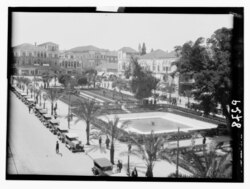
The square originated as a maydan (open space) located outside the city walls. Its earliest name, Sahat al-Burj, derived from the Burj al-Kashef, an ancient watchtower that marked the city's outer limit. The naming conventions shifted frequently based on the political and military climate of the era.
In 1773, the presence of a Russian cannon led to the name "Place du Canon." By 1860, after the Russian piece was replaced by cannons from the French fleet, it became "Place des Canons." Later, it was named Hamidiyyeh Square in 1884 to honor Sultan Abdul Hamid II, and subsequently "Union Square" and "Freedom Square" following the Young Turks revolution of 1908.
Urban Modernization and the Golden Age
In 1878, the Municipality of Beirut modernized the area to create a central meeting place. Beshara Effendi designed a garden featuring kiosks and a fountain, which was overlooked by the Petit Serail (the seat of the governor general), various souks, and public buildings. The introduction of the tramway in 1906 further solidified the square's position as the hub of Beirut's transport network.
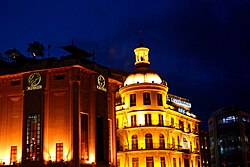
By the 1950s, the square had transitioned into a vibrant social center. It became a popular destination for coffee-houses, modest hotels, and cinemas. However, this era also saw the demolition of the Petit Serail in 1950 and the construction of the Rivoli cinema, which physically blocked the direct link between the square and the harbor.
The Martyrs and Their Monuments
The official name "Martyrs' Square" was adopted in 1931 to honor a cross-confessional group of nationalists executed by Ottoman authorities in 1916. These individuals, including figures such as Emir Aref Chehab, Father Joseph Hayek, and journalists Philippe and Farid El Khazen, fought for Lebanese independence.
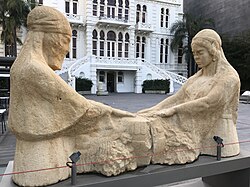
To honor them, the French Mandate authorities unveiled the first monument on December 19, 1930. Created by Youssef Hoyek, the statue was titled Les Pleureuses (the weeping women), depicting Christian and Muslim mothers grieving over a cremation urn. This depiction proved unpopular post-independence; the statue was attacked in 1948 and removed in 1953. It is now preserved at the Sursock Museum.
In 1960, a more triumphant monument designed by Marino Mazzacurati was inaugurated, which remains a defining feature of the square today.
Conflict and Contemporary Era
During the Lebanese Civil War (1975–1990), the square's central location made it a strategic flashpoint. It became the demarcation line, the physical and political divide that split Beirut into East and West.
In the 21st century, the square has reclaimed its role as the heart of the capital. Following a 2005 international competition to redesign the space and open its axis to the sea, it has once again become a site of public gathering, most notably serving as a major focal point for anti-government protests in late 2019.
Historical Summary
| Year/Period | Name/Event | Key Development |
|---|---|---|
| Early History | Sahat al-Burj | Named after the Burj al-Kashef watchtower. |
| 1773 & 1860 | Place du Canon / des Canons | Named for Russian and later French cannons. |
| 1878 | Modernization | Beshara Effendi designs garden and kiosks. |
| 1906 | Transport Hub | Tramway construction centers the square's network. |
| 1931 | Martyrs' Square | Renamed to honor those executed in 1916. |
| 1975–1990 | Civil War | Served as the city's east-west demarcation line. |
| 2005 | Redesign | International competition to reopen axis to the sea. |
Frequently Asked Questions
Why is the square called Martyrs' Square?
It was renamed in 1931 to commemorate a group of Lebanese nationalists from various religious backgrounds who were executed by the Ottoman Empire on May 6, 1916.
What happened to the first Martyrs' Monument?
The original statue, Les Pleureuses by Youssef Hoyek, was removed in 1953 after becoming unpopular and suffering an attack in 1948. It is currently located at the Sursock Museum.
What was the "demarcation line" during the Civil War?
The demarcation line was the boundary that divided Beirut into East and West sectors during the Lebanese Civil War (1975–1990), with Martyrs' Square situated directly on this divide.
What was the Petit Serail?
The Petit Serail was the official seat of Beirut's governor general. It overlooked the square until its demolition in 1950.
Who designed the current Martyrs' Monument?
The current, more triumphant monument was designed by Marino Mazzacurati and inaugurated in 1960.