RMT: The Voice of the Transport Industry
The RMT is a prominent trade union representing workers across the transport sector. Formed in 1990 through the merger of the National Union of Railwaymen (NUR) and the National Union of Seamen (NUS), the organization was designed to create a unified front for transport industry workers, consolidating the strengths of both rail and maritime labor movements.
Key Facts
- Founded: 1990 via the merger of the NUR and NUS.
- Core Representation: Transport industry workers, including a majority of London Underground staff.
- Political Affiliation: Formerly linked to the Labour Party; founding member of the Trade Unionist and Socialist Coalition (TUSC).
- Major Disputes: Frequent industrial action regarding pay, safety, pensions, and job security.
- Recent Action: Major 2022 strikes involving 40,000 members over cost-of-living pay rises and job cuts.
Political Evolution and Activism
The RMT's political roots run deep, as its predecessor unions were founding members of the original Labour Representation Committee. For years, the RMT served as a powerful voice on the left wing of the Labour Party. However, this relationship fractured in the early 2000s due to ideological differences regarding the renationalization of railways.
In 2003, several Scottish branches of the RMT donated funds to the Scottish Socialist Party (SSP) to protest the policies of Tony Blair and New Labour. This breach of rules led to the Labour Party expelling the union in early 2004.
Following its expulsion, the RMT expanded its political reach. In 2009, it ran candidates in the European Parliament elections under the "No to EU – Yes to Democracy" banner, a left-wing alter-globalisation coalition. The union subsequently became a founding member of the Trade Unionist and Socialist Coalition (TUSC), which contested general elections in 2010 and 2015. Despite these shifts, the RMT continued to engage with Labour leadership, endorsing Jeremy Corbyn's campaign for the party leadership in July 2015.
During the 2016 referendum on the UK's membership in the European Union, the RMT supported withdrawal. However, some members expressed concern over the official "Leave" campaigns. In a letter to The Guardian, members Sean Hoyle, Peter Pinkney, Paul McDonnell, and John Reid argued that the official campaigns were dominated by Tory and UKIP interests and failed to represent the socialist values of workers' rights and public ownership.
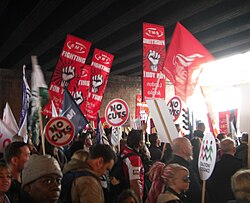
Impact on London Public Transport
The RMT plays a critical role in the operation of the capital's transit, representing most London Underground staff and various other workers within the public transport network. This significant membership has given the union substantial leverage during disputes with Transport for London (TfL) and private contractors such as Metronet and Tube Lines.
These conflicts typically center on industrial action—organized strikes or work stoppages—triggered by disagreements over pay, safety standards, pensions, and job security. Over the last decade, these disputes have frequently resulted in travel disruptions across London.
The 2022 Industrial Action
In May 2022, the RMT initiated a ballot of 40,000 members for strike action, a move potentially joined by the Transport Salaried Staffs' Association (TSSA). This action targeted both managers and operators, driven by two primary concerns: impending job cuts at Network Rail and the need for pay increases to combat the rising cost of living.
The strikes faced opposition from rail companies and Rail Minister Wendy Morton, who argued that the sector needed to modernize and reduce costs, especially as passenger numbers remained low following the pandemic. Some rail insiders further claimed the union had moved to ballot members prematurely without sufficient negotiation.
The membership overwhelmingly supported the action, leading to 24-hour strikes on June 21, 23, and 25. The RMT and TSSA warned that the resulting disruption could be the most severe since the 1926 general strike, prompting rail companies to prioritize freight delivery to ensure supermarkets remained stocked.
| Category | Details |
|---|---|
| Formation | 1990 (Merger of NUR and NUS) |
| Key Political Alliances | TUSC, Scottish Socialist Party (Scottish branches) |
| Primary Employers | Transport for London, Network Rail, Private Contractors |
| Core Demands | Pay rises, job security, safety, and public ownership |
Frequently Asked Questions
How was the RMT formed?
The RMT was created in 1990 through the merger of the National Union of Railwaymen (NUR) and the National Union of Seamen (NUS) to establish a single union for the transport industry.
Why was the RMT expelled from the Labour Party?
The union was expelled in early 2004 after some Scottish branches donated funds to the Scottish Socialist Party (SSP) in protest against New Labour's refusal to renationalise the railways.
What is TUSC?
The Trade Unionist and Socialist Coalition (TUSC) is a left-wing political party and founding member of which the RMT is a part, contesting general elections in 2010 and 2015.
What caused the 2022 rail strikes?
The strikes were driven by demands for pay rises to offset the cost of living and opposition to planned job cuts at Network Rail.
Who does the RMT represent in London?
The RMT represents the majority of London Underground staff as well as various other workers within the city's public transport network.