UNISON: Membership, Structure, and Organizational Support
UNISON is a prominent trade union primarily serving workers within the public sector. It provides a collective voice and essential support for a diverse range of employees, from administrative staff to highly specialized clinical professionals. By organizing workers into a unified body, UNISON ensures that members have the representation and protection necessary to navigate their professional lives with confidence.
The union's membership is largely comprised of individuals in local government, education, and the National Health Service (NHS), including Registered Nurses, NHS Managers, and Clinical Support Workers. It also welcomes ancillary staff, such as Assistant Practitioners, Health Care Assistants, and Allied Health Professionals. Beyond healthcare and education, UNISON represents workers in probation services, police services, transport, and utilities, including water, electricity, and gas.

Key Facts
- Membership Size: Consistently maintained between 1.2 and 1.4 million members over the last 17 years.
- Core Sectors: Heavily focused on the public sector, including the NHS, local government, and education.
- Governance: The National Delegate Conference serves as the supreme constitutional body.
- Member Benefits: Includes legal advice, workplace representation, and discounts at the UNISON Croyde Bay Resort.
- Payment Method: Most subscriptions are handled via DOCAS (Deduction of Contributions at Source).
Organizational Structure and Representation
UNISON is organized into Service Groups, each possessing its own regional and national democratic structures as defined by the union's constitution. This ensures that the specific needs of different industries are addressed effectively.
Workplace Support and Stewards
At the local level, each company or organization is typically represented by a specific UNISON branch. Members within these organizations elect volunteer stewards—trained representatives who coordinate support and represent members both individually and collectively. These stewards provide critical assistance regarding pay, conditions of service, and general protection at work.

Democratic Governance
Each branch is managed by a committee elected annually, which holds regular meetings and an annual general meeting for all members. The highest authority within the union is the National Delegate Conference, held every June. Branches elect delegates to this conference, where the union's policies for the following year are established.
Inclusivity and Self-Organized Groups
To ensure diverse perspectives are integrated into the union's operations, UNISON maintains self-organized groups. These groups are dedicated to Black members, women, disabled members, and lesbian, gay, bisexual, and transgender plus (LGBT+) members. Additionally, there are dedicated sections for retired and young members. These groups hold their own conferences, attended by elected delegates and visitors.
Membership Numbers and Trends
Over the past two decades, UNISON has maintained a stable membership base. While there have been slight fluctuations, the total number of reported members has remained within the 1.2 to 1.4 million range.
| Year | Total Reported Membership |
|---|---|
| 2024 | 1,269,500 |
| 2020 | 1,278,971 |
| 2015 | 1,254,250 |
| 2010 | 1,374,500 |
| 2005 | 1,317,000 |
| 2003 | 1,301,000 |
Membership Fees and Subscriptions
Subscription levels are determined by the National Delegate Conference and recorded in the union rules. While these rates do not change frequently, the conference can vary them via a majority vote.
Payment Methods
Most members pay through DOCAS (Deduction of Contributions at Source), a system where the employer deducts the union contribution directly from the employee's salary. Alternatively, members who join online, request it specifically, or work for employers without a DOCAS arrangement pay via Direct Debit.
Special Subscription Rates
- Students: Those in full-time education, including Modern Apprentices and student nurses, pay a fixed rate of £10 per year.
- Retired Members: Members with at least two years of continuous membership can pay a one-off fee of £15 upon retirement to retain membership benefits for life.
- Unemployed Members: Those made redundant or dismissed can maintain membership for £4 per year for up to two years.
Additionally, local branches may impose a Local Levy for branch-specific purposes, provided it is approved by a majority vote and does not exceed one-sixth of the standard subscription.
Recruitment and Public Campaigns
While much recruitment happens locally through the direct engagement of stewards and branches, UNISON also utilizes national publicity campaigns to illustrate the power of collective action.
One notable example is the "Ants and Bear" campaign, used during the formation of the amalgamated union. The campaign featured an ant that was ignored by a bear when speaking alone, but succeeded in moving the bear once joined by thousands of other ants shouting in unison.
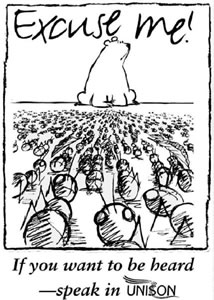
Another significant effort was the "You're one in a million" TV recruitment advertisement, launched in October 2004 and funded by the General Political Fund.

Frequently Asked Questions
What is DOCAS?
DOCAS stands for Deduction of Contributions at Source. It is a payment method where the employer deducts union membership fees directly from the employee's salary on behalf of the union.
Who can join UNISON?
UNISON typically accepts members from the public sector, including those in local government, education, the NHS (nurses, managers, and support workers), probation, police, transport, and utilities.
How are UNISON's policies decided?
Policies are set by the National Delegate Conference, which is the supreme body of the union's constitution. This conference is held every June and consists of delegates elected from various branches.
Are there benefits for retired members?
Yes. Members who have been with the union for at least two continuous years can pay a one-off fee of £15 upon retirement to remain members for life.
What is the role of a UNISON steward?
Stewards are volunteer members elected by their colleagues. They receive training to represent members on individual or collective issues, providing support with pay, working conditions, and workplace protection.