Ovidio Lagos: The Journalist Who Shaped Rosario and Argentine Federalism
Ovidio Lagos was a pivotal figure in 19th-century Argentina, operating at the intersection of journalism, business, and politics. His life was defined by a commitment to federalism—the political philosophy advocating for a confederation of self-ruled provincial states rather than a centralized government controlled by a single city.
Born in Buenos Aires on August 31, 1825, Lagos entered a world fractured by internal strife. The nation was split between the Federalists and the Unitarians, the latter of whom sought to concentrate all national power within Buenos Aires. This ideological battle would shape Lagos's career and lead him to establish one of the most enduring media institutions in South America.
Early Career and Political Exile
Lagos began his professional life in the state printing press, working first as a clerk and later as a typographist. This was during the administration of Juan Manuel de Rosas. While Rosas was nominally a federalist, his governance focused primarily on consolidating personal power and maintaining the dominance of Buenos Aires.
Because of his genuine support for the federalist cause, Lagos eventually clashed with the administration and was forced to flee to Paraná, Entre Ríos. His exile ended following the 1852 ousting of Rosas by Justo José de Urquiza, a former ally of Rosas who shifted the political landscape.
The Founding of La Capital
Upon returning to Buenos Aires, Lagos became a vocal advocate for the city to rejoin the Argentine Confederation. As an editor and columnist, he championed a proposal introduced by Deputy Manuel Quintana on July 1, 1867. Quintana suggested moving the seat of federal authorities to Rosario, a city located 300 km from Buenos Aires on the Paraná River, to decentralize power.
Lagos interviewed President Urquiza, who supported the initiative and provided the necessary funding for a newspaper to promote the cause in Rosario. This led to the publication of the first edition of La Capital on November 15, 1867.
Political Struggles and Public Service
Lagos was known for defending his political convictions with vehemence. This boldness often put him at odds with the authorities, resulting in the temporary shutdown of La Capital on several occasions. His commitment to his beliefs even led to his arrest for ten days on May 13, 1877.
Despite these challenges, Lagos transitioned into formal politics. In 1887, he was elected as a diputado (national representative) for the province of Santa Fe. He served in this capacity until his death on August 13, 1891, at the age of 65.
Key Facts
- Born: August 31, 1825, in Buenos Aires.
- Died: August 13, 1891, at age 65.
- Major Achievement: Founded La Capital in 1867, the oldest continuously published newspaper in Argentina.
- Political Stance: Staunch supporter of Federalism against the centralization of power in Buenos Aires.
- Public Office: Served as a national representative (diputado) for Santa Fe starting in 1887.
Legacy in Rosario
Today, Rosario is a major urban center that remembers Ovidio Lagos as a champion of provincial autonomy. His influence is permanently etched into the city's geography, with one of its primary avenues bearing his name.
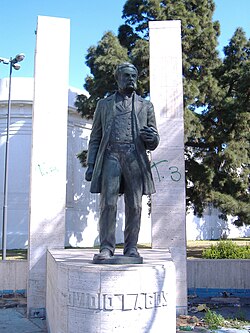
The newspaper he founded, La Capital, remained under the control of the Lagos family for 130 years. In 1997, the majority share was acquired by Grupo Uno, a media group led by businessman Daniel Vila and former Interior Minister José Luis Manzano.
| Category | Details |
|---|---|
| Primary Roles | Journalist, Businessman, Politician |
| Key Publication | La Capital (Founded Nov 15, 1867) |
| Political Affiliation | Federalist |
| Key Political Goal | Moving federal authorities to Rosario |
| Legislative Role | National Representative for Santa Fe (1887) |
Frequently Asked Questions
What was the main political conflict during Ovidio Lagos's life?
The primary conflict was between the Federalists, who wanted a confederation of self-ruled provinces, and the Unitarians, who wanted a centralized national government controlled from Buenos Aires.
Why did Ovidio Lagos found La Capital?
He founded the newspaper to advocate for the proposal to move the seat of federal authorities from Buenos Aires to Rosario, thereby reducing the concentration of power in the capital.
Who funded the creation of La Capital?
President Justo José de Urquiza sponsored the idea and provided the funding for the newspaper after being interviewed by Lagos.
How long did the Lagos family own La Capital?
The Lagos family controlled the newspaper for 130 years, until the majority share was sold to Grupo Uno in 1997.
What happened to Lagos because of his political views?
Lagos faced significant persecution; his newspaper was shut down multiple times by authorities, and he was arrested for ten days in May 1877.