Carlos Menem: The Legacy of Argentina's 50th President
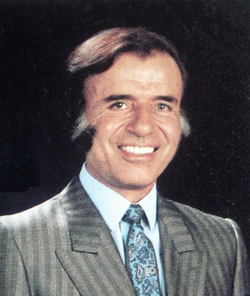
Carlos Saúl Menem (1930–2021) remains one of the most polarizing figures in Argentine history. Serving as the 50th President of Argentina from 1989 to 1999, Menem steered the nation through a period of intense economic volatility and profound social transition. His political philosophy, which became known as Menemism, blended Peronist roots with aggressive neoliberal reforms.
Born into a Syrian immigrant family in Anillaco, La Rioja, Menem was raised in the Muslim faith. However, he later converted to Roman Catholicism to facilitate his political ambitions. His trajectory was deeply influenced by a 1951 visit to Buenos Aires, where he met President Juan Perón and Eva Perón, sparking a lifelong commitment to Peronism—a populist political movement based on the teachings of Juan Perón.
Key Facts
- Presidency: Served as President of Argentina from July 8, 1989, to December 10, 1999.
- Political Party: A leading figure of the Justicialist Party.
- Early Career: Served multiple terms as the Governor of La Rioja.
- Economic Shift: Oversaw a transition from hyperinflation to a period of privatization.
- Education: Graduated with a law degree from the National University of Córdoba in 1955.
- Final Role: Served as a National Senator for La Rioja from 2005 until his death in 2021.
Rise to Power and the 1989 Transition
Menem's political ascent began in his home province of La Rioja, where he was first elected governor in 1973. His career faced a significant interruption following the 1976 Argentine coup d'état, which led to his deposition and detention. He returned to the governorship in 1983, eventually winning the primary elections for the 1989 presidency by defeating Antonio Cafiero.
His entry into the presidency was marked by chaos. Severe hyperinflation (extremely rapid, out-of-control inflation) and widespread riots forced the incumbent president, Raúl Alfonsín, to resign early. Menem took office on July 8, 1989, five months ahead of schedule. This event was historically significant as it marked the first peaceful transfer of power from an incumbent to an opposition successor since 1916.
The Presidency: Economics and Domestic Policy
Menem's decade in power was characterized by a drastic shift in economic management. He implemented wide-scale privatization of state-owned enterprises to combat inflation and modernize infrastructure. This era saw a notable increase in fixed phone subscriptions following the privatization of ENTel and a growth in vehicle export revenue during the 1990s.
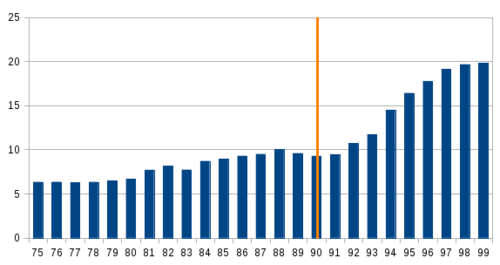
![Car and related exports (1983–2003) in millions of USD. During the 1990s, Argentina experienced growth in vehicle export revenue.[32]](/images/c4/22/c4229dd0e4fe23738737d6c9b2a34593fa0426010d3f44d7ac989fba98c9fdcb.png)
Domestically, Menem sought a path of national reconciliation to heal the wounds of the Dirty War (a period of state-sponsored violence and human rights abuses that ended in 1983). He used the repatriation of the body of 19th-century governor Juan Manuel de Rosas as a metaphor for national unity. While the historical gesture was successful, his attempts to reconcile with the military regime of the Dirty War era remained controversial.
Foreign Relations and Global Standing
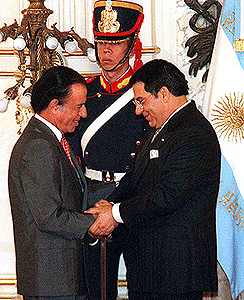
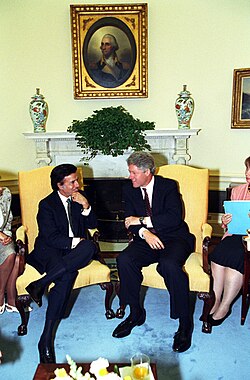
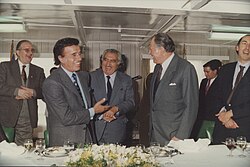
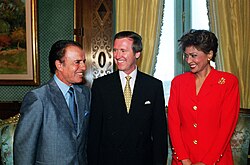
On the international stage, Menem pursued a policy of rapprochement, particularly with the United States and Chile. He maintained close ties with U.S. leaders, including Bill Clinton and Secretary of Defense William Cohen, and fostered a strong friendship with Chilean leadership.
Post-Presidency and Later Years
After leaving the presidency in 1999, Menem remained active in politics. He attempted another presidential run in 2003 but withdrew before a ballotage (a second-round runoff election) against Néstor Kirchner. In 2005, he returned to the legislature as a senator for La Rioja.
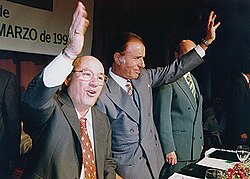
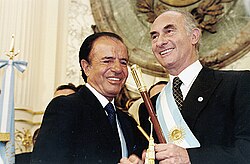
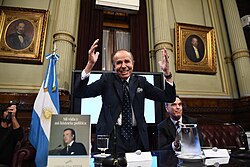
His later years were clouded by corruption charges and legal battles, though he was absolved in some cases, such as those involving Swiss bank accounts. He eventually aligned with the Frente de Todos Senate bench in 2019.
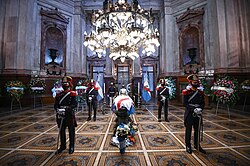
Menem passed away on February 14, 2021, at the age of 90, following complications from a urinary infection and kidney failure. He was buried in the San Justo Islamic Cemetery.
Summary of Political Career
| Role | Period | Key Detail |
|---|---|---|
| Governor of La Rioja | 1973–1976; 1983–1989 | Initial political base; deposed in 1976. |
| President of Argentina | 1989–1999 | Implemented Menemism and privatization. |
| President of Justicialist Party | 1990–2001; 2001–2003 | Led the Peronist party for 13 years. |
| National Senator | 2005–2021 | Represented La Rioja until his death. |
Frequently Asked Questions
What was "Menemism"?
Menemism refers to the political and economic approach of Carlos Menem, which combined the populist foundations of Peronism with neoliberal economic policies, such as the privatization of state industries.
Why did Carlos Menem take office early in 1989?
He took office five months early because the outgoing president, Raúl Alfonsín, resigned due to severe hyperinflation and public riots.
What was Menem's religious background?
Menem was born to a Syrian family and raised as a Muslim, but he later converted to Roman Catholicism to further his political career in Argentina.
How is Carlos Menem viewed today?
He is regarded as a polarizing figure. While some, like President Javier Milei, have praised his private-sector experience and policies, others criticize him for economic mismanagement and corruption.
What happened to Menem after his presidency?
He served as a National Senator for La Rioja from 2005 to 2021 and faced various legal challenges regarding corruption charges before his death at age 90.