Hermes Binner: The Legacy of Argentina's First Socialist Governor
Hermes Juan Binner (1943–2020) was a distinguished Argentine physician and politician who broke significant political barriers in his home country. Most notably, he became the first member of the Socialist Party to serve as the governor of an Argentine province and the first non-Peronist to lead Santa Fe since the return to democracy in 1983.
Binner's career was defined by a commitment to public health, decentralization of government, and the promotion of democratic governance, leaving a lasting imprint on both the city of Rosario and the province of Santa Fe.
Key Facts
- First Socialist Governor: The first Socialist to govern an Argentine province (Santa Fe, 2007–2011).
- Medical Background: A trained physician specializing in anesthesiology and occupational medicine.
- Municipal Leadership: Served as the Mayor of Rosario from 1995 to 2003.
- Presidential Run: Finished second in the 2011 Argentine general election with 17% of the vote.
- Global Recognition: His health administration in Rosario was recognized by the Pan-American Health Organization as a model for Latin America.
Early Life and Education
Born on June 5, 1943, in Rafaela, Santa Fe Province, to a Swiss Argentine family, Binner's political awakening began early. While attending the Rafaela National College, he became active in the Student Center during a period of intense national debate regarding the necessity of free, non-religious public education.
Binner moved to Rosario to study medicine at the National University of Rosario. At age 18, he joined the Argentine Socialist Party. His university years were marked by political activism and resistance against the military dictatorship of General Juan Carlos Onganía following the 1966 coup d'état. He graduated in 1970 and continued his involvement in professional unions, including the Physicians' College and the Rosario Medical Association.
Political Ascent and the Mayoralty of Rosario
In 1972, Binner co-founded the Popular Socialist Party (PSP) in Buenos Aires. While continuing his medical practice and specializing in public health, he transitioned into administrative roles, serving as both Sub-Director and Director of public hospitals.
His entry into municipal government occurred following the 1989 economic crisis. After the resignation of Mayor Horacio Usandizaga, Binner was appointed Public Health Secretary by the newly elected Mayor Héctor Cavallero. By 1993, Binner was elected as a concejal (City Council member), which provided the platform for his successful mayoral bid in 1995.
During his two terms as Mayor of Rosario (1995–2003), Binner implemented several transformative policies:
- Decentralization: He divided the city into large districts, moving bureaucratic services into peripheral neighborhoods to bring government closer to the citizens.
- Public Welfare: He prioritized health, education, and culture. His Health Plan was later lauded by the Pan-American Health Organization.
- International Positioning: He established Rosario as a strategic metropolis, serving as a founding member of Mercociudades (cities of the Mercosur).
In 2003, the United Nations recognized Rosario's government as a model of democratic governance among 257 Latin American cities.
Governor of Santa Fe and National Influence
After a term as a National Deputy starting in 2005, Binner ran for the governorship of Santa Fe in 2007. Running with Griselda Tessio as his vice-governor, he won the election with 48% of the vote, defeating the Justicialist Front for Victory candidate Rafael Bielsa.
As Governor from 2007 to 2011, Binner maintained a pragmatic relationship with Presidents Néstor Kirchner and Cristina Fernández de Kirchner, despite their differing political ideologies.
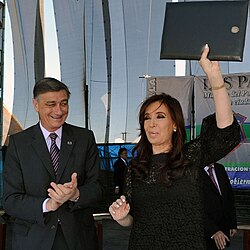
In 2011, Binner expanded his ambitions to the national stage. He ran for President of Argentina as the candidate for the Broad Progressive Front, with Senator Norma Morandini as his running mate. While he placed fourth in the primaries with 11%, he ultimately finished second in the general election on October 23, 2011, securing 17% of the popular vote.
Summary of Political Career
| Position | Location | Term | Key Achievement/Note |
|---|---|---|---|
| Mayor | Rosario | 1995–2003 | Implemented decentralization and model health plan. |
| National Deputy | Argentina | 2005–2007 | Represented the Progressive, Civic and Social Front. |
| Governor | Santa Fe | 2007–2011 | First Socialist governor in Argentine history. |
| Presidential Candidate | Argentina | 2011 | Finished second in the general election. |
Death and Legacy
In his final years, Binner struggled with kidney problems and Alzheimer's disease. He was admitted to a geriatric hospital in 2019 and passed away from pneumonia on June 26, 2020, at the age of 77 in Casilda, Santa Fe Province.
Frequently Asked Questions
Why was Hermes Binner's governorship historically significant?
He was the first member of the Socialist Party to ever serve as a governor of an Argentine province and the first non-Peronist to lead Santa Fe since the transition to democracy in 1983.
What was the "Ley de Lemas" and how did it affect Binner?
The Ley de Lemas was a controversial voting system in Santa Fe. Despite receiving a higher percentage of the popular vote than other candidates in a previous gubernatorial bid, this system caused the Socialist Party to lose the election to the Peronist Party.
How did Binner's medical background influence his politics?
Binner's expertise in anesthesiology, occupational medicine, and public health led him to prioritize public welfare. His Health Plan in Rosario became an internationally recognized model for other Latin American cities.
Who succeeded Hermes Binner as Governor of Santa Fe?
He was succeeded by Antonio Bonfatti, a longtime friend from medical school and Binner's former Minister of Government and State Reform, who won the election on July 24, 2011.
What was the Broad Progressive Front?
The Broad Progressive Front was a political alliance launched in 2011 to support Binner's presidential candidacy, comprising the Socialist Party and other "democratic left" groups such as the New Party and the Freemen of the South Movement.