National Flags: History, Design, and Global Symbolism
A national flag is a powerful visual emblem that represents and symbolizes a sovereign nation. While primarily flown by a country's government, these flags are also embraced by citizens as symbols of identity and pride. Every element of a flag—from its specific colors to its unique symbols—is typically designed with a deep meaning, often reflecting the nation's values, geography, or historical struggles. Because they are so closely tied to national identity, flag designs are frequently altered following major historical events or shifts in government.
Key Facts
- Origins: Flags began as military standards used as field signs in ancient times.
- Oldest Tricolour: The flag of the Netherlands is considered one of the oldest tricolour flags in continuous use.
- Unique Shapes: Nepal's flag is the only national flag that is not a quadrilateral.
- Common Colors: Red is the most frequent color used in national flags, appearing in approximately 76% of them.
- Religious Influence: Roughly one-third of the world's 196 countries include religious symbols on their flags.
The Evolution of National Flags
From Military Standards to Maritime Signs
Historically, flags originated as military standards. Early examples include the white cloth banners of the Zhou dynasty in the 11th century BC, the vexillum (Roman military standards) of the Roman Empire, the Black Standard of the Abbasid Caliphate, and the Raven banners used by Viking chieftains. By the 14th century, Portolan charts began depicting the flags of various polities, though these often represented the personal standards of rulers rather than the nation itself.
The transition to non-military use began with maritime flags. During the 13th century, the republics of Venice and Genoa adopted flags to indicate a ship's country of origin, with Genoa being one of the earliest states to adopt a national flag.
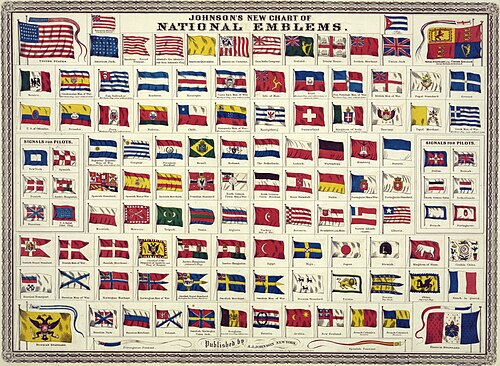
The Rise of the Tricolour and Nationalist Sentiment
The Dutch flag evolved from the 16th-century Prinsenvlag (Prince's Flag) into the Statenvlag (States Flag) in the early 17th century. This red-white-blue design became a symbol of republicanism, especially after the French Revolution of 1789, when France adopted a vertical tricolour to embody the principles of liberty, equality, and fraternity.
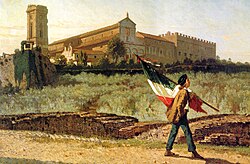
This trend spread across Europe and the Americas. Countries such as Italy, Ireland, Romania, and Estonia adopted tricolours to signal their adherence to these republican ideals. Similarly, as South American nations gained independence in the 19th century—such as Brazil in 1822 and Colombia in 1860—they established their own unique flags.
The Union Jack and Global Standardization
The Union Jack's history reflects the political merging of kingdoms. In 1606, the flags of England (St George's Cross) and Scotland (St Andrew's Cross) were joined. In 1801, the Cross of St Patrick was added to represent the legislative union with Ireland, creating the current design.
By the 19th and 20th centuries, most European nations codified their maritime flags as official national flags. For example, Denmark's flag specifications were formalized in 1748, and Switzerland introduced its flag in 1889 based on medieval war banners.

The Process of Adoption and Change
The legal basis for a flag varies by country. In Germany, the black-red-gold colors are mentioned in the 1949 Basic Law, while the United States defines its flag through a 1777 Flag Resolution rather than the Constitution. Minor changes are often handled by executive or legislative bodies, while major shifts usually require constitutional changes.
Some flags are designed to be dynamic. The U.S. flag adds a star for every new state admitted to the Union, most recently in 1960 for Hawaii. Other changes reflect regime shifts; for instance, Syria replaced its Ba'ath-era flag in 2024 with a modified independence flag following the overthrow of the Assad regime.
Flag Design and Symbolism
Visual Elements and Geometry
Most national flags are mirrored or identical on both sides, with Paraguay being a notable exception. While most are rectangular, Nepal's flag is uniquely non-quadrilateral.
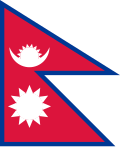
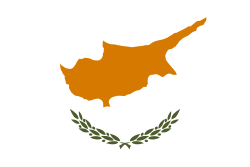
Many flags incorporate specific national symbols. The Cambodian flag features Angkor Wat, a temple associated with Hinduism and Buddhism, while the flag of Cyprus depicts the map of the island itself.
![The Cambodian flag features a depiction of Angkor Wat in the center, a temple historically associated with both Hinduism and Buddhism.[10]](/images/16/fc/16fcc64dfa36bce943b18f2a4521628833f50e60a09c77e777fe9b569de847ab.webp)
Color Distribution
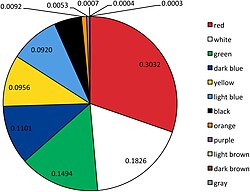
Colors are not distributed evenly across global flags. Red, white, and blue are the most common, while purple is the rarest.
| Color | Percentage of Flags | Count of Flags |
|---|---|---|
| Red | 76.14% | 150 |
| White | 71.57% | 141 |
| Blue | 51.78% | 102 |
| Yellow/Gold | 45.18% | 89 |
| Green | 44.67% | 88 |
| Black | 30.46% | 60 |
| Orange | 4.57% | 9 |
| Brown | 4.06% | 8 |
| Gray | 3.05% | 6 |
| Purple | 1.52% | 3 |
Flag Families and Similarities
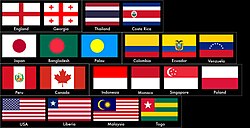
Some flags look similar by coincidence, while others belong to a flag family based on shared history. For example, the flags of Colombia, Ecuador, and Venezuela are all derived from the flag of Gran Colombia.
Other families include the Nordic Cross (Denmark, Sweden, Norway, Finland, and Iceland) and the Arab revolt variants (Kuwait, Jordan, and Palestine). Former British colonies, such as Australia and New Zealand, often feature the Union Jack in the canton (the upper left quarter).
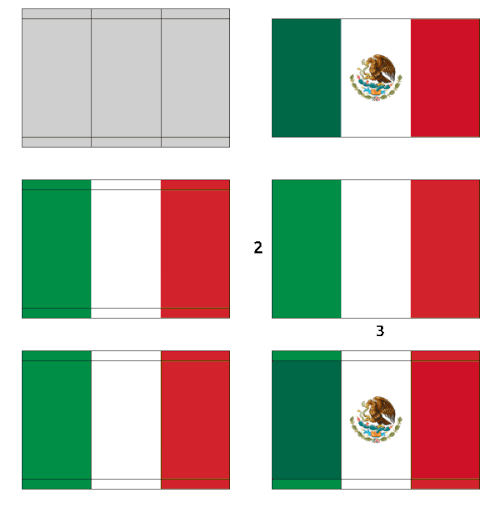
Occasionally, similarities cause practical issues. The flags of Italy and Mexico are very similar, differing primarily in the Mexican coat of arms and slight variations in shade and proportion (Italy 2:3 vs. Mexico 4:7). This led the International Maritime Organization to request distinct naval flags to avoid confusion at sea.
Flag Protocol and Usage
Strict protocols govern how national flags are displayed to ensure respect:
- Priority: A national flag must be hoisted first and lowered last.
- Equality: When flown with other national flags, they should be of equal size and height, with the host country's flag in the position of honor.
- Positioning: On a single pole, the national flag must always be at the top. In a procession, it should be on the marching right.
Vertical Display
Some nations have specific rules for hanging flags vertically. In countries like Saudi Arabia, Mexico, and Cambodia, the coat of arms or religious inscriptions must be rotated 90 degrees to remain legible and correct when the flag is displayed vertically.
Frequently Asked Questions
Which national flag is not rectangular?
The flag of Nepal is the only national flag in the world that is not a quadrilateral.
Why do so many flags use red, white, and blue?
This is often due to historical influence. For example, the U.S. used these colors because it was formerly a collection of British colonies. Additionally, the French tricolour's colors became associated with republicanism and liberty, influencing many other nations.
What is a flag family?
A flag family consists of flags that share a common design because the nations share a historical or political connection, such as the Nordic Cross flags of Northern Europe.
How are flags handled when flown together?
According to protocol, national flags should be flown at equal heights and sizes. The host nation's flag typically takes the position of honor, and the national flag is always hoisted first and lowered last.
Do all flags look the same on both sides?
Most are identical or mirrored, but there are exceptions, such as the flag of Paraguay, where the obverse and reverse are different.