Flag Design and Vexillology: A Comprehensive Analysis of Global Patterns
The study of flags, known as vexillology, reveals a complex language of geometry, color, and symbolism. From the strict proportions of a national banner to the intricate charges placed upon its field, every element of a flag is designed to convey identity, history, and sovereignty. While many flags follow standard rectangular patterns, a closer look reveals a diverse array of shapes and symbolic arrangements that distinguish one nation from another.
Key Facts
- Aspect Ratio: While most flags are rectangular, Switzerland uses a 1:1 square ratio, and Togo utilizes the Fibonacci golden ratio (approx. 1:1.618).
- Fimbriation: This refers to a thin border or stripe separating two colors, as seen in the flags of Gambia and Kenya.
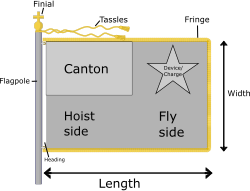
- Mobile Charges: These are symbols placed upon the flag, ranging from astronomical bodies (suns and moons) to living organisms and national coats of arms.
- Canton: The upper left quarter of a flag, often used to house a secondary symbol or a parent nation's flag.
Shape and Aspect Ratio
The aspect ratio—the proportional relationship between a flag's width and height—varies significantly across the globe. While many nations adhere to standard dimensions, several employ unique specifications to stand out.
Distinctive Proportions
Some nations use specific ratios that deviate from the norm. For example, Belgium uses a ratio of 13:15, while Monaco utilizes 4:5. Niger employs a 6:7 ratio, and Switzerland is notable for its perfectly square 1:1 shape. Togo is particularly unique, basing its proportions on the golden ratio (approximately 13:21).
Border Variations
Beyond the ratio, some flags are defined by their borders. Grenada and the Maldives feature wide red borders, while Montenegro and Sri Lanka utilize golden borders. Nepal is distinguished by a thin blue border, and Tibet's "Snow Lion Flag" features a yellow border on three sides.
Geometric Divisions and Stripes
The division of a flag's field creates the foundational visual structure. These divisions can be diagonal, horizontal, or vertical, often incorporating fimbriation (thin contrasting lines) to ensure visual clarity.
Diagonal and Radiating Patterns
Diagonal stripes are prominent in several nations. Brunei features white and black diagonal stripes, while the Democratic Republic of the Congo, Namibia, Saint Kitts and Nevis, Tanzania, and Trinidad and Tobago all utilize a single diagonal stripe fimbriated in various colors. The Seychelles is unique for its five radiating stripes.
Horizontal and Vertical Arrangements
Horizontal stripes are among the most common designs. These can be equal tri-colors (as seen in the state flags of Bolivia and Serbia) or unequal divisions. Some, like the flags of Gambia and Kenya, use white fimbriated lines to separate the colors. Vertical divisions are also common, ranging from the equal bi-color splits to the unequal ratios found in the flag of Andorra (8:9:8) and Saint Vincent and the Grenadines (1:2:1).
The Use of Mobile Charges
A mobile charge is any emblem or symbol placed upon the field of the flag. These charges often represent the natural world, political ideology, or national heritage.
Astronomical Symbols
- The Sun: Featured prominently in the flags of Japan (a red disc), Kazakhstan (a yellow rayed sun), and the Philippines (a multi-rayed sun on the hoist).
- The Moon: Laos and Palau feature full moons, while a crescent moon is a recurring theme in the flags of Türkiye, Pakistan, Malaysia, and Algeria.
- Stars: Stars vary from the single gold star of Ghana to the Southern Cross constellation found on the flags of Brazil, New Zealand, and Papua New Guinea.
Living Organisms and Objects
Many flags incorporate fauna or flora. Sri Lanka features a golden lion, Wales displays a red dragon, and Canada is world-renowned for its red maple leaf. Other flags use man-made objects, such as the kris sword in the Bangsamoro region or the oceanic canoe of Tokelau.
Text and Mottos
Some flags incorporate written language to explicitly state their values. Brazil's "Ordem e Progresso" (Order and Progress) and San Marino's "Libertas" (Freedom) are prime examples. The flags of Iraq and Iran both feature the Takbīr ("God is the greatest") in Arabic script.
Summary of Flag Design Elements
| Element Type | Description | Example Nations |
|---|---|---|
| Aspect Ratio | Proportional width to height | Switzerland (1:1), Togo (1:1.618) |
| Fimbriation | Thin separating border/line | Gambia, Kenya, Uzbekistan |
| Mobile Charge | Symbol placed on the field | Canada (Maple Leaf), Japan (Sun) |
| Canton | Upper left quadrant | Cook Islands, Niue |
| Saltire | Diagonal cross | Scotland |
Frequently Asked Questions
What is the difference between a civil flag and a state flag?
A civil flag is intended for use by the general public and often features a simpler design. A state flag (or government flag) is used by official government bodies and frequently includes a national coat of arms or badge that is absent from the civil version, as seen in the flags of Bolivia and El Salvador.
What is a Nordic Cross?
A Nordic Cross is an upright off-centre cross that shifts the vertical bar toward the hoist side of the flag. This design is used by regions such as Åland and the Faroe Islands.
What does fimbriation serve in flag design?
Fimbriation is the use of a thin strip of a different color to separate two other colors. This is often done to prevent two colors from touching that would otherwise clash or violate heraldic rules of contrast, ensuring the flag remains visible from a distance.
Which flags use non-standard shapes?
While most flags are rectangular, Switzerland is the most prominent example of a square flag. Nepal is also highly distinctive for its non-rectangular, double-pennon shape.