35 mm Film: The Standard of Motion Picture History
In the world of cinematography, few technical specifications have held as much dominance as the 35 mm film gauge. As the most commonly used gauge in motion picture history, 35 mm has served as the backbone for image origination and projection for over a century. While the term "35 mm" is a nominal name rather than a precise measurement, it refers to a standardized strip of photographic film approximately 1.377 inches (34.976 mm) wide.
From the early days of the Kinetoscope to the complex multi-track audio prints of the modern era, this format has undergone continuous technical evolution to accommodate new ways of seeing and hearing stories.
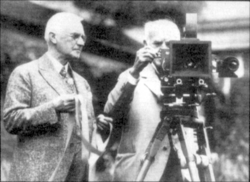
Key Facts
- Inventor: William Kennedy Dickson and Thomas Edison.
- Inception: Developed around 1889–1890.
- Standardization: Accepted as the international standard gauge in 1909.
- Frame Rate: Standard single-frame format uses four perforations per frame, resulting in 16 frames per foot.
- Primary Manufacturer: Historically Edison Company and Eastman Kodak; currently supplied by Kodak.
The Origins of a Global Standard
The development of 35 mm film was a collaborative, albeit competitive, effort involving several pioneers of early cinema. In 1889, William Kennedy Dickson utilized 70 mm celluloid film supplied by George Eastman, which he "simply slit in half" to create a more economical stock. This new width was more efficient than 70 mm and avoided the waste associated with cutting larger sheets to size.
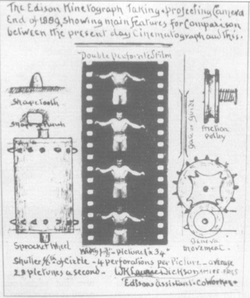
While many proprietary gauges emerged in the late 19th century, 35 mm quickly gained traction. The Lumière brothers adopted it immediately, and the Vitascope—the first projection device to use 35 mm—proved technologically superior to many contemporary devices. By 1917, the Society of Motion Picture Engineers (SMPE) officially acknowledged 35 mm as the industry's dominant engineering standard.
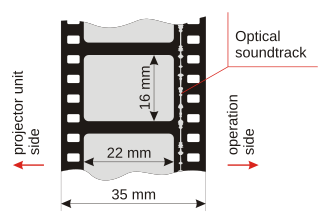
Evolution of Aspect Ratios and Formats
As filmmaking technology progressed, the industry moved away from the nearly square images of the early era toward wider, more immersive formats. This evolution is defined by the aspect ratio—the proportional relationship between the width and height of the image.
The Academy Ratio
In 1932, the Academy of Motion Picture Arts and Sciences refined the standard, creating the "Academy ratio." This format featured a camera aperture of 22 by 16 mm, resulting in an aspect ratio of 1.375:1. This remained a cornerstone of cinema for decades.
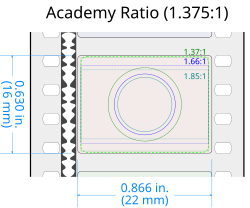
Widescreen and Anamorphic Innovations
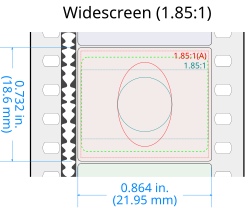
To compete with new media and provide a more epic feel, studios introduced widescreen formats. In 1953, Paramount Pictures began using removable aperture plates to crop the top and bottom of the frame, creating wider ratios without requiring expensive new lenses. This led to the widespread adoption of the 1.85:1 format, popularized in the U.S. by Universal Studios.
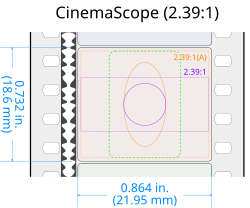
For even wider views, anamorphic processes were used to squeeze a wide image into a standard frame, which was then unsqueezed during projection. The CinemaScope format, with an aspect ratio of 2.39:1, became a hallmark of large-scale productions.
Specialized Formats: Super 35 and VistaVision
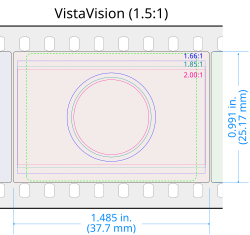
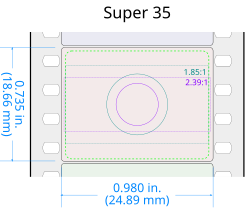
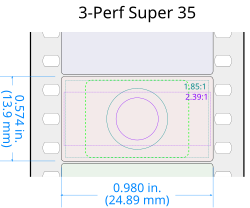
Other formats were designed to maximize the potential of the 35 mm strip. Super 35 utilizes more of the available film area, providing more flexibility for cropping. Meanwhile, VistaVision, created by Paramount in 1954, ran the film horizontally through the camera. By using eight perforations per frame instead of four, it produced a much finer-grained, high-detail negative.
Technical Components: Perforations and Audio
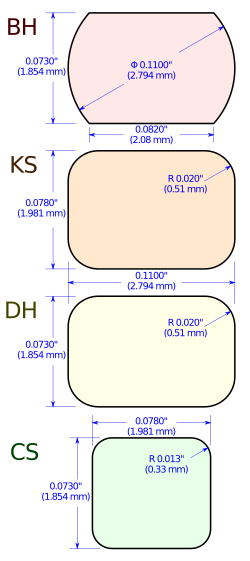
The physical movement of film through a camera or projector relies on perforations (sprocket holes). Originally round, these were replaced by the Bell & Howell (BH) perforation, which features straight top and bottom edges to prevent wear and deformation. The BH1866 is the modern standard for negative films.
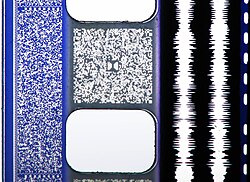
As sound became integrated into film, the space between the perforations and the image was utilized for sound-on-film technology. Modern prints can even carry multiple audio tracks, including digital signals like SDDS, Dolby Digital, and DTS time codes, all on a single strip of 35 mm film.
Modern 3D Systems
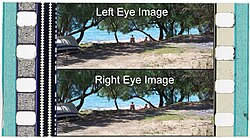
In the 21st century, the demand for 3D experiences led to the development of 3D systems compatible with standard 35 mm projectors. These systems often use "over-under" prints, where the left and right eye images are contained within the normal height of a single 2D frame, allowing for 3D viewing without massive capital investment in digital projection.
Summary of Common 35 mm Formats
| Format | Aspect Ratio | Key Characteristic |
|---|---|---|
| Academy Ratio | 1.375:1 | The historical standard for early sound films. |
| Widescreen (Flat) | 1.85:1 | Commonly used modern non-anamorphic format. |
| CinemaScope | 2.39:1 | Anamorphic widescreen for epic scale. |
| VistaVision | 1.5:1 | Horizontal running for high-detail negatives. |

Frequently Asked Questions
What is the difference between 35 mm film and 135 film?
35 mm film is a gauge specifically used for motion pictures and filmmaking, whereas 135 film refers to the standard gauge used for still photography.
Why was the Bell & Howell perforation created?
The Bell & Howell (BH) perforation was designed to replace original round holes, which were prone to wear and deformation. The BH design features straight edges to ensure more reliable film feeding and longevity.
How does VistaVision differ from standard 35 mm?
Unlike standard 35 mm, which runs vertically through the camera, VistaVision runs the film horizontally. This allows for a larger frame area (eight perforations long), resulting in much higher detail and a finer grain.
What is the "Academy Ratio"?
The Academy Ratio (1.375:1) was a standardized aspect ratio established by the Academy of Motion Picture Arts and Sciences in 1932 to provide a consistent frame size for the industry.
Can 35 mm film be used for 3D movies?
Yes. Modern 3D systems use "over-under" prints where both the left and right eye images are placed within a single standard frame, allowing them to be projected by conventional 35 mm equipment.