Minas Geraes Class: The Dreadnoughts of the Brazilian Navy
At the dawn of the 20th century, the global naval landscape was transformed by the advent of the dreadnought—a new class of battleship characterized by "all-big-gun" armament and high speeds. Brazil, seeking to assert its regional influence and modernize a navy that had fallen into obsolescence, entered this arms race with the ambitious Minas Geraes class. These vessels were not merely ships; they were symbols of national prestige and catalysts for geopolitical tension in South America.
Key Facts
- Lead Ship: Minas Geraes, commissioned in 1910.
- Primary Armament: Twelve 12-inch (305 mm) guns.
- Builders: Armstrong Whitworth and Vickers (United Kingdom).
- Total Cost: Approximately $8,863,842.
- Operational Life: 1910 to 1952.
- Notable Events: Central figures in the 1910 Revolt of the Lash.
The South American Naval Arms Race
The drive for the Minas Geraes class was born from regional rivalry. Following an 1889 revolution and a civil war in 1893, the Brazilian Navy lagged significantly behind its neighbors, Argentina and Chile. Despite Brazil's larger population, the Chilean and Argentine navies possessed superior quality and total tonnage.
While a British-mediated treaty in 1902 had temporarily cooled tensions between Argentina and Chile, Brazil's decision to build massive warships reignited the competition. The original plans for the class were scrapped in 1907 to incorporate the latest dreadnought technology, ensuring Brazil would possess the most powerful ships in the region.
Design and Construction
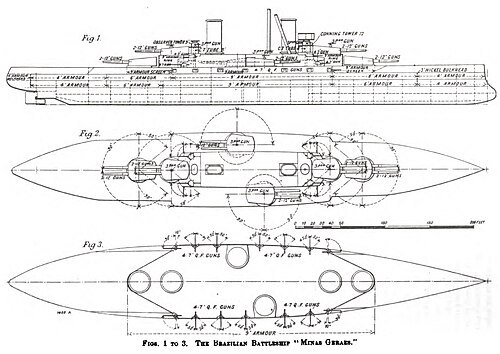
The design, led by J.R. Perrett of the Elswick Ordnance Company, focused on overwhelming firepower. The lead ship, Minas Geraes, was laid down by Armstrong in April 1907, followed shortly by the São Paulo at Vickers. A third ship, the Rio de Janeiro, was planned but eventually canceled as naval technology evolved toward "super-dreadnoughts."
The ships were engineering marvels of their time, though they utilized vertical triple expansion engines rather than the steam turbines becoming common in other contemporary dreadnoughts. This choice, combined with later maintenance neglect, would eventually impact their operational efficiency.
Operational History and the Revolt of the Lash
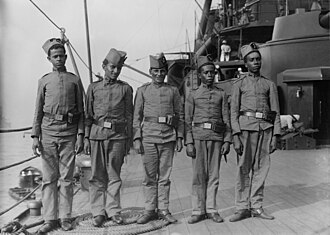
The early years of the Minas Geraes class were marked by political turmoil. Shortly after arriving in Brazil in 1910, the ships became the center of the Revolt of the Lash (Revolta da Chibata). Afro-Brazilian sailors, many of whom were sons of former slaves, rebelled against the continued use of corporal punishment in the navy.
The mutineers seized control of Minas Geraes, São Paulo, and two other vessels. The standoff ended after four days when the Brazilian government passed an amnesty bill, granting freedom to those involved.
Later Service and World War II
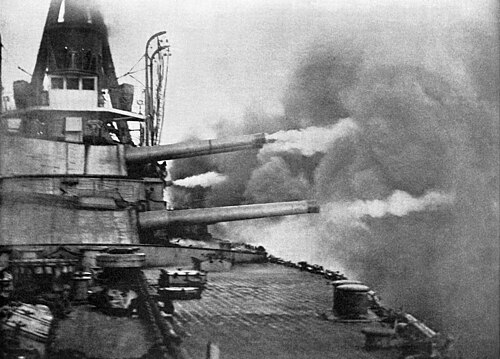
Throughout the 1920s, the ships were used for diplomatic missions and to suppress internal revolts, such as the 1922 uprising at Fort Copacabana. However, by the time World War I broke out, the ships were in poor condition. The United Kingdom declined an offer to use them in the Grand Fleet due to severe maintenance neglect.
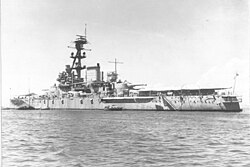
Minas Geraes underwent modernization in the 1930s, but by World War II, both ships were considered too obsolete for active combat. They spent the war serving as harbor defense ships in Salvador and Recife.
Technical Specifications
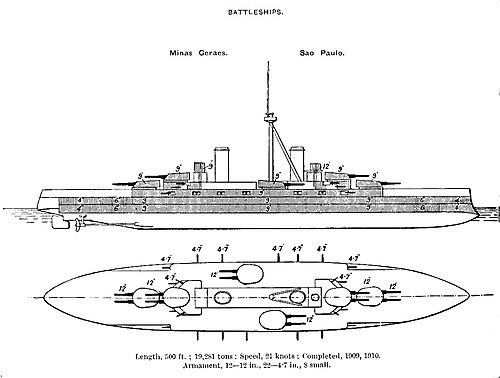
The Minas Geraes class represented a massive investment in naval power. The ships featured a heavy armor belt of Krupp cemented steel and a formidable array of primary and secondary batteries.
| Feature | Specification |
|---|---|
| Normal Displacement | 18,976 long tons |
| Full Load Displacement | 20,900 long tons |
| Length (Overall) | 543 ft (166 m) |
| Top Speed | 21 knots (designed) |
| Main Armament | 12 × 12-inch (305 mm)/45 cal guns |
| Secondary Armament | 22 × 4.7-inch (120 mm)/50 cal guns |
| Armor Belt | 9 inches (230 mm) |
| Propulsion | 2-shaft Vickers vertical triple expansion |
The End of an Era
The two battleships met very different ends. The São Paulo was decommissioned in 1947 and sold to a British shipbreaker in 1951. Tragically, while being towed to its destination, the tow line snapped during a storm north of the Azores, and the ship was lost at sea.
The Minas Geraes remained in service until 1952. It was sold to an Italian company in 1953 and towed to Genoa in 1954 for scrapping, marking the final chapter of Brazil's early dreadnought era.
Frequently Asked Questions
Why was the Minas Geraes class built?
Brazil built these ships to modernize its navy and maintain regional parity with Argentina and Chile during a period of intense naval competition in South America.
What was the Revolt of the Lash?
It was a 1910 mutiny led by Afro-Brazilian sailors on the Minas Geraes and other ships who were protesting the use of brutal corporal punishment (flogging) in the Brazilian Navy.
Did these ships fight in the World Wars?
No. During WWI, they were in too poor a condition for the British to accept them into the Grand Fleet. During WWII, they were too obsolete for active combat and served only as harbor defense ships.
What happened to the São Paulo?
After being sold for scrap in 1951, the São Paulo disappeared in a storm north of the Azores when its tow line snapped; it was never recovered.
How did the ships' speed change over time?
While designed for 21 knots, the ships suffered from severe maintenance neglect. By the 1930s, the São Paulo could only reach 10 knots, making further modernization uneconomical.