Dreadnought Battleships: The Revolution of Naval Warfare
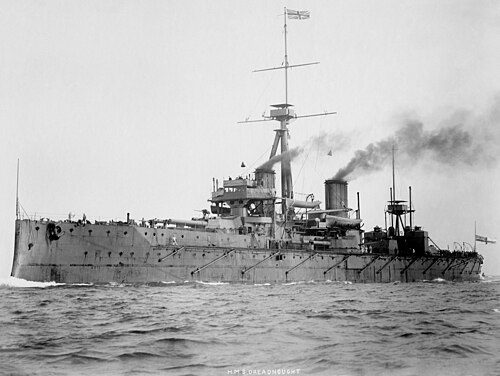
At the dawn of the 20th century, the nature of naval combat underwent a seismic shift. The catalyst was the launch of HMS Dreadnought in 1906 by the British Royal Navy. This single vessel was so revolutionary that it rendered all existing battleships obsolete overnight, dividing naval history into two distinct eras: the pre-dreadnoughts and the dreadnoughts.
The dreadnought was defined by two primary innovations: an "all-big-gun" armament scheme and the use of steam turbine propulsion. These advancements transformed the battleship into a symbol of national prestige and power, sparking an intense naval arms race between the United Kingdom and Germany, as well as smaller competitions in regions like South America.
Key Facts
- Defining Feature: The "all-big-gun" design replaced mixed-calibre batteries with a uniform set of heavy guns.
- Propulsion: Steam turbines provided significantly higher speeds and reliability than older reciprocating engines.
- Super-Dreadnoughts: A second generation of ships that appeared within five years, featuring larger guns and centerline turrets.
- The Peak Conflict: The Battle of Jutland (1916) was the only major clash between large dreadnought fleets.
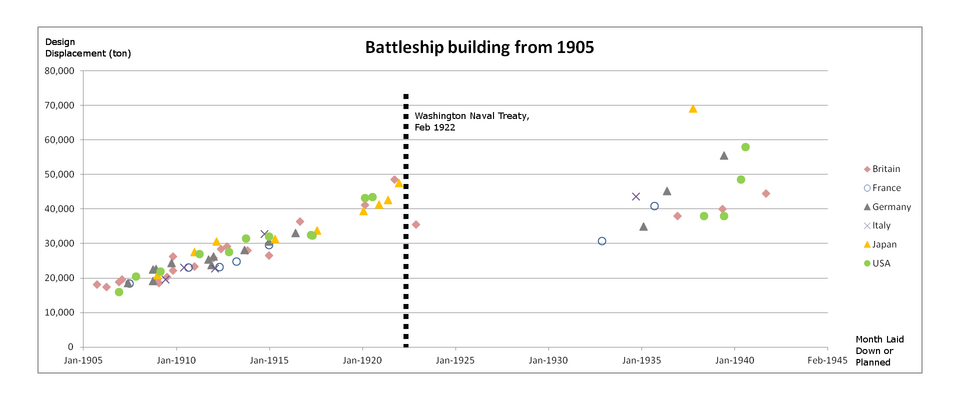
- Treaty Limitations: The Washington Naval Treaty of 1922 limited gun calibres to 16 inches to curb the arms race.
The Origins of the All-Big-Gun Design

To understand the dreadnought, one must first look at the pre-dreadnought. Typical battleships of the 1890s carried a small number of heavy guns (usually four 12-inch guns) and a large battery of quick-firing secondary guns. This design followed the theory that ships would engage at a distance but finish the fight at close range, where fast-firing smaller guns were most effective.
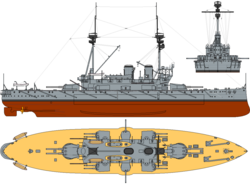
However, the Russo-Japanese War (1904–1905) proved that naval battles were increasingly fought at long distances. The Battle of the Yellow Sea saw ships exchanging fire at over 14,000 yards. This shifted the strategic focus toward long-range gunnery. Naval architects realized that a uniform heavy-calibre armament offered superior firepower and simplified fire control—the process of directing a ship's guns. At long ranges, gunners relied on observing shell splashes to adjust aim; having multiple calibres of guns created confusing, overlapping splashes that made accurate targeting difficult.
The Semi-Dreadnought Transition
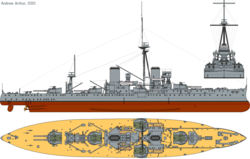
Before the full shift to all-big-gun designs, some navies developed "semi-dreadnoughts" or all-big-gun mixed-calibre ships. These vessels reduced the number of small quick-firing guns and added more heavy secondary guns (typically 9.2 to 10 inches) in wing turrets.
Engineering the Dreadnought
Armament and Calibre
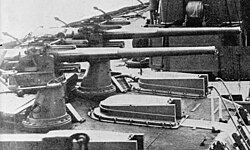
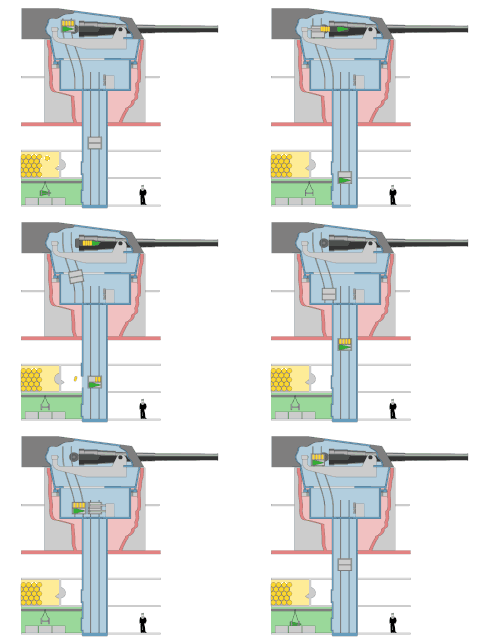
Different nations adopted different philosophies regarding gun size. The German Navy often used smaller calibres (such as 12-inch guns) compared to the British standard of 13.5 inches. However, superior German metallurgy allowed their smaller guns to achieve comparable muzzle velocity and shell weight, while allowing the ships to carry thicker armour.
As the era progressed, gun sizes grew. The British Orion class introduced 13.5-inch guns, and the Queen Elizabeth class moved to 15-inch guns. Eventually, the Japanese Nagato class and US Colorado class pushed the limit to 16.1 inches (410 mm).
Protection and Propulsion
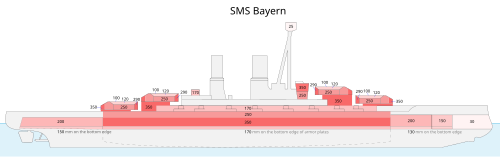
Dreadnoughts utilized a central citadel protection scheme, where the most vital areas—the magazines, engine spaces, and turrets—were encased in the thickest armour, with protection tapering off in less critical areas.
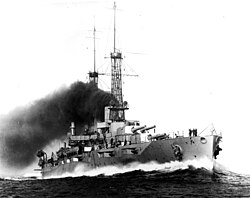
Propulsion also evolved rapidly. While early designs used triple-expansion steam engines, the dreadnought revolution championed the steam turbine. The US Navy transitioned slowly, with some ships like the USS Oklahoma retaining reciprocating engines while others, like the USS Nevada, adopted geared turbines.
The Rise of the Super-Dreadnought
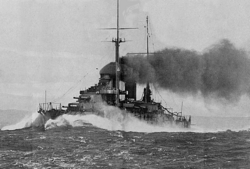
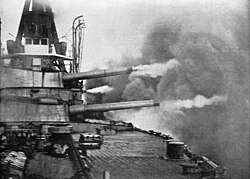
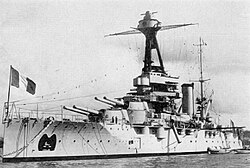
The rapid pace of innovation meant that the original HMS Dreadnought was outclassed within five years. The resulting "super-dreadnoughts" featured massive increases in displacement and firepower. The British Orion class, for example, placed all main guns on the centerline, allowing turrets to "superfire" (fire over one another), which doubled the weight of the broadside—the total weight of ammunition fired on a single bearing.
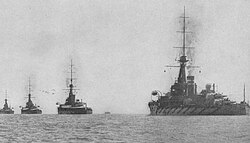
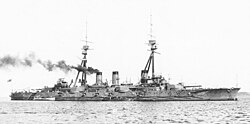
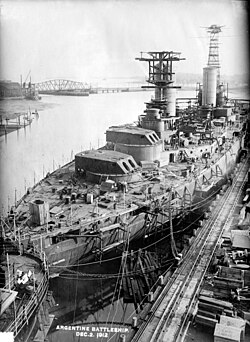
This trend sparked global competition. The US New York class adopted 14-inch guns, and Japan's Fusō and Ise classes followed suit. Even South American nations entered the race, with Brazil, Argentina, and Chile ordering powerful super-dreadnoughts to assert regional dominance.
The End of the Dreadnought Era
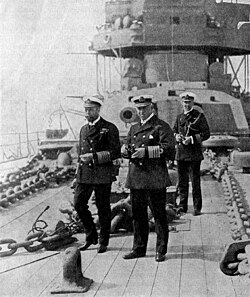
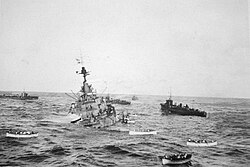
Despite the massive resources poured into these ships, they rarely fought in large numbers. The Battle of Jutland in 1916 was the definitive clash of the era, though it ended without a decisive victory. Following World War I, the Washington Naval Treaty of 1922 sought to prevent further arms races by limiting the number and size of battleships.
Most original dreadnoughts were scrapped under the treaty. However, the newer super-dreadnoughts remained viable and continued to serve through World War II. The final evolution of the type occurred after the treaty expired, culminating in the Japanese Yamato class, which carried the largest guns ever fitted to a warship: 18-inch (460 mm) main guns.
![USS Texas, the only dreadnought still in existence,[1] was launched in 1912 and is now a museum ship.](/images/28/0e/280e9a4447a3daa4d863a92816e8f5c293035dfedf62f3610d5d8de31c6491d5.jpg)
| Feature | Pre-Dreadnought | Dreadnought | Super-Dreadnought |
|---|---|---|---|
| Armament | Mixed (Few heavy, many light) | All-big-gun (Uniform heavy) | Larger calibre, Centerline layout |
| Propulsion | Reciprocating Steam | Steam Turbines | Advanced Turbines / Oil-fired |
| Tactics | Close-range decisive blows | Long-range engagement | Maximum broadside weight |
| Example | HMS Agamemnon | HMS Dreadnought | HMS Orion / USS New York |
Frequently Asked Questions
Why was HMS Dreadnought considered so revolutionary?
It combined an "all-big-gun" armament with steam turbine propulsion, making it faster and more powerful than any existing battleship and rendering previous designs obsolete.
What is the difference between a dreadnought and a super-dreadnought?
Super-dreadnoughts were a second generation of ships with larger gun calibres, increased displacement, and a centerline turret arrangement that allowed for a heavier broadside.
What was the purpose of the Washington Naval Treaty?
The treaty was designed to prevent a costly and dangerous naval arms race by limiting the total tonnage of battleships and capping gun calibres at 16 inches.
How did fire control influence the design of these ships?
Using a uniform calibre of guns made it easier for spotters to identify shell splashes at long ranges, allowing for more accurate adjustments to the guns' aim.
Which dreadnought is still available to see today?
The USS Texas, launched in 1912, is the only dreadnought still in existence and currently serves as a museum ship.