Military Desertion: Legal Definitions, Global History, and Consequences
In the context of military service, the act of leaving one's post is a grave matter of discipline and law. While often used interchangeably in casual conversation, there are critical legal distinctions between simply being late or absent and the act of desertion. At its core, desertion is the abandonment of military duty or a post without permission—such as a pass, liberty, or leave—carried out with the specific intention of not returning.
This differs from unauthorized absence (UA) or being absence without leave (AWOL), which are generally viewed as temporary absences. Understanding these nuances is essential to understanding how different nations have managed their forces during times of peace and extreme conflict.
Key Facts
- Intent is Key: Desertion is defined by the intent to permanently avoid hazardous duty or shirk contractual obligations, rather than just the duration of absence.
- Global Variation: Penalties range from imprisonment and public humiliation to the death penalty, depending on the era and country.
- Mass Desertion: Some conflicts, such as the Soviet-Afghan War and the Russian invasion of Ukraine, have seen tens of thousands of soldiers abandon their posts.
- Legal Thresholds: In the U.S. military, personnel are typically dropped from unit rolls and listed as deserters after 30 days of unauthorized absence.
Desertion versus Absence Without Leave (AWOL)

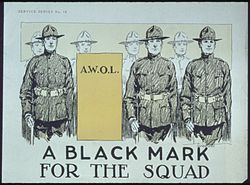
Across the armed forces of the United States, United Kingdom, Canada, Australia, New Zealand, and Singapore, personnel are classified as AWOL if they are absent from their post without a valid pass or leave. In the U.S. Navy, Marine Corps, and Coast Guard, this is more commonly termed "unauthorized absence."
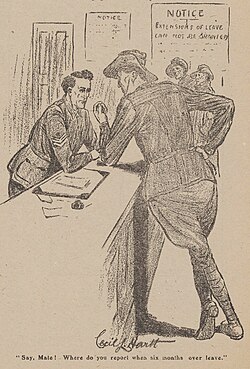
While a 30-day window is often used as a trigger to list a soldier as a deserter, U.S. military law focuses on the intent. Desertion is legally established if the individual intends to avoid hazardous duty or shirk their professional obligations.
Historical Perspectives by Country
United States
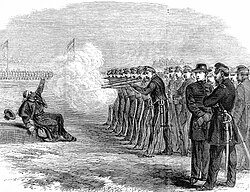
The U.S. has faced desertion challenges throughout its history. During the War of 1812, the desertion rate was 12.7%, partly driven by soldiers leaving units to re-enlist elsewhere to claim higher bonuses. The American Civil War saw massive numbers: approximately 200,000 from the Union Army and over 100,000 from the Confederate Army.
In the 20th century, the U.S. Expeditionary Forces convicted 2,657 soldiers of desertion during World War I, though President Woodrow Wilson commuted the death sentences of those condemned. More recently, the Iraq War saw a spike in desertions; the Pentagon reported over 5,500 personnel deserted between 2003 and 2004, with the vast majority occurring within the U.S. rather than in the combat zone.
Russia and the Soviet Union
The Soviet Union employed some of the most brutal measures to prevent desertion. During World War II, Joseph Stalin's Order No. 270 mandated that deserters be shot on the spot, and Order No. 227 established "blocking detachments" to shoot troops fleeing in panic. This resulted in 158,000 executions.
During the Soviet-Afghan War, the army struggled with disillusionment and the inability to distinguish civilians from the mujahideen. In the modern era, during the 2022 mobilization, Russia updated its Criminal Code to punish desertion with up to 10 years in prison. Leaked documents suggest over 50,000 Russian soldiers deserted during the invasion of Ukraine, primarily in 2023 and 2024.
Germany and France
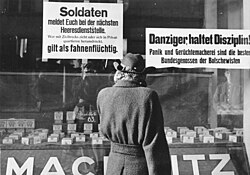
Germany's approach varied wildly between the World Wars. Only 18 deserters were executed in WWI, but 15,000 were executed from the Wehrmacht during WWII. France, meanwhile, executed between 600 and 650 soldiers for desertion during WWI, though a 2013 report recommended their pardon.
Italy and Ireland
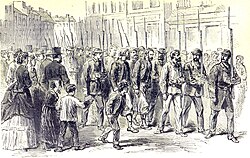
Italy experienced significant desertion during the Napoleonic Wars (40,000 soldiers) and WWI (128,000 cases), with 750 executions in the latter. Ireland, while neutral in WWII, saw about 7,000 of its 60,000 army personnel desert between 1940 and 1945, with many joining the British Army to fight the Axis powers.

Summary of Desertion Statistics and Penalties
| Country/Era | Approx. Deserters/Cases | Notable Penalties/Outcomes |
|---|---|---|
| Soviet Union (WWII) | 158,000 executed | Immediate execution via blocking detachments |
| Germany (WWII) | 15,000 executed | Death penalty for Wehrmacht deserters |
| USA (Civil War) | 300,000+ (Combined) | Flogging, tattoos, and branding |
| Italy (WWI) | 128,000 cases | Life sentences; 750 executions |
| UK (WWII) | ~100,000 (AWOL/Desertion) | Imprisonment (Death penalty abolished 1930) |
| Somalia (2007-2009) | 15,000 (80% of force) | Mass collapse of TFG military structure |
Penalties and Legal Evolution
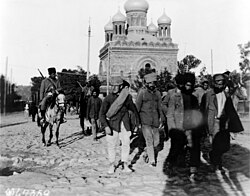
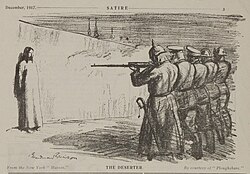
Historically, penalties for desertion were designed to be deterrents through physical pain or death. In the U.S., flogging was common before the Civil War, followed by branding and tattooing. While the death penalty remains the maximum legal penalty for wartime desertion in the U.S., it has not been applied since the execution of Eddie Slovik in 1945.
In the modern era, most Western nations have shifted toward imprisonment. For example, since September 11, 2001, no U.S. service member has received more than 24 months of imprisonment for desertion.
Frequently Asked Questions
What is the main difference between AWOL and desertion?
AWOL (Absence Without Leave) is generally a temporary absence from a post. Desertion is the abandonment of duty with the specific intent of never returning or to avoid hazardous duty.
Can a soldier be executed for desertion today?
While the death penalty remains a legal possibility in some nations' military codes during wartime (including the U.S.), it is rarely, if ever, applied in modern Western militaries. However, some countries still maintain severe prison sentences.
Why did so many soldiers desert during the Soviet-Afghan War?
Desertion was driven by disillusionment, the difficulty of distinguishing civilians from combatants, and the inefficiency of modern Soviet tanks in mountainous terrain, which left soldiers feeling exposed and unsupported.
How did the U.S. handle desertion during the American Civil War?
Both the Union and Confederacy struggled with high desertion rates. Penalties during this era evolved from flogging to include branding and tattoos to mark the deserter.
What happened to deserters in the UK during World War II?
Because the UK abolished capital punishment for desertion in 1930, most of the approximately 100,000 troops who went AWOL or deserted were sentenced to imprisonment rather than death.