Mary, Queen of Scots: The Tragic Life of a Rival Monarch
Mary Stuart, known to history as Mary, Queen of Scots, remains one of the most polarizing and tragic figures in British history. Born into the House of Stuart, her life was a whirlwind of royal prestige, political intrigue, and profound personal loss. From her birth as a child-queen to her eventual execution in England, Mary's journey was defined by her struggle to maintain power amidst religious upheaval and familial rivalry.
Her life was not merely a personal struggle but a geopolitical chess match involving the great powers of Scotland, France, and England. As a Roman Catholic in an increasingly Protestant world, Mary became a symbol of religious conflict and a constant threat to the stability of the English throne.
![Both Mary and her father King James V were born at Linlithgow Palace in West Lothian, Scotland.[2]](/images/36/b6/36b675c402b4f69cba09de5d147a42677dace80035a861754bc02c4b491e3ae1.jpg)
Key Facts
- Full Name: Mary Stuart (also known as Mary I of Scotland).
- Reign: Queen of Scotland from December 14, 1542, to July 24, 1567.
- French Tenure: Queen consort of France from July 10, 1559, to December 5, 1560.
- Family: Daughter of James V of Scotland and Mary of Guise.
- Issue: Mother of James VI of Scotland and I of England.
- Death: Executed on February 8, 1587, at Fotheringhay Castle.
Early Life and the French Connection
Mary was born on December 8, 1542, at Linlithgow Palace. She ascended to the Scottish throne just days after her birth, following the death of her father, James V. Because she was an infant, her early reign was managed by regents, including James Hamilton, 2nd Earl of Arran, and later her mother, Mary of Guise.
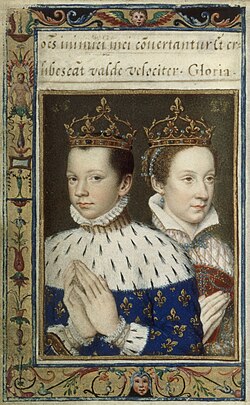
To secure a strategic alliance, Mary was sent to France, where she was raised in the French court. This period of her life was marked by high culture and political education. In 1559, she married Francis II of France, becoming the Queen consort. This union briefly placed the House of Stuart at the heart of European power.
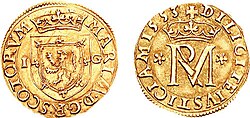
Despite her status, the death of Francis II in 1560 left Mary a widow at a young age. She returned to Scotland as a Catholic monarch in a country increasingly dominated by the Protestant Reformation, setting the stage for years of internal conflict.
The Struggle for the Scottish Throne
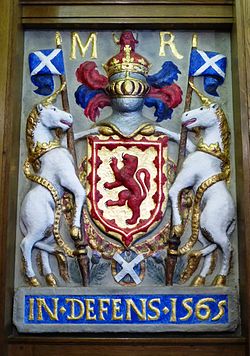
Upon her return, Mary faced the daunting task of ruling a divided nation. Her claim to the English throne—based on her descent from the Tudors—made her a focal point for those who opposed Elizabeth I of England. This claim was visually represented in the royal heraldry of the time, which often quartered the arms of Scotland and England.
![Coat of arms sent from France in July 1559.[48] Sinister: Mary's arms as Queen of Scotland quartered with the arms of England, reflecting her claim to the English throne. Dexter: Francis's arms as Dauphin of France and king consort of Scotland, with an inescutcheon of England.](/images/05/e9/05e9466258275900abcf7d9673b6c2579281c7fb417f4534a75e7f679f464225.webp)
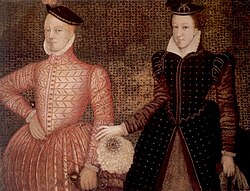
Mary's personal life further complicated her political standing. She entered into a controversial marriage with her cousin, Henry Stuart, Lord Darnley. The marriage was intended to strengthen her claim to the English throne but quickly deteriorated into mutual distrust and hostility.
The Murder of Lord Darnley
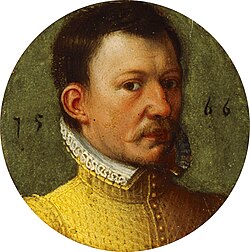
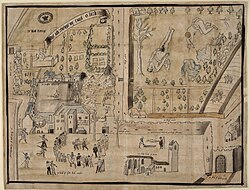
The stability of Mary's reign collapsed following the murder of Lord Darnley in 1567. The explosion at Kirk o' Field, where Darnley was staying, left the nobility suspicious and the public outraged. Mary's subsequent marriage to James Hepburn, 4th Earl of Bothwell—who was heavily implicated in the murder—proved to be a fatal political error.
Abdication and Captivity
The backlash against her marriage to Bothwell led to a rebellion. Mary was imprisoned and forced to abdicate the throne on July 24, 1567, in favor of her infant son, James VI. Though she managed a daring escape from her captors, she sought refuge in England, believing her cousin Elizabeth I would protect her.
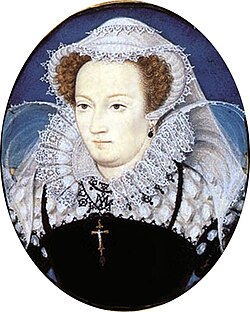
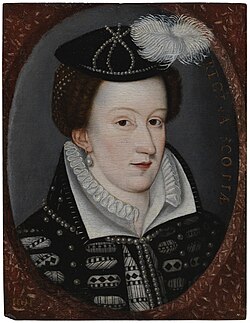
Instead, Elizabeth viewed Mary as a threat. Mary spent the next nineteen years in various states of house arrest and imprisonment. During this time, she became known as La Reine Blanche (the White Queen) due to the mourning clothes she wore following the death of her husband.
![Mary's all-white mourning garb earned her the sobriquet La Reine Blanche ("the White Queen").[59] Portrait by François Clouet, 1560.](/images/62/5e/625e38b15668826ce6a4029726bd5f3e8e00cb36f133d6ccc1496ad0e15cd519.jpg)
In captivity, Mary turned to embroidery to pass the time, creating intricate works that served as both a hobby and a silent expression of her identity and status.
!["A•CATTE". Embroidery done by Mary in captivity (now in the Royal Collection)[181][182]](/images/b9/f7/b9f75ed1d1bb69cb224903103b0e85cb5e2bb1f97c30647183aeff393d1f4a29.jpg)
Trial and Execution
The long captivity ended when evidence emerged linking Mary to plots to assassinate Elizabeth I. Central to the prosecution were the Casket Letters, a series of documents allegedly written by Mary that implicated her in the murder of Darnley and her collusion with Bothwell.
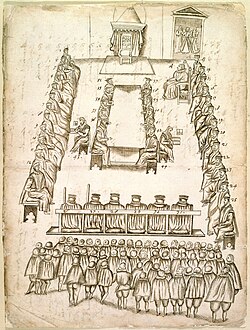
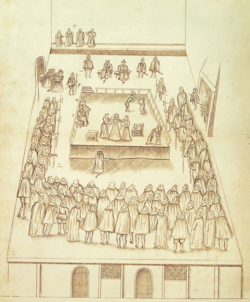
Mary was put on trial between October 14 and 15, 1586, at Fotheringhay Castle. Despite her protests regarding the legality of the trial, she was found guilty of treason and sentenced to death.
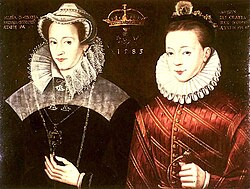
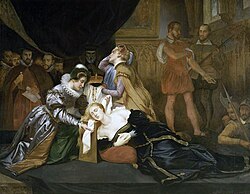
On February 8, 1587, Mary was beheaded. Her death marked the end of a lifelong rivalry between two queens, though her legacy lived on through her son, James VI, who would eventually unite the crowns of Scotland and England.
Summary of Mary Stuart's Life
| Period/Date | Role/Event | Location |
|---|---|---|
| 1542–1567 | Queen of Scotland | Scotland |
| 1559–1560 | Queen Consort of France | France |
| 1567 | Forced Abdication | Scotland |
| 1568–1587 | Imprisonment | England |
| Feb 8, 1587 | Execution | Fotheringhay Castle |
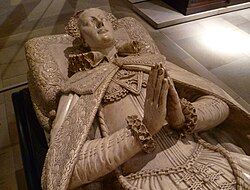
Mary's final resting place is Westminster Abbey, where her effigy stands as a testament to her royal lineage and the turbulent era she inhabited.
Frequently Asked Questions
Why was Mary, Queen of Scots, executed?
Mary was executed after being found guilty of treason. The trial focused on her alleged involvement in plots to assassinate Queen Elizabeth I of England, supported by evidence including the Casket Letters.
Who was the "White Queen"?
The sobriquet La Reine Blanche refers to Mary Stuart, specifically during the period she wore all-white mourning garb following the death of her husband.
What were the Casket Letters?
The Casket Letters were a collection of documents used during Mary's trial to suggest she had conspired with the Earl of Bothwell to murder her second husband, Lord Darnley.
Did Mary ever see her son, James VI, after her abdication?
No. In a tragic turn of events, Mary saw her son for the last time when he was only ten months old; they never met again during her years of imprisonment.
Where is Mary, Queen of Scots buried?
After her execution, she was initially buried in Peterborough Cathedral. In 1612, her remains were moved to Westminster Abbey.