Llamas: History, Characteristics, and the Legacy of South American Camelids
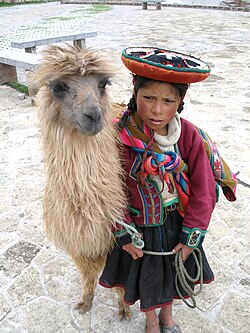
The llama (Lama glama) is a highly social, domesticated mammal renowned for its strength, soft wool, and intelligence. Originating from the rugged landscapes of South America, these animals have served as vital companions to human civilizations for millennia, acting as beasts of burden and sources of fiber. Their name is derived from the native Peruvian Quechua language, a testament to their deep roots in Andean culture.
Beyond their utility, llamas are characterized by their gentle nature and ability to learn simple tasks quickly. Whether guarding livestock or transporting goods across mountain passes, the llama remains one of the most distinctive members of the camelid family.
Key Facts
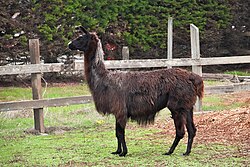
- Scientific Name: Lama glama.
- Wild Ancestor: The guanaco.
- Lifespan: Typically 15 to 25 years, though some exceed 30.
- Load Capacity: Can carry 25% to 30% of their body weight for 8 to 13 km.
- Gestation: Approximately 11.5 months (350 days).
- Social Structure: Highly social animals that live in herds.
Evolution and Classification
While llamas are synonymous with South America today, their ancestors actually originated on the Great Plains of North America approximately 40 million years ago. They migrated south during the Great American Interchange about three million years ago. By the end of the last ice age (10,000–12,000 years ago), camelids had become extinct in North America, though fossil remains of the extinct genus Hemiauchenia have been found in regions such as Texas, Florida, and California.
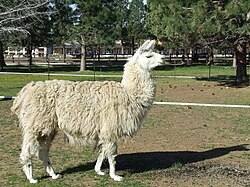
In modern biological classification, llamas belong to the family Camelidae. DNA analysis has clarified the relationships between the four South American camelids: the domesticated llama and alpaca, and the wild guanaco and vicuña. Specifically, the guanaco is the wild ancestor of the llama, while the vicuña is the ancestor of the alpaca.
Comparative Camelid Overview
| Species | Status | Wild Ancestor | Primary Use/Trait |
|---|---|---|---|
| Llama (Lama glama) | Domesticated | Guanaco | Pack animal, guarding |
| Alpaca (Lama pacos) | Domesticated | Vicuña | Fine fiber production |
| Guanaco (Lama guanicoe) | Wild | N/A | Wild ancestor of llama |
| Vicuña (Lama vicugna) | Wild | N/A | Wild ancestor of alpaca |
Physical Characteristics

A full-grown llama typically stands 1.7 to 1.8 meters tall at the head and weighs between 130 and 272 kg. There is a notable difference in weight at maturity between males (averaging 94.74 kg) and females (averaging 102.27 kg). A newborn llama, known as a cria, typically weighs between 9 and 14 kg.
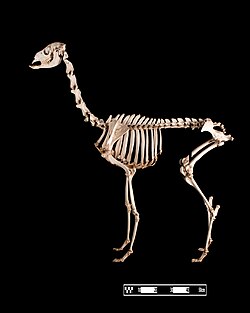
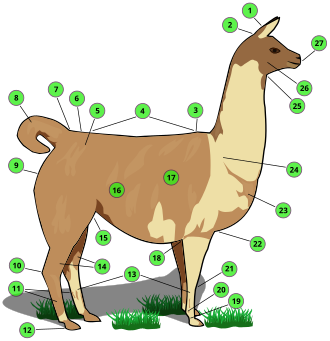
The llama's skeletal structure is specialized for its environment. Their dentition consists of 32 teeth, including specialized incisors and molars similar to those of the genus Camelus. Their vertebral column is composed of 7 cervical, 12 dorsal, 7 lumbar, and 4 sacral vertebrae.
Reproduction and Care
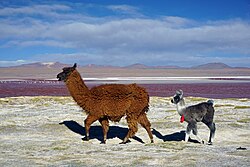
Llamas have a long gestation period of roughly 11.5 months. An interesting biological trait of the dam (female) is her attached tongue, which cannot extend more than 13 millimeters outside the mouth. Because they cannot lick their newborns, dams bond with their cria through nuzzling and humming.
Nutrition and Fiber
Llamas are herbivores with dietary needs that vary by body weight. Common feed sources include bromegrass, alfalfa, and corn silage. Beyond their utility as workers, llamas are valued for their fiber. Llama wool is soft and contains very little lanolin (a natural wax found in sheep wool), making it highly desirable for textiles.

Behavior and Utility
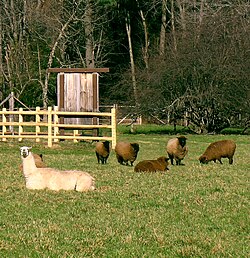
Llamas are naturally social and thrive in herds. One of their most unique behavioral applications is as guard llamas. Due to their protective instincts, they are often placed with flocks of sheep to deter predators like coyotes.
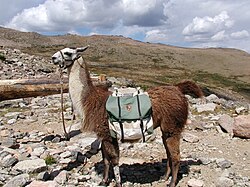
Historically, llamas were indispensable to the Inca Empire and pre-Incan cultures. During the Spanish conquest, they were used extensively to transport ore from mountain mines; in the Potosí mines alone, an estimated 300,000 llamas were employed. However, the introduction of European livestock—such as horses, mules, and donkeys—eventually diminished their role as primary beasts of burden.
Llamas in the Modern Era
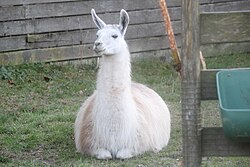
Llamas were introduced to the United States in the late 1800s, primarily for zoos. A surge of interest in the 1970s and 80s led to a speculative agricultural bubble, where prices for breeding stock skyrocketed, with some animals selling for as much as $220,000 by 2002. This bubble burst due to a lack of end-markets for meat or fiber, leading to a significant decline in the US llama population by 2017.
Cultural Significance
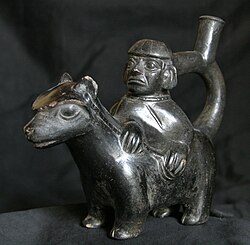
The llama has long been a symbol of Andean identity, appearing in ancient Moche and Chancay sculptures. These artworks often capture the animal's natural inquisitiveness and its central role in the spiritual and economic life of early South American civilizations.
![This sculpture, originating from the Chancay Valley and adjacent Chillón Drainage region (Late Intermediate Period), captures the llama's natural inquisitiveness.[48] The Walters Art Museum.](/images/5d/ac/5dac440d57648c270f12a74f7a95cba379d314853bf4e92d1be568cb74c0df91.jpg)
Frequently Asked Questions
What is the difference between a llama and an alpaca?
Llamas are generally larger and were historically bred as pack animals, whereas alpacas are smaller and bred primarily for their finer fiber. They have different wild ancestors: the guanaco for the llama and the vicuña for the alpaca.
How much can a llama carry?
A healthy llama can carry approximately 25% to 30% of its own body weight over distances ranging from 8 to 13 kilometers (5 to 8 miles).
Why are llamas used to guard sheep?
Llamas possess a natural protective instinct and social behavior that makes them effective at deterring predators, such as coyotes, from attacking smaller livestock.
Do llamas lick their babies?
No, female llamas cannot lick their newborns because their tongues are attached in a way that prevents them from extending more than 13 millimeters outside the mouth. Instead, they bond with their cria through humming and nuzzling.
Where did llamas originally come from?
Although they are native to South America today, the ancestors of llamas originated on the Great Plains of North America about 40 million years ago before migrating south.