Livestock Production: History, Economic Role, and Environmental Impact
Livestock refers to domesticated animals raised in agricultural settings to provide labor and a diverse range of products for human consumption. These products include meat, eggs, milk, fur, leather, and wool. While the term is sometimes used specifically for animals raised for food, it can also refer broadly to farmed ruminants—animals like cattle, sheep, and goats that have a specialized digestive system.
The practice of animal husbandry—the breeding, maintenance, slaughter, and general management of livestock—is a cornerstone of modern agriculture. This practice has been integral to human civilization since the transition from hunter-gatherer lifestyles to settled farming. Today, livestock continue to play vital economic and cultural roles in communities worldwide.
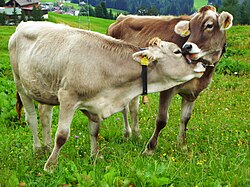
Cows on a pasture in Austria
Key Facts
- Livestock provides approximately 39% of the global protein supply.
- Animal husbandry is responsible for 20% to 33% of global freshwater usage.
- Livestock and their feed production occupy about one-third of Earth's ice-free land.
- Enteric methane from livestock accounts for 30% of the planet's overall methane emissions.
- The term "livestock" originated between 1650 and 1660 as a compound of "live" and "stock."
The History of Domestication
The history of livestock is a timeline of human evolution and settlement. Domestication occurred in various waves across different continents:
- Dogs: Appearing in Europe and the Far East approximately 15,000 years ago.
- Cattle: Domesticated roughly 10,500 years ago.
- Sheep and Goats: Domesticated in Southwest Asia between 11,000 and 5,000 years ago.
- Pigs: Domesticated by 8,500 BC in the Near East and 6,000 BC in China.
- Chickens: Likely domesticated around 7,000 BC.
- Horses: Domestication dates to approximately 4,000 BC.
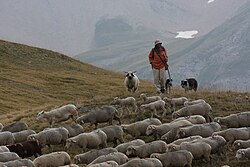
Sheep in Écrins National Park (France)
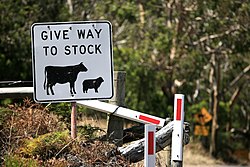
This Australian road sign uses the less common term "stock" for livestock.
Diverse Types of Livestock and Their Uses
Livestock species vary significantly in their ancestry and the specific ways humans utilize them. Some animals are primarily used for food, while others provide essential labor or materials.
| Animal | Ancestor | Primary Utilization |
|---|---|---|
| Cow | Eurasian aurochs | Meat, milk, and draught |
| Sheep | Mouflon | Meat and fleece |
| Goat | Bezoar ibex | Meat and milk |
| Pig | Wild boar | Meat and companionship |
| Chicken | Red junglefowl | Meat and egg |
| Horse | Tarpan | Riding, racing, and pulling loads |
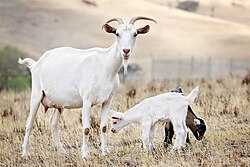
Goat family with one-week-old kid
Economic and Social Benefits
Beyond food, livestock provide essential non-food products such as leather, pharmaceuticals, bone products, and industrial fats. In many regions, animal manure is a critical resource, used as fertilizer to maintain soil fertility or, in some areas, as a direct fuel source. In regions where machine power is limited, draft stock—animals used for pulling heavy loads—are essential for tillage and the transport of goods and people.

Farrowing site in a natural cave in northern Spain
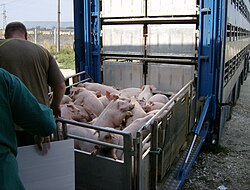
Pigs being loaded into their transport
Environmental Impact and Climate Change
Modern agriculture has seen a significant shift toward intensive animal farming. While this increases commercial yields, it also presents challenges for animal welfare, public health, and the environment. Livestock production is a major contributor to habitat destruction; for instance, animal husbandry is responsible for up to 91% of deforestation in the Amazon region.
The environmental footprint of livestock is also reflected in greenhouse gas emissions. Cattle produce an estimated 79 million tons of methane per day. Furthermore, livestock are responsible for 34% of all human-related nitrous oxide emissions through manure and feed production. These factors contribute to the current sixth mass extinction by driving species loss through habitat conversion and the targeting of predators.
![Biomass distribution of humans, livestock, and other animals[41]](/images/b8/a2/b8a220726a30eacb23e5643b94b21aeb8b49de0bd28268d90235257467d71567.webp)
Biomass distribution of humans, livestock, and other animals[41]
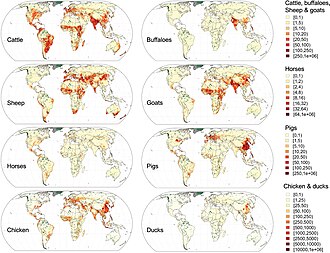
Global distribution data for cattle, buffaloes, horses, sheep, goats, pigs, chickens and ducks in 2010
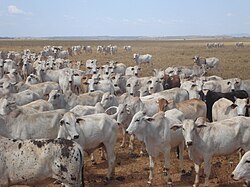
Livestock production requires large areas of land.
Climate change presents a dual challenge: livestock production is a driver of global warming, yet the industry is also highly vulnerable to its effects. Proposed adaptations include improved cooling in shelters and changes in animal feed, though these can be costly. Global net-zero transition plans often involve discussions regarding limits on total livestock headcounts to meet temperature targets.
![A map of countries considered most and least vulnerable to adverse impacts of climate change on their grazing livestock[73]](/images/08/a5/08a5163e31a5f5354f0902e600875c0cb7c03fcf2442da36dd118184c669f4be.jpg)
A map of countries considered most and least vulnerable to adverse impacts of climate change on their grazing livestock[73]
![Multi-faceted impacts of climate change on livestock[74]](/images/2a/23/2a231c4c76f23bf3abcacef5ae6c43333a253cc8da14b344029694dbea38b4d8.jpg)
Multi-faceted impacts of climate change on livestock[74]
Frequently Asked Questions
What is the difference between livestock and cattle?
Historically, the terms were used interchangeably. However, in modern usage, "cattle" refers specifically to domesticated bovines, while "livestock" is a broader term encompassing various domesticated animals like sheep, pigs, and goats.
How does livestock production affect the environment?
Livestock production impacts the environment through significant freshwater usage, land occupation for grazing and feed, and the emission of greenhouse gases like methane and nitrous oxide. It is also a driver of deforestation and habitat loss.
What are the primary products derived from livestock?
Livestock provide a wide array of products, including meat, milk, eggs, wool, leather, fur, and even industrial proteins and bone products.
What is animal husbandry?
Animal husbandry is the branch of agriculture concerned with the breeding, care, and management of domesticated animals.
How does climate change impact livestock?
Climate change can affect animal health and productivity. Adaptations such as improved shelter cooling and dietary changes are being explored to mitigate these impacts, though they face economic and practical challenges.