Lebanese Sunni Muslims: History, Demographics, and Political Influence
The Lebanese Sunni Muslims represent one of the largest religious denominations in Lebanon, sharing this status with the Shia community. With a history spanning over a millennium, the Sunni community is deeply integrated into the social, political, and geographic fabric of the nation. Speaking Lebanese Arabic, this group plays a pivotal role in the country's complex power-sharing system.
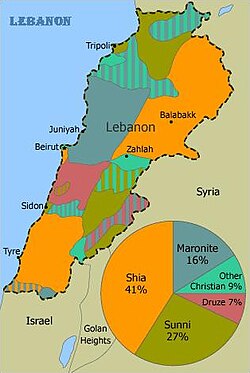
According to a 2018 CIA study, Sunni Muslims constitute approximately 30.6% of the total population. Their influence is most visible in the administrative and political spheres, where traditional agreements have historically designated them as the sole eligible group for the office of the Prime Minister.
Key Facts
- Population: Estimated at 30.6% to 31.9% of the Lebanese population.
- Political Role: Traditionally hold the position of Prime Minister under the National Pact.
- Major Hubs: Highly concentrated in Beirut, Tripoli, Sidon, and the Akkar region.
- International Ties: Maintain strong financial and political links with Saudi Arabia.
- Genetic Markers: High prevalence of haplogroup J-M267, common in the Arabian Peninsula and the Levant.
Historical Evolution
Ottoman Rule and the French Mandate
During the Ottoman era, Sunnis were part of the imperial majority. However, the geopolitical landscape shifted in 1920 when France established "Greater Lebanon." By extending the borders to include predominantly Muslim areas, the French mandate altered the demographics; while the Sunni population increased eightfold, they became a minority in a state dominated by Maronite Christians.
This transition created significant tension. Many Sunnis viewed Greater Lebanon as an artificial entity and advocated for reunification with Greater Syria and the broader Arab homeland, contrasting with the Christian preference for a European-oriented state separate from Syria.
The Lebanese Civil War and the Taif Agreement
The 1975 outbreak of the Lebanese Civil War saw Sunni militias, including the Lebanese National Movement (LNM) and the Palestine Liberation Organization (PLO), clash with Maronite forces and the Lebanese Army. The conflict was fueled by ideologies of leftism and Pan-Arabism, which found strong support within the Sunni community.
The war concluded with the Taif Agreement in October 1989. This landmark accord restructured the government to provide equal representation for Christians and Muslims, reduced the powers of the Maronite president, and transferred significant authority to the Sunni prime minister.
Regional and International Relations
Saudi Arabia and the Salafi Movement
Lebanese Sunnis maintain close ties with Saudi Arabia, which provides substantial financial support. This relationship is reflected in public opinion; a 2016 poll indicated that 82% of Lebanese Sunnis view Saudi Arabia favorably. Tripoli, a major Sunni stronghold, is also the birthplace of the local Salafi movement.
Syria and the Alawite Conflict
Historically, Lebanese Sunnis sought integration with Syria. However, relations were strained by the rise of the Assad family—members of the Alawite sect—who took power in Syria in 1970. The tension between Sunnis and Alawites dates back centuries to the Ottoman era.
In December 2024, the fall of the Assad regime sparked widespread celebrations in Beirut and Tripoli. Many Lebanese Sunnis share views with the new Syrian government under Ahmed al-Sharaa, particularly in their opposition to the "Axis of Resistance" and Hezbollah.
Opposition to Iran and Hezbollah
There is widespread hostility toward Iran, which is viewed as a destabilizing force. Polling from 2012 showed that 95% of Lebanese Sunnis hold a negative view of Iran. Similarly, Hezbollah is viewed as an untrustworthy sectarian force. This animosity intensified after the 2005 assassination of former Prime Minister Rafik Hariri, for which Hezbollah was blamed, and further deepened during Hezbollah's intervention in the Syrian civil war.
Demographics and Geographic Distribution
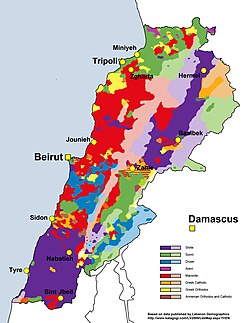
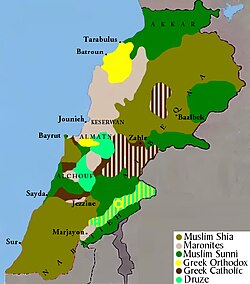
Sunni Muslims are primarily concentrated in West Beirut, Tripoli, and Sidon. They also have a strong presence in the Akkar and Minnieh Dinnieh districts of North Lebanon, the Western Beqaa, the Chouf district, and the city of Arsal in the Northeastern Beqaa Valley.
Population estimates have fluctuated over the decades due to the absence of a formal census since 1932. Recent data suggests a steady presence, with the 2023 CIA World Factbook estimating their share at 31.9%.
| Governorate | Population | Percentage of Sunni Total |
|---|---|---|
| North Governorate | 333,184 | 29.29% |
| Beirut Governorate | 231,695 | 20.37% |
| Akkar Governorate | 202,146 | 17.77% |
| Beqaa Governorate | 124,952 | 10.98% |
| Mount Lebanon Governorate | 78,383 | 6.89% |
| South Governorate | 79,501 | 6.99% |
| Baalbek-Hermel Governorate | 48,328 | 4.25% |
| Nabatieh Governorate | 36,877 | 3.24% |
| Keserwan-Jbeil Governorate | 2,499 | 0.22% |
Genetics and Ancestry
DNA research indicates that 27.7% of Lebanese Muslims belong to the Y-DNA haplogroup J-M267. While frequent in the Arabian Peninsula, this marker has been present in the Levant since the Bronze Age. Interestingly, only 4.7% of Lebanese Muslims carry haplogroup R1b (compared to 9.6% of Christians), suggesting minimal genetic influence from the Crusaders.
Additionally, haplogroup J2 is found in 27% of the population regardless of religion, signaling pre-Arab ancestry, including the Phoenicians. These findings suggest that there are no significant genetic differences between the Muslim and non-Muslim populations of Lebanon.
Notable Figures
- Politics: Riad Al Solh (first Prime Minister), Rafik Hariri, and Najib Mikati.
- Arts: Singers Walid Toufic, Wael Jassar, and the late Suzanne Tamim.
- Intellectuals: Feminist author Anbara Salam Khalidi and journalist Nahla Chahal.
- Business: Saudi-Lebanese businessman Al-Waleed bin Talal.
Frequently Asked Questions
Which political office is traditionally reserved for Sunni Muslims in Lebanon?
Under the unwritten National Pact, the position of Prime Minister is traditionally held by a Sunni Muslim.
Where are the highest concentrations of Sunni Muslims located in Lebanon?
They are most concentrated in the capital city of Beirut (specifically West Beirut), Tripoli, Sidon, and the Akkar region.
How did the Taif Agreement affect the Sunni community?
The Taif Agreement ended the Lebanese Civil War by providing equal representation for Christians and Muslims in parliament and increasing the executive powers of the Sunni prime minister.
What is the relationship between Lebanese Sunnis and Saudi Arabia?
The community maintains very close ties with Saudi Arabia, which provides financial support and shares strong political and religious alignments.
Why is there tension between Lebanese Sunnis and Hezbollah?
Tensions are driven by sectarian differences, Hezbollah's alliance with Iran, and the 2005 assassination of former Prime Minister Rafik Hariri, which many Sunnis attribute to Hezbollah.