HL-10 Lifting Body: NASA's Revolutionary Flight Technology Demonstrator
In the mid-1960s, NASA embarked on a critical mission to understand how a vehicle could safely maneuver and land during reentry from space without traditional wings. The solution was the lifting body—a design where the fuselage itself generates lift. Among the most successful of these experimental craft was the Northrop HL-10, a heavyweight technology demonstrator that pushed the boundaries of supersonic flight and high-altitude research.
Built by the Northrop Corporation, the HL-10 was designed by the Langley Research Center to evaluate the "inverted airfoil" lifting body and delta planform. This research was vital for developing the landing capabilities required for future spacecraft, including the early concepts of the Space Shuttle program.
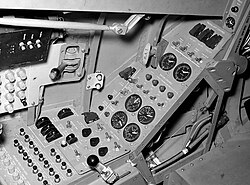
Key Facts
- Manufacturer: Northrop
- Primary User: NASA
- First Flight: December 22, 1966
- Highest Altitude: 90,030 feet (27,440 m)
- Fastest Speed: Mach 1.86 (1,228 mph)
- Current Location: NASA Armstrong Flight Research Center
Technical Development and Design
The name "HL-10" carries specific technical meaning: "HL" stands for horizontal landing, while "10" identifies it as the tenth design studied by engineers at NASA's Langley Research Center. The construction of the HL-10 and its sibling, the Northrop M2-F2, was part of a $1.8 million contract.
The vehicle featured several specialized systems to manage the unique challenges of unpowered and powered flight:
- Landing Gear: The main gear was a modified T-38 system, while the nose gear was a modified T-39 unit; both were retracted manually and lowered using nitrogen pressure.
- Power Systems: Silver zinc batteries provided electrical power for the flight instruments, radios, cockpit heat, the control system, and the stability augmentation system.
- Rocket Propulsion: An XLR-11 four-chamber rocket engine provided 8,000 lbf of thrust. To assist with the pre-landing flare, four throttleable hydrogen peroxide rockets provided up to 400 lbf of thrust.
- Safety: The pilot ejection system was a modified F-106 unit.
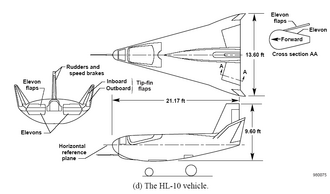
Operational History and Flight Achievements
The HL-10's flight program began with unpowered glide tests. After being dropped from a B-52 launch aircraft at approximately 45,000 feet, the pilot would ignite the XLR-11 engine to increase speed and altitude. Following engine shutdown, the pilot would maneuver through a simulated reentry corridor, using a circular approach to lose altitude before performing a "flare out" maneuver at 100 feet to land on the Rogers Dry Lake bed at Edwards.
Throughout its 37 flights, the HL-10 proved to be the best-handling of the three original heavyweight lifting bodies (the others being the M2-F2/F3 and the X-24 A). It set significant records for the program:
- Speed Record: On February 18, 1970, pilot Peter Hoag reached Mach 1.86.
- Altitude Record: On February 27, 1970, pilot Bill Dana reached 90,030 feet.
Flight Summary Table
| Flight # | Date | Pilot | Max Mach | Max Altitude (m) |
|---|---|---|---|---|
| 1 | Dec 22, 1966 | B. Peterson | 0.693 | 13,716 |
| 10 | Sep 24, 1968 | B. Peterson | 0.682 | 13,716 |
| 17 | May 9, 1969 | J. Manke | 1.127 | 16,246 |
| 34 | Feb 18, 1970 | P. Hoag | 1.861 | 20,516 |
| 35 | Feb 27, 1970 | W. Dana | 1.314 | 27,524 |
The Unrealized Space Flight Proposal
An ambitious proposal once suggested using the HL-10 for actual spaceflight in the early 1970s. Project engineer R. Dale Reed proposed modifying the HL-10 with an ablative heat shield and reaction controls, then launching it atop a Saturn V rocket alongside an Apollo Command Service Module (CSM).
The plan involved a robotic arm in orbit extracting the HL-10 from the rocket's third stage to place it near the crewed Apollo spacecraft. An astronaut would then perform a spacewalk to board the HL-10 for a piloted reentry. While Wernher von Braun reportedly supported the idea, the proposal was ultimately rejected due to the high costs of the Apollo program and the inefficiency of using a Saturn V for such a light payload.
Legacy and Impact
The HL-10 provided invaluable data for the development of the Space Shuttle. While the lifting body shape was eventually passed over for the Shuttle's delta-wing design—largely because it was difficult to fit cylindrical fuel tanks into a curved lifting-body fuselage—the research validated the fundamental physics of unpowered, high-speed landings.
Beyond science, the HL-10 has appeared in popular culture. It was featured in the television series The Six Million Dollar Man, specifically in the episode "The Deadly Replay," though some sources suggest the aircraft in the show was actually a fictionalized version called the M3-F5.
Frequently Asked Questions
What does "HL" stand for in HL-10?
HL stands for horizontal landing, referring to the vehicle's ability to land on a runway rather than splashing down in the ocean.
How was the HL-10 launched into the air?
The HL-10 was carried to an altitude of approximately 45,000 feet by a B-52 aircraft and then released from a pylon mount attached to the B-52's wing.
Why wasn't the HL-10 shape used for the Space Shuttle?
While the lifting body shape was a major proposal for the Shuttle, engineers found it difficult to integrate necessary cylindrical fuel tanks into the curved fuselage, leading to the preference for a more conventional delta-wing design.
Where can I see the HL-10 today?
The original HL-10 is currently on display at the entrance of the NASA Armstrong Flight Research Center at Edwards Air Force Base in California.
What was the primary engine used in the HL-10?
The vehicle used a Reaction Motors XLR-11, which was a four-chamber rocket engine capable of producing 8,000 lbf of thrust.