Armstrong Flight Research Center: NASA's Premier Hub for Aeronautical Innovation
Located within the expansive grounds of Edwards Air Force Base in California, the NASA Neil A. Armstrong Flight Research Center (AFRC) stands as the agency's leading site for aeronautical research. As a cornerstone of aviation advancement, the center has been the testing ground for some of the most significant milestones in flight history, pushing the boundaries of speed, stability, and digital control.
From the first crewed aircraft to exceed the speed of sound in level flight to the development of advanced digital fly-by-wire systems, the AFRC has consistently defined the cutting edge of aerospace technology. Today, under the leadership of Director Bradley Flick, the center continues to drive the future of flight through sophisticated research and experimental programs.

Key Facts
- Primary Location: Edwards Air Force Base, California, situated on the northwestern edge of Rogers Dry Lake.
- Core Mission: Conducting advanced aeronautical research and flight testing.
- Historical Milestones: Supported the Bell X-1 (supersonic flight), North American X-15 (highest crewed speed), and the F-8 DFBW (digital fly-by-wire).
- Unique Geography: Utilizes the vast, flat expanse of Rogers Dry Lake for emergency landings and long-distance runways.
- Current Leadership: Directed by Bradley C. Flick.
A Legacy of Evolution and Renaming
The center's history is a timeline of evolving scientific focus. It began in 1946 as the NACA Muroc Flight Test Unit. Over the decades, it transitioned through several identities, including the High-Speed Flight Research Station and the NASA Flight Research Center. In 1976, it was renamed the Ames-Dryden Flight Research Center to honor aeronautical engineer Hugh L. Dryden and physicist Joseph Sweetman Ames.
On March 1, 2014, the facility received its current name, honoring Neil Armstrong. Armstrong was not only the first human to walk on the Moon but also a former test pilot at this very center.
The Unique Advantages of Rogers Dry Lake
The geography of the center is integral to its success. The facility sits on the shores of Rogers Dry Lake, a landscape that provides a rare combination of dry conditions, minimal rainfall, and immense, flat open spaces. This environment allows for emergency landings and can even host runways exceeding 40,000 feet in length. A massive 5,200-foot compass rose on the lake bed enables aircraft to land into the wind from any direction, providing critical flexibility for flight testing.
Historic Flight Research Projects
The AFRC has been the stage for numerous experimental programs that shaped modern aviation. These projects often involved high-risk, high-reward testing of new technologies.
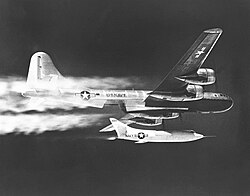
The Douglas D-558-2 Skyrocket
A successor to the Bell X-1, the Douglas D-558-2 Skyrocket was a versatile research aircraft capable of operating under both rocket and jet power. In November 1953, it achieved a landmark feat by becoming the first aircraft to exceed twice the speed of sound, reaching Mach 2.005. The aircraft could be air-launched from a B-29 Superfortress or take off from a runway using JATO (Jet-Assisted Take-Off) units.
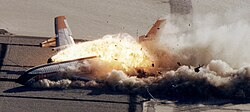
Controlled Impact Demonstration
In a joint effort with the FAA, NASA conducted the Controlled Impact Demonstration to research jet fuel additives designed to reduce fire damage during airliner crashes. On December 1, 1984, a remotely piloted Boeing 720 was crashed into wing openers to simulate a disaster. While the resulting fireball was massive, the experiment provided vital data on how certain fuel additives could cool a fuselage and prevent combustion during a crash, alongside research into crash survivability using instrumented dummies.
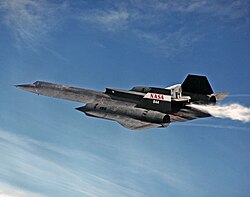
Linear Aerospike SR-71 Experiment (LASRE)
The LASRE project was a collaboration with Lockheed Martin to study reusable launch vehicle designs using a linear aerospike rocket engine. By mounting a half-span model of a lifting body onto an SR-71 Blackbird, researchers created a "flying wind tunnel." This allowed them to study how an engine plume interacts with the aerodynamics of a lifting body at speeds of approximately 340 m/s (760 mph).
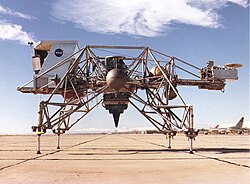
Lunar Landing Research Vehicle (LLRV)
During the Apollo era, the center utilized the Lunar Landing Research Vehicle, colloquially known as "Flying Bedsteads." These specialized aircraft served as simulators, allowing pilots to practice the unique techniques required to land the Apollo Lunar Module in the airless environment of the Moon.
Current and Future Frontiers
The center remains at the forefront of aerospace development with several active and upcoming projects aimed at sustainability and noise reduction:
- X-59 QueSST: Researching quiet supersonic technology.
- X-66 Sustainable Flight Demonstrator: Advancing efficient aircraft design.
- UAS in the NAS: Integrating Unmanned Aircraft Systems into the National Airspace.
- TGALS: Ongoing advanced flight research.
Summary of Center Overview
| Category | Details |
|---|---|
| Parent Agency | NASA |
| Headquarters | Edwards Air Force Base, California |
| Current Director | Bradley C. Flick |
| Primary Research Site | Rogers Dry Lake |
| Notable Aircraft | Bell X-1, North American X-15, SR-71, B-52 "Balls 8" |
Frequently Asked Questions
Why is the center named after Neil Armstrong?
The center was renamed in 2014 to honor Neil Armstrong, who was a test pilot at the facility before becoming the first human to walk on the Moon.
What is the significance of Rogers Dry Lake?
The lake bed provides a massive, flat, and dry surface that is ideal for flight testing and emergency landings, offering runways that can reach over 40,000 feet.
What was the purpose of the "Flying Bedsteads"?
The Lunar Landing Research Vehicles (LLRV) were used as simulators to help pilots learn how to land the Apollo Lunar Module in the Moon's airless environment.
Has the center always been located at Edwards Air Force Base?
While the center has always been located on the shore of Rogers Dry Lake, its precise location and administrative boundaries have shifted slightly over the years.
What happened to the Palmdale facility (Building 703)?
Following the retirement of the SOFIA and DC-8 aircraft in 2024, NASA vacated Building 703 in Palmdale, as the lease was no longer considered a prudent use of taxpayer funds.