High-Income Economies: World Bank Classifications and Thresholds
In the study of global economics, the term "high-income economy" serves as a critical benchmark for assessing the wealth and productive capacity of nations. According to the World Bank, this classification is determined by a country's Gross National Income (GNI) per capita, a metric that measures the total domestic and foreign output claimed by residents of a nation. To ensure consistency, the World Bank utilizes the Atlas method, a specific calculation technique used to convert local incomes into US dollars.
For the 2027 fiscal year—which is based on economic data from 2025—the threshold for entering the high-income category is set at an annual GNI per capita exceeding $14,375.
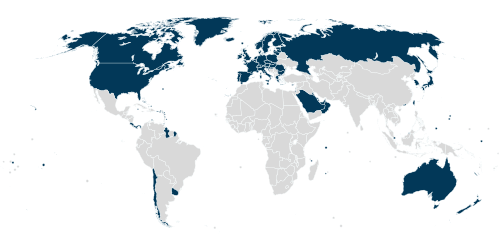
Key Facts
- 2027 Threshold: A GNI per capita of $14,375 or more is required for high-income status.
- Economy Count: Approximately 87 economies are classified as high-income as of the 2026 classification.
- Diverse Composition: The group includes major industrial powers like the United States and Japan, as well as smaller nations like Andorra and Bahrain.
- Classification Nuance: A high-income country can be classified as either "developed" or "developing" depending on the institution (e.g., the United Nations).
- Methodology: Thresholds are adjusted annually based on inflation in major economies to remain constant in real terms.
Understanding Economic Classifications
While the World Bank uses GNI per capita as its primary metric, other global institutions apply different criteria. For instance, the International Monetary Fund (IMF) and the Central Intelligence Agency (CIA) may incorporate additional factors when categorizing nations as "developed" or "advanced economies."
This distinction is vital because wealth does not always equate to a specific developmental status. The United Nations notes that some high-income countries may still be categorized as developing countries. A notable example includes the GCC (Gulf Cooperation Council) countries, which are classified as developing high-income nations. Furthermore, while Vatican City is a sovereign state, it is not classified under the World Bank's high-income definition.
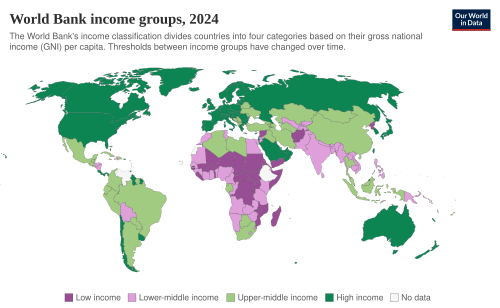
High-Income UN Member States
The following list includes UN members that have held high-income status, noting the years they maintained this classification (beginning in 1987):
- Long-term High-Income: Australia, Austria, Belgium, Canada, Denmark, Finland, France, Germany, Iceland, Ireland, Italy, Japan, Luxembourg, Netherlands, New Zealand, Norway, Sweden, Switzerland, United Kingdom, and the United States.
- Recent Additions or Fluctuating Status: Bulgaria (2023–present), Costa Rica (2024–present), Guyana (2022–present), and Romania (2019, 2021–present).
- Other Notable Members: Andorra, Antigua and Barbuda, Bahrain, Barbados, Brunei, Chile, Croatia, Cyprus, Czech Republic, Estonia, Greece, Hungary, Israel, Kuwait, Latvia, Liechtenstein, Lithuania, Malta, Monaco, Nauru, Oman, Palau, Panama, Poland, Portugal, Qatar, Saint Kitts and Nevis, San Marino, Saudi Arabia, Seychelles, Singapore, Slovakia, Slovenia, South Korea, Spain, Trinidad and Tobago, United Arab Emirates, and Uruguay.
Historical Threshold Evolution
The economic bar for high-income status has shifted over the decades to account for global inflation. In 1987, the threshold was set at US$ 6,000 (in 1987 prices). To maintain the threshold's value in real terms, the World Bank adjusts it based on the average inflation of the G-5 countries (the United States, United Kingdom, Japan, Germany, and France). Since 2001, the calculation has also factored in the eurozone.
| Year | GNI Per Capita Threshold | Classification Date |
|---|---|---|
| 1987 | $6,000 | October 2, 1988 |
| 1990 | $7,620 | September 11, 1991 |
| 1995 | $9,385 | June 3, 1996 |
| 2000 | $9,265 | July 1, 2001 |
| 2005 | $10,725 | July 1, 2006 |
| 2010 | $12,275 | July 1, 2011 |
| 2015 | $12,475 | July 1, 2016 |
| 2020 | $12,696 | July 1, 2021 |
| 2025 | $14,375 | July 1, 2026 |
Frequently Asked Questions
What is the Atlas method?
The Atlas method is a specific calculation used by the World Bank to convert a country's local income into US dollars to allow for standardized global comparisons.
Can a high-income country also be a developing country?
Yes. According to the United Nations, some high-income countries, such as those in the GCC, are classified as developing high-income countries.
How does the World Bank adjust income thresholds?
Thresholds are adjusted annually to account for inflation in major economies like the US, UK, Japan, Germany, and France, ensuring the classification remains consistent in real terms.
Why are some countries not listed in the high-income category?
Countries may not be listed if their GNI per capita falls below the required threshold or if they do not meet the specific criteria used by the World Bank for that fiscal year.
Is Vatican City considered a high-income economy?
No. Although Vatican City is a sovereign state, it is not classified under the World Bank's high-income definition.