Gran Canaria Blue Chaffinch
The Gran Canaria blue chaffinch (Fringilla polatzeki) is a rare passerine bird belonging to the finch family Fringillidae. This striking bird is endemic to Gran Canaria in Spain's Canary Islands, meaning it is found nowhere else on Earth. Known for its distinct coloration and specialized habitat, it stands as one of the most critically threatened avian species globally.
Key Facts
- Conservation Status: Endangered (IUCN 3.1).
- Endemic Range: Restricted to the highlands of Gran Canaria, Spain.
- Primary Habitat: Mature Canary Island pine forests at approximately 1,000 meters altitude.
- Diet: Primarily Canary Island pine seeds, though young are fed insects.
- Distinguishing Feature: Two white wing bands and a whiter belly compared to its Tenerife relative.
Taxonomy and Classification
The classification of the Gran Canaria blue chaffinch has evolved with scientific research. Until 2015, it was considered a subspecies (Fringilla teydea polatzeki) of the Tenerife blue chaffinch. However, a study published in March 2016 provided evidence that the two populations are distinct enough to be classified as separate species: Fringilla polatzeki for Gran Canaria and Fringilla teydea for Tenerife.
The species was named in honor of Johann Polatzek (1838–1927), the collector who first identified the bird.
Physical Description
The Gran Canaria blue chaffinch is slightly smaller than its Tenerife counterpart. Males typically weigh between 27 and 29 grams, while females weigh between 26 and 28 grams. In contrast, the Tenerife blue chaffinch is heavier, with males weighing 31–33 grams and females 28–30 grams.
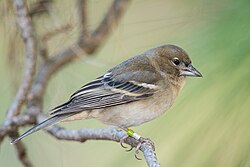
Visually, the Gran Canaria species is distinguished by two white bands on its wings and a whiter belly with fewer blue shades. Females exhibit a more muted, dull grey-brown plumage.
Distribution and Habitat
This non-migratory bird is found exclusively in the highlands of Gran Canaria. Its primary stronghold is the Inagua Natural Reserve, specifically within the mountain Canary Island pine (Pinus canariensis) forests. These birds prefer mature forests characterized by dense, old trees at altitudes of around 1,000 meters.
Behavior and Breeding
The diet of the Gran Canaria blue chaffinch consists mainly of seeds from the Canary Island pine. Interestingly, while adults focus on seeds, they feed their young extensively on insects—a behavior shared with the common chaffinch but differing from many other finch species.
The breeding season occurs from late April to late July or early August. The birds construct nests using broom branches and pine needles, typically laying two eggs. Unfortunately, breeding success is low, largely due to predation by the Great Spotted Woodpecker.
Conservation Status and Threats
The Gran Canaria blue chaffinch is currently listed as Endangered. It is one of the most endangered bird species on the planet. Unlike the Tenerife blue chaffinch, which enjoys a wider distribution, the Gran Canaria population is extremely small and restricted to a few specific areas of pine forest, including Ojeda, Inagua, and Pajonales.
| Feature | Gran Canaria Blue Chaffinch | Tenerife Blue Chaffinch |
|---|---|---|
| Scientific Name | Fringilla polatzeki | Fringilla teydea |
| Male Weight | 27–29 g | 31–33 g |
| Female Weight | 26–28 g | 28–30 g |
| Wing Markings | Two white bands | Different/Fewer bands |
| Belly Color | Whiter, less blue | More blue shades |
Frequently Asked Questions
What makes the Gran Canaria blue chaffinch different from the Tenerife blue chaffinch?
The Gran Canaria blue chaffinch is slightly smaller, has a whiter belly with fewer blue tones, and possesses two distinct white bands on its wings.
Where can the Gran Canaria blue chaffinch be found?
It is endemic to the highlands of Gran Canaria, Spain, primarily inhabiting mature Canary Island pine forests in areas like the Inagua Natural Reserve, Ojeda, and Pajonales.
What do these birds eat?
Adults primarily eat Canary Island pine seeds, but they feed their young a diet rich in insects.
Why is the species endangered?
The species has an extremely small population restricted to a very limited geographic area. Additionally, breeding success is hindered by predation, particularly by the Great Spotted Woodpecker.
Is the Gran Canaria blue chaffinch a migratory bird?
No, the Gran Canaria blue chaffinch is not migratory and remains in its highland habitat year-round.