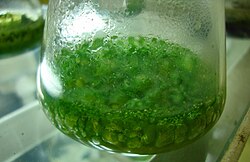
Cyanobacteria: The Ancient Architects of Earth's Atmosphere
Often referred to as "blue-green algae," cyanobacteria are not actually algae, but a phylum of bacteria that changed the course of planetary history. These microorganisms are among the oldest life forms on Earth, with a temporal range extending back approximately 2.1 billion years. By mastering the art of oxygenic photosynthesis, they transformed a primitive, anaerobic world into one capable of supporting complex aerobic life.
From the depths of the ocean to the heights of the atmosphere as aeroplankton, cyanobacteria are ubiquitous. They serve as the foundation of aquatic food webs and engage in complex symbiotic relationships with other organisms, making them indispensable to global ecology.
![Cyanobacteria are found almost everywhere. Sea spray containing marine microorganisms, including cyanobacteria, can be swept high into the atmosphere where they become aeroplankton, and can travel the globe before falling back to earth.[20]](/images/8a/bd/8abd5779ac1b86904af5644289d998f5d5bc4bb144a98de23a50999235033975.jpg)
Key Facts
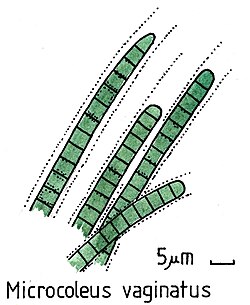
- Domain: Bacteria (Phylum Cyanobacteriota).
- Primary Role: Oxygen production via photosynthesis and atmospheric nitrogen fixation.
- Distribution: Found globally in marine, freshwater, and terrestrial environments.
- Evolutionary Impact: Responsible for the Great Oxidation Event and the origin of chloroplasts in plants.
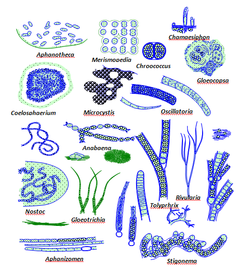
- Morphology: Ranges from single cells to complex filamentous structures.
Morphology and Cellular Structure
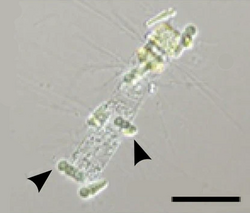
Cyanobacteria exhibit a diverse array of physical forms. Some are unicellular, existing as single cells, while others form colonies or long filaments. In filamentous species, cells can differentiate into specialized types to survive environmental stress:
- Vegetative cells: The standard photosynthetic cells active during favorable conditions.
- Akinetes: Thick-walled, climate-resistant spores that allow the organism to survive harsh environments.
![Morphological variations:[56] Unicellular: (a) Synechocystis and (b) Synechococcus elongatusNon-heterocytous: (c) Arthrospira maxima,(d) Trichodesmium and (e) PhormidiumFalse- or non-branching heterocytous: (f) Nostoc and (g) Brasilonema octagenarumTrue-branching heterocytous: (h) Stigonema (ak) akinetes (fb) false branching (tb) true branching](/images/4f/da/4fda1dec0f0a5e8a76a9a27194575515467c2a5a4b6d35d7be04de993e5bcc5f.jpg)
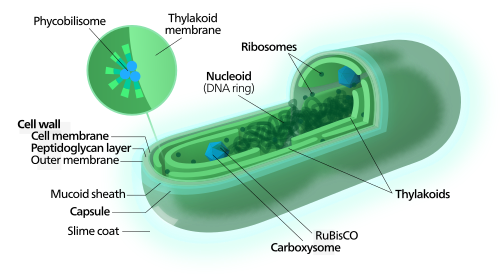
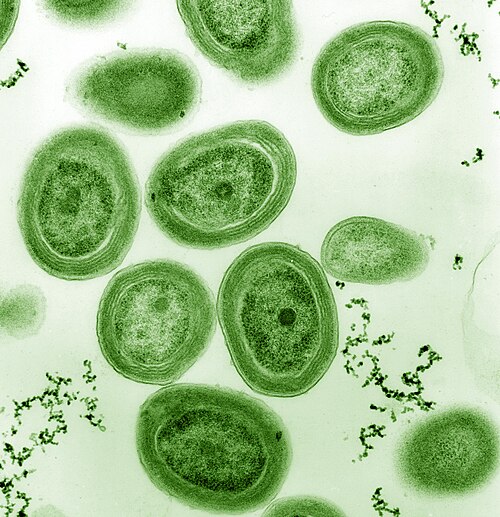
At the cellular level, these bacteria possess a complex internal architecture. Unlike many other bacteria, they contain thylakoid membranes—internal membranes where the machinery for photosynthesis is located. They also utilize carboxysomes for carbon fixation and glycogen granules for energy storage.
![Cyanobacterial thylakoid membrane [66] Outer and plasma membranes are in blue, thylakoid membranes in gold, glycogen granules in cyan, carboxysomes (C) in green, and a large dense polyphosphate granule (G) in pink](/images/e8/c3/e8c3027108eb8b1d2d17e7c355fe425268e4232e89b1aed1b9a8ed3af74b1263.png)
Metabolic Capabilities
![Model of a clumped cyanobacterial mat [135]](/images/e4/90/e49098c60d5127b981b26ab151e1986c6d777916fe50e898ef8d9c1a8087f1d6.png)
Photosynthesis and Carbon Fixation
Cyanobacteria are the only prokaryotes capable of oxygenic photosynthesis. They use sunlight to split water molecules, releasing oxygen as a byproduct. A notable example is Prochlorococcus, a marine cyanobacterium that contributes a significant portion of the world's total oxygen production.
Nitrogen Fixation
Many cyanobacteria can perform nitrogen fixation, the process of converting atmospheric nitrogen (N2) into ammonia, a form usable by plants and other organisms. This capability makes them vital for soil fertility in agriculture.
Ecology and Symbiosis
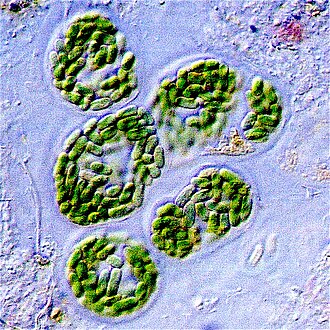
Cyanobacteria interact with their environment in diverse ways. They can form dense microbial mats or exist as cyanobionts—symbiotic partners living within other organisms. For example, they colonize the leaves and roots of land plants, often forming para-nodules that enhance nitrogen fixation for the host.
![Symbiosis with land plants [110]Leaf and root colonization by cyanobacteria (1) Cyanobacteria enter the leaf tissue through the stomata and colonize the intercellular space, forming a cyanobacterial loop. (2) On the root surface, cyanobacteria exhibit two types of colonization pattern; in the root hair, filaments of Anabaena and Nostoc species form loose colonies, and in the restricted zone on the root surface, specific Nostoc species form cyanobacterial colonies. (3) Co-inoculation with 2,4-D and Nostoc spp. increases para-nodule formation and nitrogen fixation. A large number of Nostoc spp. isolates colonize the root endosphere and form para-nodules.[110]](/images/c4/c2/c4c28171d967e210f5df650b1b27bb5db4ffe57ea66a119b1a50aaaf73681602.jpg)
![Cyanobionts of Ornithocercus dinoflagellates [111] Live cyanobionts (cyanobacterial symbionts) belonging to Ornithocercus dinoflagellate host consortium(a) O. magnificus with numerous cyanobionts present in the upper and lower girdle lists (black arrowheads) of the cingulum termed the symbiotic chamber.(b) O. steinii with numerous cyanobionts inhabiting the symbiotic chamber.(c) Enlargement of the area in (b) showing two cyanobionts that are being divided by binary transverse fission (white arrows).](/images/50/c2/50c2af8549682247519485e811edf1cf80f0afb08ff3bfd230734849fc618222.png)
While they are essential for healthy ecosystems, shifting environmental conditions can lead to community dysbiosis. This imbalance can trigger harmful algal blooms, where opportunistic species grow rapidly and produce toxins that threaten fish stocks, livestock, and human health.
![Environmental impact of cyanobacteria and other photosynthetic microorganisms in aquatic systems. Different classes of photosynthetic microorganisms are found in aquatic and marine environments where they form the base of healthy food webs and participate in symbioses with other organisms. However, shifting environmental conditions can result in community dysbiosis, where the growth of opportunistic species can lead to harmful blooms and toxin production with negative consequences to human health, livestock and fish stocks. Positive interactions are indicated by arrows; negative interactions are indicated by closed circles on the ecological model.[98]](/images/c2/dc/c2dcf5feee8ddf1948d496505542c1e01696ea5d3f9b3c32b1551caf78206b6d.png)
Evolution and Earth History
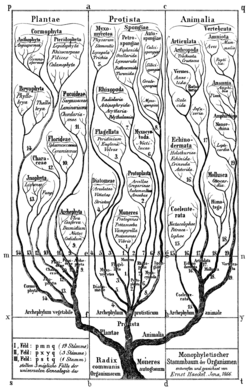
The evolutionary trajectory of cyanobacteria is inextricably linked to the history of Earth. Their ability to produce oxygen led to the Great Oxidation Event, fundamentally altering the planet's chemistry. Furthermore, the endosymbiotic theory suggests that ancient cyanobacteria were engulfed by eukaryotic cells, eventually evolving into the chloroplasts found in modern plants and algae.
![Timing and trends in cell diameter, loss of filamentous forms and habitat preference within cyanobacteria Based on data: nodes (1–10) and stars representing common ancestors from Sánchez-Baracaldo et al., 2015,[45] timing of the Great Oxidation Event (GOE),[215] the Lomagundi-Jatuli Excursion,[216] and Gunflint formation.[217] Green lines represent freshwater lineages and blue lines represent marine lineages are based on Bayesian inference of character evolution (stochastic character mapping analyses).[45] Taxa are not drawn to scale – those with smaller cell diameters are at the bottom and larger at the top](/images/3a/1b/3a1b5573852453d7a03d36148ed8c34e6758fe75223d99e17bbc12754b6a2e7e.png)
Biological Processes and Movement
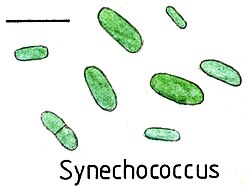
Cyanobacteria exhibit sophisticated behaviors, including collective movement and buoyancy strategies to optimize light exposure. Some species, such as Synechococcus, utilize a gliding technique to navigate their environment.
![Collective behaviour and buoyancy strategies in single-celled cyanobacteria [132]](/images/96/7c/967c6d892bd5f41ce04c41a9684b957c263dff8e8c8274a4e58f2ae279a2b7a3.png)
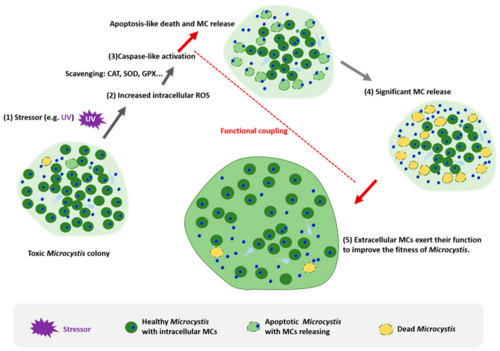
They are also subject to biological pressures, such as cyanophages (viruses that infect cyanobacteria), which regulate their populations in the wild. Additionally, research indicates they undergo forms of regulated cell death (RCD), similar to processes seen in more complex eukaryotes.
![Cell death in eukaryotes and cyanobacteria [27] Types of cell death according to the Nomenclature Committee on Cell Death (upper panel;[138] and proposed for cyanobacteria (lower panel). Cells exposed to extreme injury die in an uncontrollable manner, reflecting the loss of structural integrity. This type of cell death is called "accidental cell death" (ACD). "Regulated cell death (RCD)" is encoded by a genetic pathway that can be modulated by genetic or pharmacologic interventions. Programmed cell death (PCD) is a type of RCD that occurs as a developmental program, and has not been addressed in cyanobacteria yet. RN, regulated necrosis.](/images/2e/24/2e24f8bd7e2996cf525b8670bbd3bfec895d6049e2050a81b7e66c995e7a427a.jpg)
Summary of Cyanobacterial Characteristics
| Feature | Description | Ecological/Economic Impact |
|---|---|---|
| Photosynthesis | Oxygenic (produces O2) | Primary oxygen source for Earth |
| Nitrogen Fixation | Converts N2 to ammonia | Natural fertilizer for agriculture |
| Morphology | Unicellular to Filamentous | Diverse habitat colonization |
| Symbiosis | Cyanobionts in plants/protists | Enhanced nutrient cycling |
| Risk Factors | Toxin-producing blooms | Threat to aquatic life and health |
Frequently Asked Questions
Are cyanobacteria the same as algae?
No. While they are commonly called "blue-green algae," they are prokaryotic bacteria. True algae are eukaryotes, meaning they have a nucleus and other membrane-bound organelles.
How do cyanobacteria help the environment?
They produce a significant amount of the world's oxygen through photosynthesis and enrich the soil and water by fixing atmospheric nitrogen, which supports plant growth.
What are harmful cyanobacterial blooms?
These occur when environmental changes cause certain cyanobacteria to grow uncontrollably. These blooms can deplete oxygen in the water and release toxins harmful to humans and animals.
What is the relationship between cyanobacteria and plants?
Beyond the evolutionary origin of chloroplasts, some cyanobacteria live symbiotically with plants, colonizing roots and leaves to provide essential nitrogen.
Can cyanobacteria be used in biotechnology?
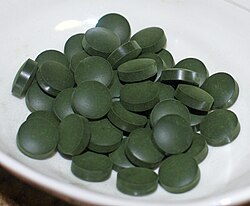
Yes, they are explored for various applications, including the production of biofuels (like biodiesel and ethanol) and as nutritional supplements, such as Spirulina.