Cuneiform: The Evolution of the World's Earliest Writing System
Cuneiform stands as one of the most significant intellectual achievements of human history. Emerging in the region of Sumer (modern-day southern Iraq), this script transformed the way humans recorded information, moving from simple accounting to the preservation of complex laws, literature, and royal genealogies. The term "cuneiform" is derived from the Latin word cuneus, meaning "wedge," referring to the characteristic shape of the marks made by a stylus in wet clay.
Initially developed as a logographic system—where a single sign represents a whole word or concept—cuneiform evolved over three millennia into a sophisticated tool used by multiple languages and empires across the ancient Near East.
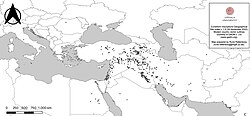
Key Facts
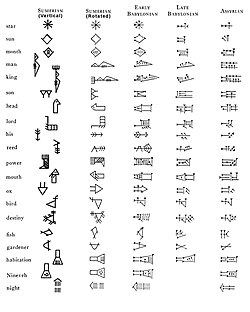
- Period of Use: Approximately 2900 BC to 100 AD.
- Primary Medium: Clay tablets inscribed with a wedge-tipped stylus.
- Direction: Written from left to right.
- Parent System: Proto-cuneiform (a form of proto-writing).
- Geographic Reach: Centered in Sumer, extending to the Akkadian, Hittite, Elamite, and Persian empires.
- Unicode Range: U+12000 to U+1247F.
The Evolution of the Script
Cuneiform did not appear overnight; it was the result of a gradual transition from concrete images to abstract symbols. This process is known as the simplification of signs.
Proto-Cuneiform and Pictographs
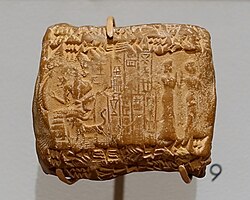
Around 3300 BC, the earliest forms of writing were pictographic. These were simple drawings of objects—such as a head or a throne—used primarily for administrative purposes, such as tracking livestock or grain. These early characters were often written vertically.
![A tablet with proto-cuneiform pictographic characters, end of 4th millennium BC, Uruk III. This is thought to be a list of slaves' names, the hand in the upper left corner representing the owner.[5]](/images/f6/0c/f60c5acb5d017b9b3dd3ece73d7bb763ae5f20b7b246659fb1e8d9a1a558e908.jpg)
![Early pictographic signs in archaic cuneiform, used vertically before c. 2300 BC.[19]](/images/2c/3e/2c3eaa6abc35748ae1755b12ee09004c3f69376cbbf8cd5cdba06be15f341992.jpg)
The Transition to Wedges
By 2900 BC, the script shifted toward archaic cuneiform. Scribes began using a reed stylus with a triangular tip, which created wedge-shaped impressions rather than drawn lines. This change was more efficient for writing on clay and led to the rotation of signs by 90 degrees, changing the writing direction to left-to-right.
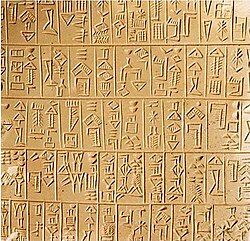
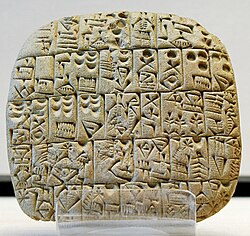
Abstraction and Standardization
Over time, the pictographs became so abstracted that they no longer resembled the original objects they represented. For example, the sign for "head" (SAG) evolved from a recognizable drawing into a series of stylized wedges.

![The cuneiform sign "EN", for "Lord" or "Master": the evolution from the pictograph of a throne c. 3000 BC, followed by rotation and then simplification, down to c. 600 BC.[51]](/images/15/2a/152aabe184ae1b68c90460ab5a32497269a36935a5155272bba39a84b1d3b397.jpg)
Languages and Regional Adaptations
While cuneiform began as a tool for the Sumerian language, its versatility allowed it to be adapted for various other linguistic groups. This adaptation often involved shifting the script from purely logographic to a syllabary, where signs represented phonetic sounds.
- Sumero-Akkadian: The most widespread use, blending Sumerian concepts with the Akkadian language.
- Hittite and Hurrian: Adapted by the peoples of Anatolia and Northern Mesopotamia.
- Elamite: Used in the region of ancient Elam (modern-day Iran).
- Old Persian: A later, more simplified version used by the Achaemenid Empire in the 5th century BC.

The Cuneiform Corpus
Archaeologists have recovered hundreds of thousands of tablets, providing an unprecedented window into ancient life. These range from mundane sales contracts for houses and fields to the grand proclamations of kings.
| Location/Source | Estimated Tablet Count | Primary Languages |
|---|---|---|
| Sumerian Collections | 100,000 | Sumerian |
| Babylonian/Sippar | 60,000–70,000 | Babylonian |
| Hattusa | 30,000 | Hittite, Hurrian |
| Mari | 20,000–25,000 | Akkadian |
| Persepolis | 15,000–18,000 | Elamite, Old Persian |
| Ugarit | 23,000 | Ugaritic, Hurrian |
Frequently Asked Questions
What is the difference between proto-cuneiform and cuneiform?
Proto-cuneiform consists of pictographic drawings used for basic accounting at the end of the 4th millennium BC. Cuneiform is the evolved version that uses wedge-shaped impressions and abstract signs to represent both words and phonetic sounds.
How was cuneiform written?
Scribes used a wedge-tipped stylus made from a reed, pressing it into soft, moist clay tablets. Once the text was complete, the tablets were often dried in the sun or baked in a kiln to create a permanent record.
Which languages used the cuneiform script?
Cuneiform was used for several languages, including Sumerian, Akkadian, Hittite, Hurrian, Elamite, and Old Persian.
When did cuneiform stop being used?
The script saw a gradual decline as alphabetic systems became more common. The final periods of use extended until approximately 100 AD.
Is cuneiform an alphabet?
No, it is not a true alphabet. It began as a logographic system (signs for words) and evolved into a mix of logograms and a syllabary (signs for syllables), though later versions like Ugaritic were more alphabetic in nature.