Proto-Semitic: The Ancestral Root of the Semitic Languages
Proto-Semitic is the reconstructed common ancestor of the Semitic language family, a major branch of the broader Afroasiatic phylum. While no written records of Proto-Semitic itself exist, linguists use the comparative method to reconstruct its sounds, grammar, and vocabulary by analyzing its descendant languages, such as Arabic, Hebrew, and the extinct Akkadian.
Estimated to have been spoken between 4500 and 3900 BC, Proto-Semitic serves as the foundation for understanding the linguistic evolution of the Near East and the Horn of Africa.
Key Facts
- Timeframe: Reconstructed to have existed approximately 4500–3900 BC.
- Ancestry: Descended from Proto-Afroasiatic.
- Earliest Evidence: Akkadian inscriptions date back to the 24th–23rd centuries BC, with earlier personal names appearing in Sumerian texts.
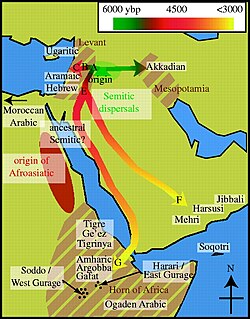
- Homeland: A prominent hypothesis suggests the Levant around 3750 BC as the point of origin.
- Descendants: Includes major languages such as Arabic, Hebrew, Aramaic, Ge'ez, and Phoenician.
The Timeline and Evidence of Semitic Languages
The historical record of Semitic languages begins with Akkadian, the earliest attested member of the family. While formal texts date to the 24th or 23rd centuries BC—notably during the era of Sargon of Akkad—earlier evidence exists in the form of personal names found in Sumerian texts from the first half of the third millennium BC. One significant early artifact is a bowl from Ur addressed to King Meskiagnunna (c. 2485–2450 BC) by Queen Gan-saman, who is believed to have originated from Akkad.
Beyond Mesopotamia, the earliest fragments of West Semitic appear as snake spells within Egyptian pyramid texts, dating to the mid-third millennium BC.
The Linguistic Homeland
Determining where Proto-Semitic was first spoken remains a subject of academic debate. The Levant hypothesis, supported by a 2009 Bayesian analysis, proposes that all known Semitic languages originated in the Levant around 3750 BC. This model suggests a subsequent migration from South Arabia into the Horn of Africa around 800 BC.
However, this statistical approach does not definitively pinpoint when or where the ancestral Semitic line diverged from the broader Afroasiatic family, leaving open the possibility that this divergence occurred within Africa.
Phonology and Sound Systems
Proto-Semitic possessed a complex system of consonants, characterized by a distinction between voiced, voiceless, and emphatic sounds (consonants produced with a constriction of the pharynx or a glottalic mechanism).
Consonantal Structure
The language featured a wide array of obstruents, including stops and fricatives, across various points of articulation: labial, interdental, alveolar, palatal, velar, pharyngeal, and glottal. A notable feature was the presence of four voiceless fricatives and three emphatic fricatives, which evolved differently across descendant languages. For example, the Proto-Semitic *ś became /s/ in Hebrew, /ʃ/ in Arabic, and /ɬ/ in Ge'ez.
Vowels and Prosody
The reconstructed system included a set of vowels and specific prosodic patterns that influenced the rhythm and stress of the language, though these are more varied in their reconstruction than the consonantal framework.
Grammar and Morphology
The grammatical structure of Proto-Semitic was highly systematic, utilizing specific markers for case, number, and verb conjugation.
Nouns and Case Systems
Nouns were marked for case (nominative, accusative, and genitive) and number (singular, dual, and plural). Plurals were formed through affixation, while feminine plurals were specifically marked by the lengthening of a vowel using the marker *-āt.
| Case | Singular | Plural | Dual |
|---|---|---|---|
| Nominative | *-u | *-ū | *-ā |
| Accusative | *-a | *-ī | *-āy |
| Genitive | *-i | *-ī | *-āy |
Verbal Systems
Proto-Semitic verbs utilized two primary conjugations: the prefix conjugation (used for imperfective aspects) and the suffix conjugation (used for perfective aspects). The imperative mood was reserved exclusively for the second person, with the singular masculine form consisting of the pure stem.
Numerals and Lexis
Comparative linguistics has allowed for the reconstruction of cardinal numbers from one to ten. For instance, the number "one" is reconstructed as *ʔaħad-, which is clearly visible in the Arabic wāḥid and Hebrew eḥad.
Frequently Asked Questions
What is Proto-Semitic?
Proto-Semitic is the theoretical, reconstructed ancestor of all Semitic languages. It is not recorded in any ancient text but is deduced by comparing descendant languages like Arabic, Hebrew, and Akkadian.
Where was Proto-Semitic spoken?
While debated, the Levant hypothesis suggests it was spoken in the Levant around 3750 BC, though some theories suggest an African origin for its divergence from the Afroasiatic family.
What is the earliest written Semitic language?
Akkadian is the earliest attested Semitic language, with formal inscriptions appearing around the 24th to 23rd centuries BC, though personal names in Sumerian texts appear even earlier.
What are "emphatic consonants"?
Emphatic consonants are a distinct class of sounds in Proto-Semitic produced with a constriction in the throat (pharynx), a feature that persists in several modern Semitic languages like Arabic.
How did Proto-Semitic mark plurals?
Plurals were primarily marked through affixation, with feminine nouns specifically using the *-āt marker involving vowel lengthening.