Old Babylonian Empire: The Rise and Fall of the First Dynasty
The Old Babylonian Empire, also known as the First Babylonian Empire, flourished between approximately 1894 and 1595 BC. Emerging after the decline of Sumerian power and the subsequent Isin-Larsa period, this Bronze Age civilization transformed Babylon from a small town into the dominant center of Mesopotamia. Its legacy is defined by military expansion, sophisticated diplomacy, and one of the most influential legal frameworks in human history.
Key Facts
- Timeline: c. 1894 BC – c. 1595 BC.
- Capital: Babylon.
- Key Ruler: Hammurabi (r. c. 1792–1750 BC).
- Languages: Akkadian (official), Sumerian (literary), and Amorite.
- Major Achievement: The Code of Hammurabi, a comprehensive set of written laws.
- End of Empire: The sack of Babylon by the Hittites c. 1595 BC.
The Origins and Early Rulers
Pinpointing the exact origins of the First Babylonian Dynasty is challenging for archaeologists. Because Babylon has a high water table, many physical structures and artifacts have degraded into mud, leaving few intact archaeological materials. Historians rely instead on cuneiform (wedge-shaped writing on clay) records, including royal inscriptions, literary texts, and year-name lists.
The early kings, from Sumu-abum to Sin-muballit, were Amorites rather than Akkadians. While they did not significantly expand the empire's borders, they laid the necessary foundations. Sumu-abum, the first named king, conquered Dilbat and Kish, while his successor, Sumualailum, completed the city walls of Babylon and briefly controlled Nippur. Later, Sin-muballit strengthened the city's defenses and built canals, successfully defending Babylon from Rim-Sin I before passing the throne to his son, Hammurabi.
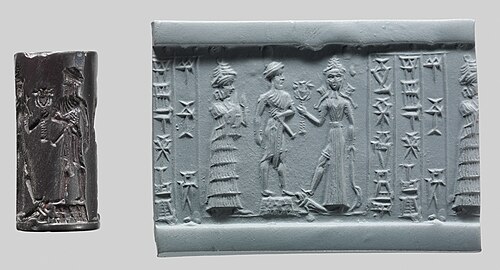
The Reign of Hammurabi
King Hammurabi (r. c. 1792–1750 BC) elevated Babylon from a minor power to a regional hegemon. When he ascended the throne, his domain consisted of only a few towns, including Sippar and Borsippa. Through strategic military campaigns, he captured Eshnunna by 1762 BC, gaining control of vital trade routes. He subsequently expanded into Assyria and the Zagros Mountains, and by 1761 BC, he had seized Mari, effectively reclaiming much of the territory once held by the Third Dynasty of Ur.
Hammurabi's most significant territorial victory occurred in his thirtieth regnal year when he conquered Larsa, granting him control over the urban centers of Ur, Uruk, and Isin. This established Babylon as the undisputed center of Southern Mesopotamia, a position of dominance the city would maintain for over a millennium.
The Code of Hammurabi
Beyond military conquest, Hammurabi is immortalized by the Code of Hammurabi. This collection of laws is inscribed on a 2.25-meter diorite stele. The monument depicts Hammurabi receiving his royal insignia from Shamash, the sun god of justice, signaling that the laws were divinely ordained.
![Hammurabi (standing), depicted as receiving his royal insignia from Shamash (or possibly Marduk). Hammurabi holds his hands over his mouth as a sign of prayer[10] (relief on the upper part of the stele of Hammurabi's code of laws).](/images/82/2a/822aa99e0d42589f0e29443ab9a39a89d322d0c708b5a62b9e49022f9ea28a14.jpg)
The code emphasizes the king's role in establishing truth and justice to enhance the well-being of his people. It provides detailed rules for appropriate behavior and just punishments for crimes, serving as one of the oldest and most complete written legal codes in the ancient Near East.
![Tablet of Hammurabi (𒄩𒄠𒈬𒊏𒁉, 4th line from the top), King of Babylon. British Museum.[4][5][6]](/images/ff/75/ff75351c81e8902700839936724372ace259c5e1730692d4b04a4aecdcb2253e.jpg)
Diplomacy and the Archives of Mari
Much of what we know about Hammurabi's diplomacy comes not from Babylon, but from the palace of Zimri-Lim in Mari. While Babylon's own archives were destroyed by the water table, the archives at Mari were preserved because Hammurabi burned the palace during his conquest, effectively sealing the documents in ash. These letters reveal a complex web of alliances, treaties, and military conflicts between the leaders of the Syro-Mesopotamian region.
Decline and Fall
The stability achieved by Hammurabi did not last. His successors, starting with Samsuiluna, struggled to maintain the empire's vast territories. While Samsuiluna defeated Rim-Sîn II, he lost significant portions of the conquered lands, leaving the empire reduced to its core Babylonian territory.
The dynasty eventually collapsed due to economic degradation and external pressure. The Hittites, expanding from Anatolia, launched an invasion that culminated in the sack of Babylon c. 1595 BC. Following this collapse, the Kassite dynasty took control of the region, ruling from 1570 to 1154 BC.
Astronomy and Chronology
Babylonian history is closely tied to astronomical observations. The god Shamash represented the sun and justice, reflecting the belief that royal law mirrored divine order. Modern historians use astronomical events to date the empire's timeline.
A critical piece of evidence is the record of a "twin eclipse"—a lunar eclipse on February 9, 1659 BC, and a solar eclipse on February 23, 1659 BC—which occurred during the reign of the final king, Samsuditana. Additionally, the Venus tablets of Ammisaduqa provide planetary observations that help scholars calculate the probability of specific dates, supporting the 1659 BC date for the fall of Babylon.
| Key Period/Ruler | Approx. Dates | Major Contribution/Event |
|---|---|---|
| Sumu-abum | c. 1894–1881 BC | Founder; conquered Dilbat and Kish. |
| Hammurabi | c. 1792–1750 BC | Unified Mesopotamia; created the Code of Laws. |
| Ammisaduqa | c. 1647–1626 BC | Associated with the Venus tablets observations. |
| Samsuditana | c. 1626–1595 BC | Last king; witnessed the sack of Babylon by Hittites. |
Frequently Asked Questions
Who were the Amorites in the context of Babylon?
The Amorites were the ethnic group to which the early kings of the First Babylonian Dynasty, including Sumu-abum and Hammurabi, belonged. They were distinct from the earlier Akkadian rulers.
Why is the Code of Hammurabi so significant?
It is one of the oldest and most complete written legal codes in history, establishing a formal system of justice and punishment that was presented as divinely sanctioned by the god Shamash.
How do historians date the Old Babylonian Empire?
Historians use a combination of king lists (List A and List B) and astronomical data, such as the Venus tablets and records of lunar and solar eclipses, to establish a chronology.
What caused the eventual fall of the First Babylonian Empire?
The empire suffered from internal degradation and a loss of territory under Hammurabi's successors, which left it vulnerable to the Hittites, who sacked the city of Babylon c. 1595 BC.
Why are there so few archaeological finds in Babylon itself?
A high water table in the region has caused many of the ancient structures and organic materials to decay or turn to mud, making excavation difficult.