Bronze Age Civilizations: The Dawn of Metallurgy and Urban Society
The Bronze Age (c. 3000 BC – c. 1200 BC) represents a pivotal era in human history, marking the transition from the use of stone and copper to the mastery of bronze—an alloy created by combining copper with tin. This technological leap did more than just improve tools; it catalyzed the development of writing, the invention of the chariot, and the rise of the first complex urban societies across Asia, Europe, and North Africa.
While the period is broadly defined by its metallurgy, the experience of the Bronze Age varied significantly by region. In some areas, it was a slow evolution from the Copper Age, while in others, such as parts of Africa, the transition to iron occurred almost simultaneously with copper smelting.
Key Facts
- Timeline: Generally spans from 3000 BC to 1200 BC, though regional dates vary.
- Core Technology: The smelting of copper and tin to create bronze, a harder and more durable metal.
- Major Innovations: Development of early writing systems and the invention of the chariot.
- Defining Event: The Late Bronze Age collapse (c. 1200 BC) led to widespread societal disruption.
- Global Reach: Spanned the Near East, Central Asia, East Asia, Europe, and North Africa.
The Near East and North Africa
The Near East was the heart of early bronze development. In Mesopotamia, the Bronze Age began around 3500 BC, though scholars prefer divisions based on art and history rather than a strict tripartite timeline. In the Levant, the era is categorized into Early, Old, and Middle Syrian periods.
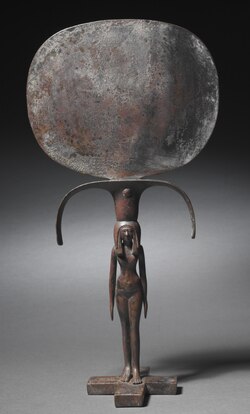
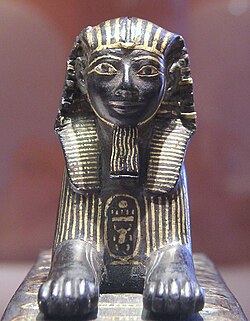
Ancient Egypt entered the Bronze Age during the Protodynastic Period (c. 3150 BC). Following the unification of Upper and Lower Egypt around 3100 BC, the Early Dynastic Period saw the rise of Memphis, which became the largest city of its time. This era laid the foundation for Egyptian art, religion, and architecture, eventually leading to the Old Kingdom's peak of complexity.
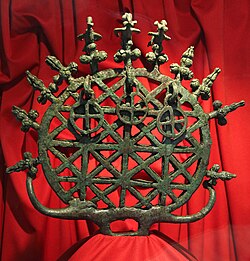

Further south, the Bronze Age in Nubia began around 2300 BC. Copper smelting was introduced to Meroë by Egyptians around 2600 BC, and evidence of bronze casting furnaces in Kerma dates back to 2300–1900 BC.
Asia: From the Steppes to the East
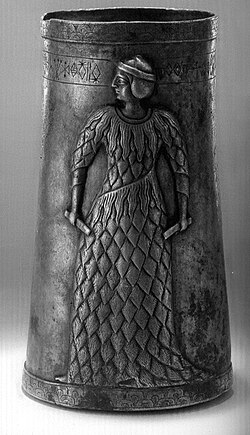
Central Asia was home to the Bactria–Margiana Archaeological Complex (BMAC), also known as the Oxus civilization (c. 2400–1600 BC). Centered on the upper Amu Darya river, this culture developed proto-urban societies with wheel-turned pottery and viticulture.
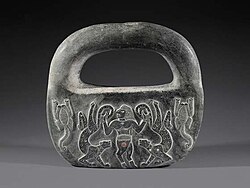
In South Asia, the Indus Valley Civilization (beginning c. 3300 BC) saw the Harappans master the production of copper, bronze, lead, and tin. Meanwhile, in East Asia, China's relationship with metal was unique. While iron use began during the Zhou dynasty (c. 1046–256 BC), bronze remained the dominant and most prestigious metal for vessels well into the Eastern Han period.
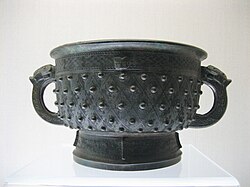
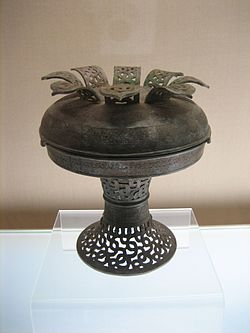
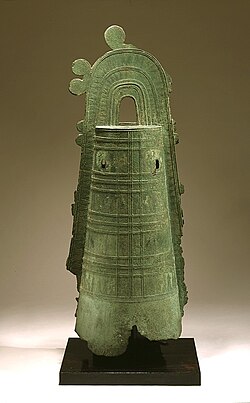
Southeast Asia also saw significant bronze production. In Thailand, sites like Ban Chiang show bronze artifacts dating to 2100 BC, while in Myanmar, the Bronze Age began around 1500 BC, with smelting knowledge spreading rapidly along Neolithic trade routes.
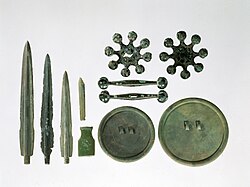
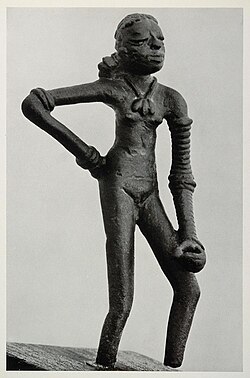
The European Bronze Age
Europe's transition to bronze was diverse. In Southeast Europe, evidence from the Pločnik site suggests tin bronze foil existed as early as 4650 BC, indicating that early tin bronze may have developed independently in Europe long before it appeared in the Near East.

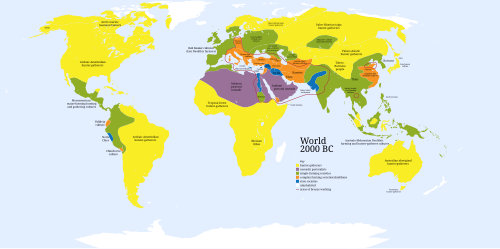
Central Europe was characterized by several distinct cultures. The Unetice culture (2300–1600 BC) showed early signs of social stratification through rich gold burials. This was followed by the Tumulus culture (inhumation burials) and later the Urnfield culture (1300–700 BC), known for cremation burials.

![Bronze chariot wheel, Urnfield culture, c. 13th–12th century BC[86]](/images/d9/cf/d9cf81bcdd003a5d13886e9c928543404ea440a973c556c057968fa4f2a0205e.jpg)
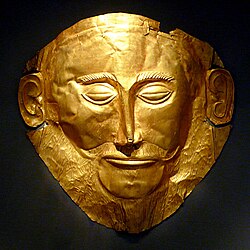
In the north and west, the Bronze Age brought significant changes. Ireland's Bronze Age (c. 2000 BC) is noted for its flat axes and the construction of stone circles. In Eastern Europe, the Yamnaya culture (c. 3300–2600 BC) of the Pontic-Caspian steppe is associated with early Indo-Europeans and the spread of pastoralist ancestry across Europe and South Asia.

![Bronze Age spread of Yamnaya steppe pastoralist ancestry into two subcontinents—Europe and South Asia, and location of the Afanasievo culture, which has the same genetic characteristics as the Yamnayas.[108]](/images/c2/61/c261d90253ace72a6f4ed2ec73c8d8cdbc476f04725e313133fec06ef104124d.jpg)
The Late Bronze Age Collapse
Around 1200 BC, many of the great civilizations of the Late Bronze Age experienced a sudden and violent decline. This period, known as the Late Bronze Age collapse, involved invasions, destruction, and massive population movements that disrupted trade and political structures across the Mediterranean and Near East.

Regional Bronze Age Summary
| Region | Approx. Start | Key Culture/Civilization | Defining Feature |
|---|---|---|---|
| Mesopotamia | 3500 BC | Sumerian/Akkadian | Early urbanism and writing |
| Egypt | 3150 BC | Early Dynastic/Old Kingdom | God-kings and monumental architecture |
| Indus Valley | 3300 BC | Harappan | Advanced metallurgy (lead, tin, bronze) |
| Central Asia | 2400 BC | BMAC (Oxus) | Proto-urban society on Amu Darya |
| Europe | Varies (up to 4650 BC) | Unetice, Urnfield, Yamnaya | Social stratification and burial shifts |
| China | Varies | Shang/Zhou | High-status bronze ritual vessels |
Frequently Asked Questions
What exactly is bronze?
Bronze is a metal alloy consisting primarily of copper, usually with tin as the main additive. This combination creates a material that is harder and more durable than pure copper, making it superior for tools and weapons.
Did every part of the world have a Bronze Age?
No. For example, in most parts of Sub-Saharan Africa, iron and copper smelting appeared around the same time, meaning these regions did not experience a distinct, prolonged Bronze Age before the Iron Age.
What caused the Late Bronze Age collapse?
The collapse around 1200 BC is attributed to a combination of factors, including invasions, internal societal destruction, and large-scale population movements.
How did the Bronze Age affect social structures?
The need for tin—which was rare and often required long-distance trade—led to increased social stratification. Rich burials, such as those in the Unetice culture, indicate the emergence of a wealthy elite class.
Where were the earliest chariots found?
Some of the earliest known chariots have been discovered in the burials of the Sintashta culture in Eastern Europe, with earlier evidence also appearing in the Abashevo culture.