Crinoids: The Ancient and Modern World of Sea Lilies and Feather Stars
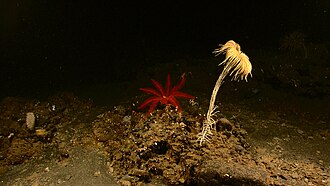
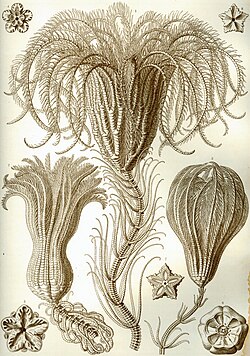
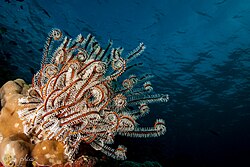
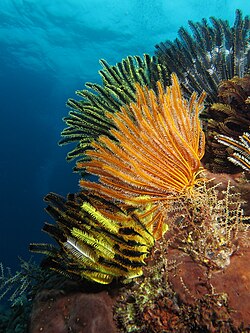
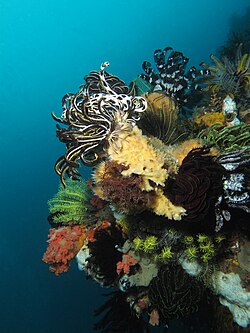
Crinoids are fascinating marine invertebrates belonging to the class Crinoidea. These creatures are members of the phylum Echinodermata, making them close relatives of starfish, sea urchins, brittle stars, and sea cucumbers. Known for their striking, plant-like appearance, crinoids are divided into two primary forms: the stalked sea lilies, which remain anchored to the ocean floor, and the unstalked feather stars (comatulids), which are the most diverse group of living crinoids.
These animals are remarkably adaptable, inhabiting a vast range of marine environments. They can be found in sunlit shallow waters as well as the crushing pressures of the deep sea, with some recorded at depths exceeding 9,000 meters (30,000 ft).
Key Facts
- Classification: Phylum Echinodermata, Class Crinoidea.
- Types: Stalked (sea lilies) and unstalked (feather stars/comatulids).
- Diet: Passive filter feeders using mucus-covered tube feet.
- Temporal Range: Present from the Ordovician period to the modern day.
- Habitat: Global oceans, from shallow reefs to depths of 9,000m.
- Movement: Most modern forms are motile, though some stalked species can crawl.
Morphology and Anatomy
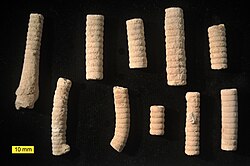
The structure of a crinoid varies significantly between its stalked and motile forms. Sea lilies possess a stem composed of a column of highly porous ossicles (small mineralized plates) connected by ligamentary tissue. This stem is anchored to the seabed via a flattened holdfast or cirri—jointed, root-like structures. Depending on the environment, cirri may be robust and curved for hard surfaces or slender and rod-like for soft sediment.
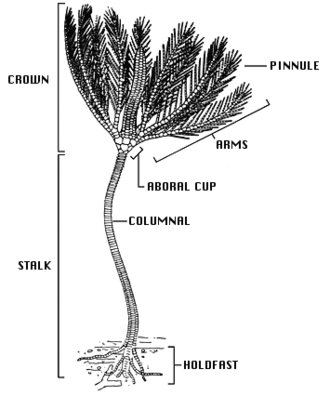
Feather stars begin their lives with a stem, but lose it as they mature, often retaining only a few cirri at the base of their crown for attachment. While most living crinoids have only a vestigial stalk, some deep-sea stalked species reach lengths of 1 meter (3 ft), and ancient fossil species have been discovered with stems as long as 20 meters (66 ft).
Feeding Mechanisms
Crinoids are specialized filter feeders. They use their arms, which are lined with pinnules and sticky, mucus-covered tube feet, to trap organic particles from the water. Once food is captured, the tube feet flick the particles into an ambulacral groove. Cilia (tiny hair-like structures) then propel the food and mucus toward the mouth, while lappets on the side of the groove keep the stream aligned.
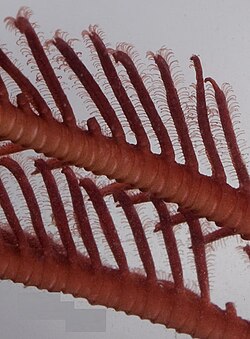
The efficiency of this system is immense. For example, a Japanese sea lily with 56 arms (each 24 cm long) possesses a total food-trapping surface area of approximately 80 meters (260 ft). Generally, crinoids in nutrient-poor environments evolve longer, more branched arms to maximize their food intake.
Locomotion and Behavior
While traditionally viewed as sessile (stationary), many crinoids exhibit surprising mobility. Comatulids are free-swimming and can move across the seabed. Even stalked crinoids are capable of movement. In 2005, the species Neocrinus decorus was observed pulling itself along the ocean floor off Grand Bahama Island at a rate of 4 to 5 cm per second (144 to 180 meters per hour), far exceeding the previously known speed of 0.6 meters per hour for stalked varieties.
Evolutionary History
Crinoids have a long and complex geological record, starting with mineralized skeletons in the early Cambrian (540 Mya). They dominated the oceans for the next 100 million years alongside blastoids. Their history is marked by two major episodes of adaptive radiation (rapid evolutionary diversification).
- The Ordovician Radiation: Occurred between 485 and 444 Mya. This era of dominance ended with a selective mass extinction at the end of the Permian period, which wiped out all blastoids and most crinoid lineages.
- The Triassic Radiation: Occurred around 230 Mya. This period saw the rise of flexible arms and increased motility. This shift was largely a response to predation pressure, particularly from sea urchins (echinoids). As predation intensified around 225 Mya, stalked crinoids retreated to deeper waters, while motile forms became more common.
The Fossil Record
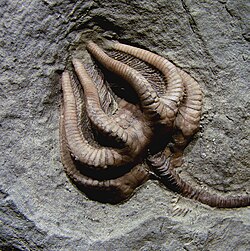
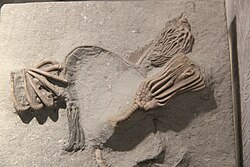
Crinoid fossils are abundant and provide critical data on ancient marine ecosystems. In 2012, geologists isolated complex organic molecules—specifically aromatic or polyaromatic quinones—from 340-million-year-old Mississippian fossils. These are the oldest molecules definitively associated with specific individual fossils, preserved within the ossicle pores by precipitated calcite.
Taxonomy and Classification
The class Crinoidea was defined by Miller in 1821. It encompasses numerous extinct orders and four living orders within the subgroup Articulata: Comatulida, Cyrtocrinida, Hyocrinida, and Isocrinida. Living articulates consist of approximately 540 to 700 species.
| Group | Status | Key Characteristics |
|---|---|---|
| Sea Lilies | Extant & Extinct | Stalked, sessile adults, anchored by holdfasts. |
| Feather Stars (Comatulids) | Extant | Unstalked adults, motile, largest living order. |
| Articulata | Extant | Includes all living orders; approx. 540-700 species. |
| Camerata / Disparida | Extinct | Ancient Paleozoic lineages. |
Frequently Asked Questions
Are crinoids plants?
No. Despite their appearance as "sea lilies," crinoids are marine animals. They are echinoderms, related to starfish and sea urchins, and they feed by capturing organic particles from the water rather than through photosynthesis.
What is the difference between a sea lily and a feather star?
The primary difference is the stalk. Sea lilies are stalked and remain attached to the sea floor as adults. Feather stars (comatulids) lose their stalk during development and are capable of moving independently.
How do crinoids eat?
They are passive filter feeders. They use their branched arms and sticky, mucus-covered tube feet to trap plankton and other particles, which are then transported via cilia in ambulacral grooves to the mouth.
How old are crinoid fossils?
Crinoids have a temporal range from the Ordovician period to the present. Some of the oldest mineralized echinoderms appear in the early Cambrian, and specific organic molecules have been recovered from fossils dating back 340 million years.
Can stalked crinoids move?
Yes, although they are much slower than feather stars. Some species, such as Neocrinus decorus, have been observed crawling across the seabed at speeds of up to 180 meters per hour.