Crinoids: The Ancient and Modern Marine Filter-Feeders
Crinoids are fascinating marine invertebrates belonging to the class Crinoidea. Members of the phylum Echinodermata—which also includes sea urchins, starfish, and sea cucumbers—these creatures are primarily known for their striking, plant-like appearance. While they may look like flowers of the ocean, they are complex animals that have inhabited the Earth's oceans from the Ordovician period to the present day.
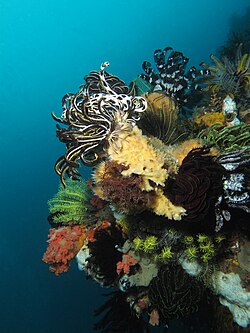
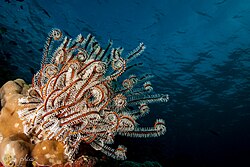
Crinoids are generally divided into two main forms: the stalked sea lilies, which remain anchored to the sea floor, and the unstalked feather stars (comatulids). These organisms are incredibly adaptable, thriving in environments ranging from shallow coastal reefs to the extreme depths of the ocean, reaching over 9,000 meters (30,000 ft).
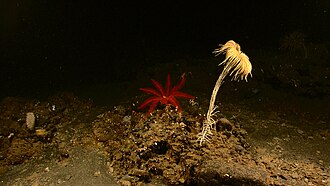
Key Facts
- Classification: Phylum Echinodermata, Class Crinoidea.
- Types: Stalked (sea lilies) and unstalked (feather stars/comatulids).
- Habitat: Marine environments from shallow waters to depths of 9,000+ meters.
- Diet: Filter-feeders that trap plankton using mucus-covered tube feet.
- Temporal Range: Present from the Ordovician period to the modern era.
- Movement: While many are sessile, some stalked species can move at speeds up to 180 meters per hour.
Morphology and Anatomy
The structure of a crinoid varies significantly between its two primary forms. Sea lilies possess a stem composed of a column of porous ossicles (small mineralized plates) connected by ligamentary tissue. This stem is anchored to the substrate via a flattened holdfast or cirri—jointed, root-like structures. Depending on the environment, cirri may be robust and curved for hard surfaces or slender and rod-like for soft sediment.
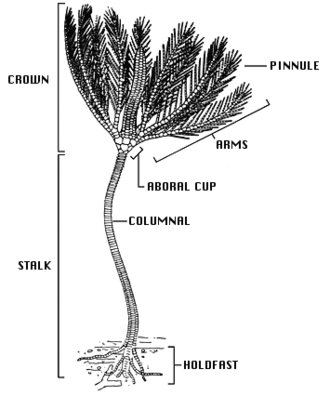
Feather stars, members of the order Comatulida, begin their lives with a stem but lose it as they mature, though some retain a few cirri at the base of their crown for attachment. In the deep sea, some stalked species reach lengths of 1 meter, while ancient fossil records reveal species with stems as long as 20 meters (66 ft).
Feeding Mechanisms
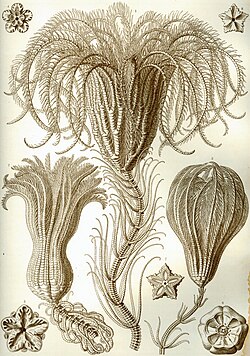
Crinoids are specialized filter-feeders. They use tube feet covered in sticky mucus to trap organic particles from the water. Once captured, the food is flicked into an ambulacral groove, where cilia (tiny hair-like projections) propel the mucus and food toward the mouth. To maintain the flow of food, lappets on the side of the groove keep the mucus stream in place.
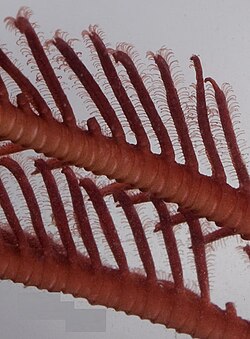
The efficiency of this system is remarkable. For example, a Japanese sea lily with 56 arms, each 24 cm long, possesses a total food-trapping surface area of approximately 80 meters (260 ft) when including the pinnules (small side-branches on the arms).
Evolutionary History
Echinoderms with mineralized skeletons first appeared in the early Cambrian period. For the following 100 million years, crinoids and blastoids were the dominant stalked filter-feeders of the ocean. Their history is marked by two major episodes of adaptive radiation.
The first radiation occurred during the Ordovician period (485 to 444 Mya). However, a selective mass extinction at the end of the Permian period wiped out all blastoids and the majority of crinoid species. The survivors never regained the same level of morphological diversity they held during the Paleozoic era.
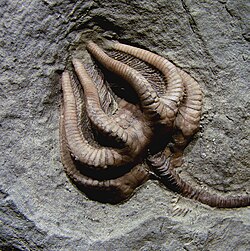
The second radiation took place during the early Triassic (around 230 Mya). This era saw the rise of flexible arms and a shift toward motility (the ability to move). This change was largely a response to increased predation pressure from benthic predators, particularly sea urchins. As a result, stalked crinoids gradually retreated to deeper waters, while motile forms evolved to retain stalks only during their juvenile stages.
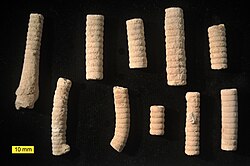
The Fossil Record
Crinoids leave behind extensive fossil records, often appearing as stacked disks (columnals). In 2012, geologists isolated complex organic molecules from 340-million-year-old Mississippian fossils. These molecules, resembling aromatic or polyaromatic quinones, are the oldest definitively associated with specific individual fossils, having been sealed inside ossicle pores by calcite during fossilization.
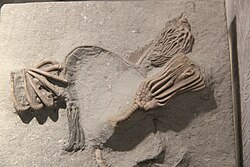
Modern Distribution and Diversity
Today, crinoids continue to thrive in diverse marine ecosystems. In the shallow, warm waters of Indonesia, colorful crinoids are common sights on coral reefs, adding vibrant hues to the underwater landscape.
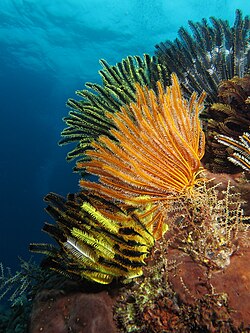
| Group | Common Name | Key Characteristic | Status |
|---|---|---|---|
| Comatulida | Feather Stars | Unstalked adults, motile | Extant |
| Sea Lilies | Stalked Crinoids | Attached to sea floor via stem | Extant & Extinct |
| Camerata | - | Ancient stalked forms | Extinct |
| Articulata | - | Includes most living species | Extant |
Frequently Asked Questions
Are crinoids plants?
No. Despite their appearance and names like "sea lily," crinoids are marine animals and members of the phylum Echinodermata.
How do crinoids move?
Feather stars are naturally motile. While stalked crinoids were long thought to be mostly stationary, observations of species like Neocrinus decorus have shown they can pull themselves along the sea floor at speeds of 4 to 5 cm per second.
What do crinoids eat?
They are filter-feeders that consume plankton and other small organic particles trapped by sticky mucus on their tube feet.
Why did crinoids evolve to be motile?
Motility evolved primarily as a defense mechanism against predation. Increased pressure from benthic predators, such as sea urchins around 225 Mya, drove the evolution of forms that could move rather than remain sessile.
Where can crinoids be found today?
They are found worldwide in marine environments, from shallow tropical reefs in places like Indonesia to the deepest parts of the ocean floor.