Canadair CL-44: The Legacy of the Yukon and the Swing-Tail Transport
The Canadair CL-44 stands as a fascinating chapter in aviation history, blending ambitious engineering with a complex operational journey. Originally developed as a heavy-lift transport, the aircraft is perhaps best remembered by its Royal Canadian Air Force (RCAF) designation, the CC-106 Yukon. From setting long-distance endurance records to pioneering cargo loading techniques, the CL-44 pushed the boundaries of mid-century aerospace capability.
The CC-106 Yukon: A Record-Breaking Workhorse
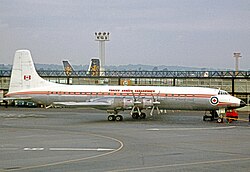
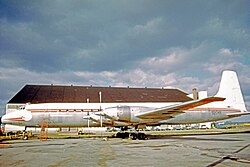
The CL-44-6 was first produced for the RCAF as the CC-106 Yukon. While the aircraft faced initial teething problems, it eventually became a highly reliable asset. In December 1961, the Yukon cemented its place in history by setting a world record for its class, flying 6,750 miles (10,860 km) from Tokyo to RCAF Station Trenton, Ontario. The journey took 17 hours and three minutes, maintaining an average speed of 400 mph (640 km/h).
The Yukon's capabilities extended beyond speed; it also set an endurance record by remaining airborne for 23 hours and 51 minutes. These milestones remained unbeaten until 1975, when they were finally surpassed by the Boeing 747SP. By the time the fleet was retired, the Yukons had accumulated a staggering 65 million miles in total flight, including 1.5 billion passenger miles and 360 million ton-miles.
Engineering Innovation: The Swing-Tail Design
One of the most distinctive features of the CL-44D4 cargo variant was its innovative swing-tail. To facilitate the rapid loading of oversized items, the entire tail section was hinged and could be opened using hydraulic actuators. This was the first time a large aircraft utilized such a mechanism, as previous smaller naval aircraft with similar features required manual rigging before flight.
To ensure the aircraft remained functional and safe, Canadair implemented several critical systems:
- Pressure Maintenance: An inflatable seal at the hinge-break allowed the cabin to remain pressurized during flight.
- Structural Integrity: Eight hydraulic-operated locks secured the tail section.
- Efficiency: The tail could be opened from internal controls in just 90 seconds.
- Control Continuity: A system of push pads maintained flight control connectivity across the joint.
Commercial Variants and the CL-44J
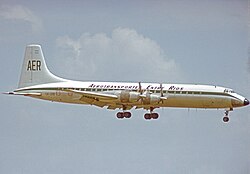
While the cargo version was specialized, Canadair also produced the CL-44J, a stretched version of the CL-44D4. This variant was operated exclusively by Loftleiðir, making it the largest passenger aircraft crossing the Atlantic Ocean at the time. Loftleiðir marketed the plane as the "Rolls-Royce 400 PropJet," which led to the aircraft occasionally being misidentified as the Canadair-400.
Loftleiðir Icelandic Airlines eventually merged with Air Iceland in 1973, forming the modern-day Icelandair.
Political Hurdles and the USAF Deal
Despite its technical merits, the CL-44D4 faced significant political headwinds in the 1960s. The United States Air Force (USAF) considered purchasing the aircraft as part of a "swap deal": the US would provide 100 McDonnell F-101 Voodoo fighters in exchange for a contract for 232 CL-44-D4 transports for the Military Air Transport Service (MATS).
However, the deal collapsed due to political backlash in both Canada and the US. The controversy was fueled by the recent cancellation of the Avro Canada CF-105 Arrow; critics questioned why a Quebec-based company (Canadair) was receiving a massive contract so soon after an Ontario-based company had lost one. Additionally, domestic pressure from American manufacturers led the USAF to award the contract to Boeing for the KC-135 Stratotanker instead.
Retirement and Certification Challenges
The CC-106 Yukons were retired in March 1971 and replaced by the Boeing 707 (CC-137). Their retirement was accelerated by the need for in-flight refueling tankers and the high cost of spare parts, which remained expensive because the CL-44 never entered large-scale production.
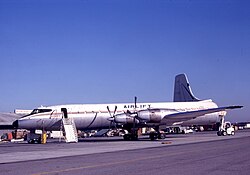
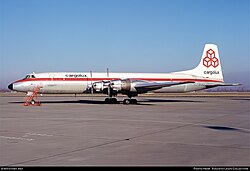
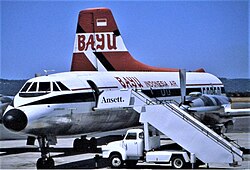
A peculiar regulatory issue also affected the fleet's second life. The FAA refused to certify the original windshields—sourced from the Bristol Britannia—because they did not meet flight crew vision standards. While windshields from the General Dynamics CV880/990 were compatible, the conversion cost was approximately $250,000 per unit, which was prohibitively expensive. Consequently, most Yukons were sold to operators in Africa and South America, as they could not be registered in North America or Europe (though a special exclusion for civil cargo operations in Canada was granted in 1974).
Key Facts
- World Record: Tokyo to Trenton in 17 hours, 3 minutes (1961).
- Endurance: Remained airborne for 23 hours and 51 minutes.
- Innovation: First large aircraft to feature a hydraulic swing-tail for cargo loading.
- Total Usage: 65 million total miles flown by the Yukon fleet.
- Certification Issue: Bristol Britannia windshields prevented registration in the US and Europe.
| Variant | Primary Role | Key Feature | Notable Operator |
|---|---|---|---|
| CC-106 Yukon | Military Transport | Long-range endurance | RCAF |
| CL-44D4 | Cargo Transport | Hydraulic swing-tail | Various Cargo Carriers |
| CL-44J | Passenger Transport | Stretched fuselage | Loftleiðir |
Frequently Asked Questions
Why was the CL-44D4 not purchased by the USAF?
The deal failed due to political controversy surrounding the cancellation of the Avro Canada CF-105 Arrow and pressure from American aircraft manufacturers, leading the USAF to choose the Boeing KC-135 Stratotanker.
What was unique about the CL-44D4's cargo loading system?
It featured a hinged tail section that could be opened in 90 seconds using hydraulic actuators, allowing large items to be loaded quickly while maintaining structural integrity via eight hydraulic locks.
Why couldn't the CC-106 Yukon be registered in North America or Europe after retirement?
The FAA refused to certify the original Bristol Britannia windshields because they did not meet vision standards, and the cost to replace them with compatible General Dynamics windshields was too high.
What happened to the Loftleiðir CL-44J aircraft?
The CL-44J was a stretched passenger version marketed as the "Rolls-Royce 400 PropJet." Loftleiðir eventually merged with Air Iceland in 1973 to become Icelandair.
How long did the Yukon's world records stand?
The records for speed and endurance set by the Yukon in 1961 remained unbroken until 1975, when they were surpassed by the Boeing 747SP.