Bristlebirds: The Elusive Ground-Dwellers of Australia
The bristlebirds are a unique family of passerine birds, known scientifically as Dasyornithidae. Endemic to the south-east coastal regions and the south-west corner of Australia, these birds are masters of concealment. Primarily ground-scampering creatures, they spend most of their lives foraging on foot within dense coastal scrub, making them far more likely to be heard than seen.
Characterized by their sweet, resonant, and metallic calls, bristlebirds occupy restricted and mostly separate ranges. While they are capable of short flights, their physical adaptations and behaviors are heavily geared toward a life lived among the thickets of the Australian coast.
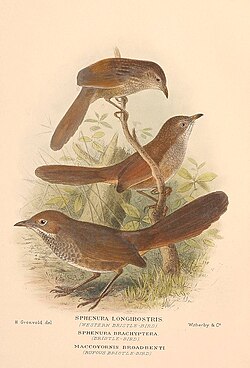
Key Facts
- Endemism: Found exclusively in specific coastal regions of Australia.
- Species: The family consists of one genus, Dasyornis, containing three species.
- Defining Feature: Possess rictal bristles (stiff, hair-like feathers) near the gape of the mouth.
- Behavior: Primarily terrestrial; they prefer running over flying to avoid danger.
- Conservation: Two of the three species are currently classified as endangered.
Taxonomy and Evolutionary History
The classification of bristlebirds has evolved as scientific understanding has grown. Once grouped with Northern Hemisphere lineages like Old World flycatchers, they are now recognized as part of the Meliphagides infra-order. This group includes other Australian endemics such as honeyeaters, pardalotes, and fairywrens.
Molecular data suggests a deep evolutionary history. The Rufous bristlebird diverged from its relatives approximately 13 million years ago (mid-Miocene), while the Eastern and Western bristlebirds diverged from each other about 5 million years ago (early Pliocene). This suggests that their genetic differences are more significant than their similar physical appearances might imply.
Physical Description
Bristlebirds are sedentary birds with long tails, ranging in length from 17 cm to 27 cm. The Eastern bristlebird is the smallest of the family, while the Rufous bristlebird is the largest. Their plumage is generally grey with upperparts featuring shades of olive-brown, chestnut, or rufous, often with pale dappling or scalloping on the mantle.
Their most distinctive feature is the rictal bristles—three stiff feathers curving downward on each side of the mouth. These bristles are common in birds that hunt insects in dark environments and are believed to serve a tactile function, helping the bird locate or manipulate prey.
Distribution and Habitat
Each species of bristlebird occupies a distinct, non-overlapping range:
- Eastern Bristlebird: Found in relict pockets of far south-east Queensland, northern New South Wales, and coastal fringes from Sydney to the Victorian border. They favor coastal heath scrub and grasslands.
- Rufous Bristlebird: Located in dense coastal shrubland and heathland in far south-west Victoria and eastern South Australia. A bold subspecies, caryochrous, also inhabits open eucalyptus forests in the Otway range.
- Western Bristlebird: The most isolated species, restricted to a tiny area of dense heathland on the south-west coast of Western Australia.
Habitat Requirements
These birds rely on dense vegetation for protection. Interestingly, their habitats are often fire-dependent; regular burning is sometimes necessary to prevent trees from shading out the grasses and shrubs the birds require. However, because they are poor flyers, large-scale bushfires can be catastrophic, leading to local extinctions.
Behavior and Ecology
Bristlebirds are shy and elusive. They move through thick vegetation on strong legs, often holding their tails partly erect. While they can fly short distances using rounded wings, they preferentially run to escape threats.
The males are the primary singers, delivering territorial songs from the tops of logs or shrubs to maximize the sound's reach. They are diurnal and typically occur in pairs, maintaining contact through small calls while foraging for insects, seeds, spiders, worms, and occasionally nectar.
Breeding and Nesting
Bristlebirds are generally monogamous. Breeding seasons vary by species: the Western bristlebird breeds from July to October, while the eastern species breed between August and February. The female constructs a large, ovoid dome nest with a side entrance in low vegetation.
Typically, two eggs are laid and incubated solely by the female for 16 to 21 days. Both parents feed the young, who remain in the nestling stage for 18 to 21 days. Eastern and Rufous bristlebirds are known to lay replacement clutches if the first is lost.
Conservation Status
The Dasyornithidae family faces significant threats from habitat destruction and climate-driven bushfires. Land clearing for agriculture and urban development along coastal strips has fragmented their populations.
| Common Name | Scientific Name | Primary Range | IUCN Status |
|---|---|---|---|
| Eastern Bristlebird | Dasyornis brachypterus | SE Queensland, NSW, Victoria | Vulnerable (VU) |
| Rufous Bristlebird | Dasyornis broadbenti | SW Victoria, SE South Australia | Least Concern (LC) |
| Western Bristlebird | Dasyornis longirostris | SW Western Australia | Endangered (EN) |
Management strategies differ by species. While the Western and Rufous bristlebirds benefit from the total avoidance of fire, the Eastern bristlebird requires a balanced approach where limited burning promotes grassland regeneration without destroying essential refugia.
Frequently Asked Questions
Why are they called bristlebirds?
They are named for their rictal bristles, which are three stiff, hair-like feathers on either side of the gape that likely help them find insects in dark undergrowth.
Are bristlebirds good flyers?
No, they have short, rounded wings and are poor flyers. They prefer to scamper through dense vegetation on their strong legs to avoid danger.
What do bristlebirds eat?
Their diet primarily consists of insects and seeds, though they also eat spiders and worms and have been observed drinking nectar.
Which bristlebird is the most threatened?
The Western bristlebird is highly endangered due to its extremely restricted and isolated range in south-west Western Australia.
How do bristlebirds communicate?
They are known for their sweet, resonant, and metallic songs, usually performed by the male to establish territory. They also use small contact calls when foraging in pairs.