Meliphagoidea: The Diverse Songbirds of the Austropacific
The Meliphagoidea is a superfamily of passerine birds—perching songbirds—that encompasses a vast diversity of small to mid-sized species. These birds are widespread across the Austropacific region, though the Australian continent boasts the highest richness in both genera and species.
Key Facts
- Distribution: Primarily found in the Austropacific region, with the highest diversity in Australia.
- Composition: Includes honeyeaters, fairy-wrens, scrubwrens, bristlebirds, and pardalotes.
- Largest Family: Meliphagidae (honeyeaters) is the most populous family with 195 species.
- Classification: Defined as a monophyletic group (descended from a single common ancestor) through modern cladistic analysis.
Systematics and Classification
The grouping of Meliphagoidea was originally proposed using phenetic DNA-DNA hybridization studies conducted by Charles Sibley and his colleagues. In more recent years, ornithologists at the American Museum of Natural History refined this definition using cladistic analysis—a method of classifying organisms based on shared derived characteristics—to establish the group as monophyletic.
While the general grouping is accepted, the internal relationships between families remain a subject of scientific debate. For instance, the Sibley-Ahlquist taxonomy once suggested that the bristlebirds (Dasyornithidae) and thornbills (Acanthizidae) were subfamilies of the pardalotes (Pardalotidae). However, subsequent research suggests different affiliations.
The Families of Meliphagoidea
The superfamily is composed of several distinct families, though their boundaries are often debated by taxonomists.
Meliphagidae (Honeyeaters)
With 195 species, this is the largest family within the superfamily. Some researchers suggest that other families, such as the pardalotes and thornbills, may actually be subfamilies of the honeyeaters due to close genetic relationships.
Maluridae (Fairy-wrens, Emu-wrens, and Grasswrens)
This family consists of 33 species of small, colorful songbirds.
Acanthizidae (Scrubwrens, Thornbills, and Gerygones)
Containing 66 species, these birds have traditionally been viewed as aberrant honeyeaters. Because they are very ancient members of the Meliphagoidea, some ornithologists argue they should remain a separate family, while others suggest merging them into Meliphagidae to avoid creating small, monotypic families.
Dasyornithidae (Bristlebirds)
This family includes 3 species and was formerly classified under the Acanthizidae.
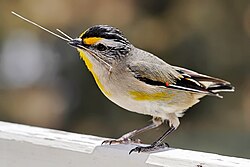
Pardalotidae (Pardalotes)
Consisting of 4 species, the pardalotes have often misled researchers regarding their affiliations due to their plesiomorphy—the possession of ancestral traits that do not uniquely identify a specific lineage.
Taxonomic Summary
The following table provides an overview of the families currently associated with the Meliphagoidea superfamily.
| Family Name | Common Names | Number of Species |
|---|---|---|
| Meliphagidae | Honeyeaters | 195 |
| Acanthizidae | Scrubwrens, Thornbills, Gerygones | 66 |
| Maluridae | Fairy-wrens, Emu-wrens, Grasswrens | 33 |
| Pardalotidae | Pardalotes | 4 |
| Dasyornithidae | Bristlebirds | 3 |
Evolutionary Shifts and Exclusions
Taxonomy is a fluid science, and the composition of Meliphagoidea has changed over time. For example, the Sibley-Ahlquist taxonomy previously included the Petroicidae (Australasian robins) within this superfamily. However, modern research has discarded this view. Current evidence indicates that Petroicidae forms a distinct lineage that is neither part of the "advanced" songbirds (Passerida) nor a very ancient group, leaving its exact relationship to other birds uncertain.
Frequently Asked Questions
Which family in Meliphagoidea has the most species?
The Meliphagidae, commonly known as honeyeaters, is the largest family with 195 species.
Where are Meliphagoidea birds primarily found?
They are widespread throughout the Austropacific region, with the greatest diversity of species and genera found on the Australian continent.
Why is the classification of pardalotes and thornbills controversial?
The controversy stems from whether they should be their own distinct families or be classified as subfamilies within the Meliphagidae. Some scientists prefer merging them to avoid creating very small families with few species.
Are Australasian robins part of the Meliphagoidea?
No. While they were once included in the Sibley-Ahlquist taxonomy, recent work shows that the Petroicidae (Australasian robins) form a distinct lineage and are not part of the Meliphagoidea.