Australasian Wrens: The Unique Birds of Australia and New Guinea
The Australasian wrens, belonging to the family Maluridae, are a group of small, insectivorous passerine birds endemic to Australia and New Guinea. While they share a name with the wrens of Europe and America, they are not closely related to them. Instead, their similarity is a result of convergent evolution—a process where unrelated species independently evolve similar traits because they occupy similar ecological niches.
Key Facts
- Family: Maluridae, comprising 33 species across six genera.
- Distribution: Endemic to Australia and New Guinea.
- Diet: Insectivorous, primarily foraging in underbrush.
- Closest Relatives: Honeyeaters (Meliphagidae) and pardalotes (Pardalotidae).
- Diversity: Includes fairywrens, emu-wrens, and grasswrens.
Taxonomy and Evolutionary History
Early researchers frequently misclassified these birds, placing them with Old World flycatchers, warblers, or babblers. It wasn't until the late 1960s that morphological studies suggested a closer relationship between fairywrens, grasswrens, and emu-wrens. In the mid-1970s, pioneering work on egg-white proteins by Charles Sibley led researchers to formally adopt the family name Maluridae in 1975.
Modern DNA analysis has further clarified their lineage, revealing that Maluridae emerged from the great corvid radiation in Australasia. A 2011 genetic analysis led to the re-classification of the broad-billed fairywren and Campbell's fairywren into the genus Chenorhamphus, separating them from the genus Malurus.
Physical Characteristics and Habitat
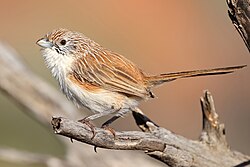
Malurids are small to medium-sized birds that adapt to diverse environments, ranging from dense rainforests to arid deserts, though they are most common in scrub and grassland. Their appearance varies significantly by group; grasswrens possess black and brown patterns for camouflage, while many other species, particularly males, exhibit brilliantly colored plumage.
Nesting and Diet
These birds are insectivorous and typically forage within the underbrush. They construct domed nests tucked away in dense vegetation. Interestingly, these species often exhibit cooperative breeding, where young birds remain in the nest to help raise subsequent clutches of chicks.
Behavior and Communication
Fairywrens are particularly noted for their complex social structures. They are socially monogamous (forming stable pairs) but sexually promiscuous, meaning partners may mate with other individuals and collectively assist in raising the resulting offspring. In some species, males engage in a unique courtship ritual by plucking brightly colored petals to display to females.
Their vocalizations are equally complex. While most small birds use universal alarm calls, the superb and splendid fairywrens utilize a "Type II Vocalization." This song-like call is specifically used when confronted by predators, such as butcherbirds, though its exact purpose remains a mystery as it does not function as a standard warning call.
Classification Summary
| Subfamily | Tribe/Genus | Common Name / Species Count |
|---|---|---|
| Malurinae | Tribe Malurini (Sipodotus, Chenorhamphus, Malurus, Clytomyias) | Fairywrens (including 12 Malurus species) |
| Tribe Stipiturini (Stipiturus) | Emu-wrens (3 species) | |
| Genus Chenorhamphus | 2 species | |
| Genus Clytomyias | Orange-crowned fairywren | |
| Amytornithinae | Genus Amytornis | Grasswrens (14 species) |
Frequently Asked Questions
Are Australasian wrens related to true wrens?
No. Despite the name, they are not closely related to the wrens of Europe and America. Their similarities are due to convergent evolution, as they share similar ecological roles.
What is the diet of the Maluridae family?
They are insectivorous birds that typically find their food while foraging in the underbrush of their habitats.
What is unique about fairywren mating habits?
Fairywrens are socially monogamous but sexually promiscuous, often forming pairs while mating with others and cooperatively raising young.
What is "Type II Vocalization"?
It is a song-like vocalization used by the superb and splendid fairywrens when facing predators like butcherbirds, distinct from standard alarm calls.
Where are these birds found?
They are endemic to Australia and New Guinea, inhabiting environments from rainforests to deserts.